ICE Targets Somali Community in Minneapolis
Minneapolis, MN — About 100 Immigration and Customs Enforcement agents have descended on Minneapolis for Operation Metro Surge, a new phase of the Trump Administration’s crackdown on immigrants, this time targeting the city’s Somali population. The government reported on Thursday that they’ve picked up 12 “criminal illegal aliens” so far, six from Mexico, five from Somalia and one from El Salvador.
During a cabinet meeting on Dec. 2, President Donald Trump conflated the entire Somali community in the state with recent financial fraud scandals that have received national attention.
“We’re going to go the wrong way if we keep taking garbage into our country,” Trump said. “Ilhan Omar is garbage. She’s garbage. Her friends are garbage… When they come from hell, and they complain and do nothing but bitch, we don’t want them in our country.”
In a press release from the White House on Dec. 1, the administration announced that it would be reversing Temporary Protected Status for Somali immigrant refugees as well as indefinitely pausing all “migration from third-world countries,” including asylum decisions.
City leaders condemned the federal government’s plans in a Dec. 2 news conference live streamed on YouTube. Minneapolis Mayor Jacob Frey opened the conference, showing his support for the largest Somali community in the country.
“Targeting Somali people means that due process will be violated,” Frey said. “Mistakes will be made. And let’s be clear, it means that American citizens will be detained for no other reason than the fact that they look like they are Somali. That is not now and will never be a legitimate reason.”
St. Paul Mayor Melvin Carter, Minneapolis City Council member Jamal Osman and Minneapolis Police Chief Brian O’Hara also spoke at the conference. O’Hara said MPD would not work with federal law enforcement to conduct immigration enforcement.
“We don’t provide information to federal immigration authorities,” O’Hara said. “We don’t ask people about their immigration status.”
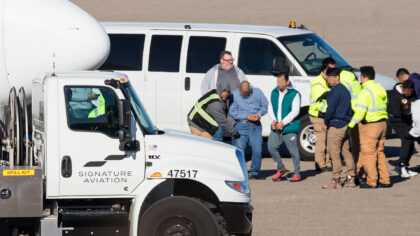
“Over the past two weeks, we have seen an increase in hateful rhetoric and aggressive actions targeting immigrants, especially and specifically Somalis,” said Imam Yusuf Abdullah during a rally on Dec. 3 at the Minneapolis-Saint Paul International Airport, demanding an end to deportation flights. The rally was organized by union workers and faith leaders.
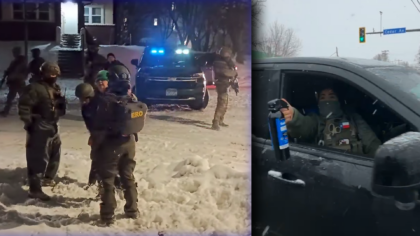
Since the federal operation started, the Twin Cities have seen an uptick on social media with reports spotting ICE activity from community residents to elected officials. Consistent with the ICE raids in the metro area that have already taken place, ICE activity is being met with resistance in a majority of the neighborhoods it’s being spotted in.
Around 6 p.m. on Dec. 1, ICE was spotted detaining multiple men near the 24 Somali Mall in South Minneapolis. On Dec. 3, apparent ICE agents were spotted trying to use facial recognition on people near Karmel Mall, which hosts an expansive commercial center of Somali-owned businesses in South Minneapolis.
They were also recorded at an apartment building on Pillsbury Avenue with a Jeep Wagoneer with Nebraska Plates, according to the poster. A Ford SUV with Nebraska plates was also spotted in a parking lot in Minneapolis, and another witnessed two people being grabbed by ICE at a bus stop on Lake St. and Nicollet Ave.
The same day, Minneapolis Ward 9 City Council Member Jason Chavez warned of increased ICE activity in South Minneapolis, specifically in Phillips, Powderhorn and along Lake Street.
On Dec. 4, an apparent ICE stop was spotted in Marcy Holmes and posted on the r/TwinCities subreddit. Another incident was reported at 32nd Street and Park Avenue near Lake Street, as well as 37th Street and Elliot, and 37th Street and Portland Avenue on Dec. 4. The SUV of a suspected ICE agent was video recorded being followed by a caravan of cars blaring their horns.
An immigration attorney in the city’s Somali community told FOX 9 that ICE activity in Minneapolis began as early as Thanksgiving weekend.
On Thanksgiving, President Donald Trump posted on Truth Social a rambling screed that targeted Minnesota’s Somali population.
“Hundreds of thousands of refugees from Somalia are completely taking over the once great State of Minnesota,” Trump wrote. “Somalian gangs are roving the streets looking for ‘prey’ as our wonderful people stay locked in their apartments and houses hoping against hope that they will be left alone.”
Minnesota Compass, a project maintained by the Wilder Foundation, estimates that as of 2023, Minnesota is home to nearly 80,000 Somali residents, and that 78% of them live in the Twin Cities metropolitan area. Of that population, 44% are citizens born in the United States. Around 4,200 Somalis are green-card holders.
The Metropolitan Council, the governing body for the Twin Cities metropolitan area, estimated that the region’s total population in 2023 was 3,163,104. This means that less than 0.02% of the Twin Cities area population is Somali.
On Dec. 3, U.S. Rep. Tom Emmer (R-MN6), the House majority whip, told Fox Business that “80% of the crime being committed in the Twin Cities and Minnesota are being committed by Somalis.”
The Minnesota Department of Public Safety’s 2024 uniform crime report does not list Somali as a separate category for offenders, but does list that less than 28% of arrestees were Black and a majority of the arrested were white males.
This is not the first time that Somalis have been targeted. Somali mosques have repeatedly been vandalized and bombed by white supremacists. Somali youth and men have bore the brunt of racist attacks by elected officials in Minneapolis over the years and several have faced state-sanctioned deaths at the hands of police.
In the late 2000s, federal agents enacted wide-sweeping surveillance programs and swarmed Minneapolis mosques and Somali communities seeking what they deemed to be radicalized youth. This was in response to youth going back to Somalia to fight against invading foreign troops alongside Al-Shabaab, which was named on the State Department’s list of Foreign Terrorist Organizations in 2008.
The emigration of Somalis across the globe over the recent decades is a byproduct of European imperialism. After being colonized by French, Italian and British forces who carved up Somalia’s highly-contested borders and parceled the land, the country gained independence in 1960.
The dispersing of the Somali diaspora from the 1990s onward was pushed in part due to the U.S. ending their support of General Siad Barre’s military dictatorship after the Soviet Union collapsed. Barre’s fall led to a power vacuum, extended civil war, and famine. Failed US military involvement in Somalia led to massacres and left more than a million people as refugees forced to emigrate.
Refugee resettlement agencies helped facilitate the arrival of Somalis into Minnesota, a state mostly welcoming to refugees. Somali families have moved into the Twin Cities and smaller cities and towns like Rochester, Saint Cloud and Marshall since 1992. Somalis are widely represented across industries, civil society, and elected office.
“Immigrants are part of every street, every school, every union, every workplace. You hold up our airports, clear our buildings, drive our buses, care for our elders, build our homes and serve our communities. You deserve dignity, respect and due process,” said Imam Yusuf Abdullah.
The community is on edge and US citizens have been detained and released several times already. The director of the predominantly East African-serving Brian Coyle Center, Amano Dube, told Sahan Journal that “ICE said they are looking for Somali illegals and criminals, but they are snatching everyone, whether they are Somali, Ethiopian, Eritrean, or Oromo, because they don’t know the difference.”
Somalis are not the first to be targeted in the metro area. Hmong and other Asians as well as Latin and Central Americans have faced months of actions against their respective communities.
On Dec. 3, the City of Minneapolis announced an executive order prohibiting the use of city-owned parking lots, garages, ramps and vacant lots for immigration enforcement operations. The order also calls for the creation of custom signage for property owners to restrict such activity on private property.
As ICE activity has intensified this year, local groups such as MIRAC and Monarca have been hosting know-your-rights trainings. A nonviolent direct action training is also happening on December 7. A number of liberal groups are hosting others, including Gender Justice, the Immigrant Defense Network, Indivisible Twin Cities, Jewish Community Action, Minnesota 50501, MN AFL-CIO, the MN Democracy Defense Table, the Minnesota State Retiree Council (AFL-CIO), the Saint Paul Regional Labor Federation (AFL-CIO), TakeAction Minnesota, and Women’s March MN.
The Minnesota Education Equity Partnership has released a toolkit for “Creating Safe & Supportive Schools for Immigrant & English Learner (EL) Students,” which includes information about immigration enforcement.
MSP Whistles (bsky / linktree) is distributing large numbers of whistles to alert people to ICE activity. Resource sheets in Somali, Spanish and English have also been posted.
At the rally on Dec. 3, SEIU 26 President Greg Nammacher said, “This is the beginning. We know that, especially with this focus in the last couple of days on our Somali brothers and sisters, that these attacks will only increase.”
“This is the beginning of a long struggle that we are going to be doing. It may be snowy outside. It may get even worse. But we are going to have to be here and continue to show up until we stop this deportation machine.”
SEIU 26 President Greg Nammacher
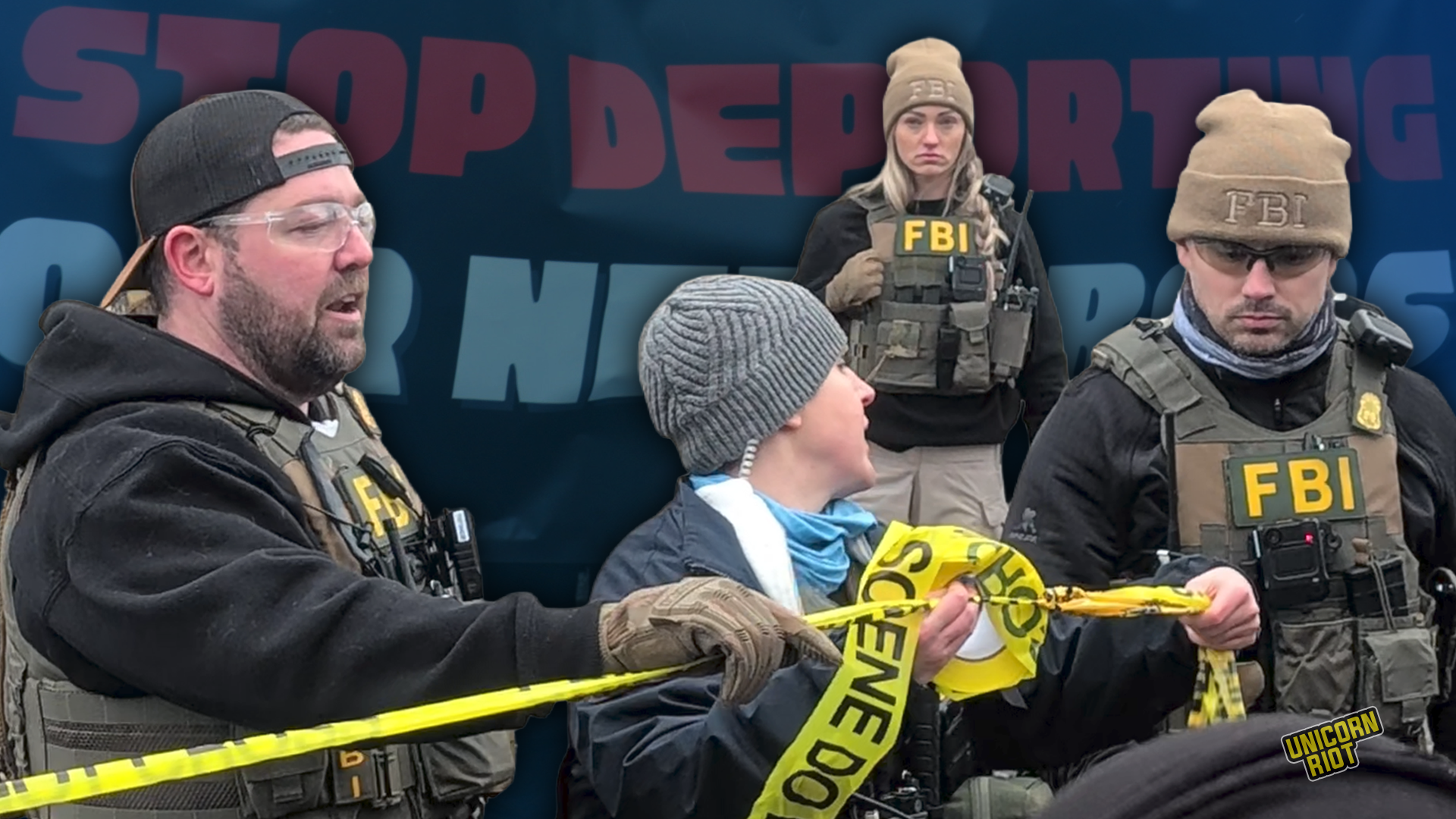
Cover image by Niko Georgiades for Unicorn Riot using images by Akičita Šuŋka-Wakaŋ Ska and Anthony Maki.
2025-2026 Unicorn Riot Coverage of the DHS / ICE Crackdown Campaign in Minnesota:
Click the image to see all UR coverage of federal law enforcement operations in MN.
Watch Unicorn Riot’s videos from ICE in Minneapolis in playlist below.
More: Documenting Deportation Flights at MSP Airport
Follow us on X (aka Twitter), Facebook, YouTube, Vimeo, Instagram, Mastodon, Threads, BlueSky and Patreon.
Please consider a tax-deductible donation to help sustain our horizontally-organized, non-profit media organization: