As Senegal Cracks Down on LGBTQ Rights, Activists Seek Help From Abroad
“I prefer to remain anonymous because of the authorities in Senegal,” Mamadou, one of the founders of the Senegalese LGBTQ rights organization Free Senegal, told Unicorn Riot. Speaking under an alias, Mamadou agreed to speak with Unicorn Riot only if he could remain anonymous. He fled the country in 2021 after years of harassment and is one of many now worried for their safety amid a wave of anti-LGBTQ repression that took hold this year.
His fears are not unfounded. Since February, Senegalese authorities have initiated a crackdown against the LGBTQ community, reportedly arresting hundreds across the country. Local newspapers announce new arrests every week, including of celebrities.
The recent crackdown started after the dismantling of a suspected French-Senegalese pedophilia ring in early February. It culminated with Parliament passing a new anti-LGBTQ law by an overwhelming majority in March, which doubled prison sentences for “acts against nature” to up to 10 years.
Under this provision, the law equates same-sex relationships with sexual crimes such as bestiality and necrophilia. Furthermore, in a separate article, it stipulates a sentence of up to seven years in prison for the “promotion or financing” of homosexuality, bisexuality, or transgender identity.
According to Free Senegal, at least 184 members of the LGBTQ community have been detained and jailed as of early April. “Those who are not detained are trying to flee the country because they are afraid for their security. There is a mass exodus,” said Mamadou.
“All community leaders have left, members of organizations have left. There are currently no allies of the community in Senegal,” he added.
Mamadou describes an atmosphere of panic where LGBTQ individuals are being arrested after being reported to the police, often by those close to them or identified after authorities search the phones of detainees. Even lawyers are hesitant to take their cases for fear of being targeted themselves.
Due to this restrictive environment, LGBTQ individuals in Senegal have to turn to either informal support networks or organizations outside Senegal for help. One of them is the Canadian LGBTQ rights organization Rainbow Railroad, which provides assistance to persecuted LGBTQ individuals around the world.
According to Chief Programs Officer Devon Matthews, the organization, until early April had already received 90 requests for help from Senegalese citizens, a sharp increase compared to 2025, when it received 106 the whole year. The number of requests followed domestic developments, with a spike in early March during the discussion and voting on the law.
The organization does not have an on-the-ground presence in Senegal, however, it is drawing from its experience in Uganda and other African countries to assist the community in the country.
Uganda’s Death Sentence on its LGBTI+ Communities [2023]
“We’re trying to focus most of our efforts right now internally on the activists and organizations that we are aware of, some of whom are reaching out to us directly,” said Matthews, adding that Rainbow Railroad is providing limited financial assistance, helping connect activists with one another and offering support with information and logistics.
“Right after these laws are passed, certain activists are [being] targeted or [put] on government lists. What we want to do is just make sure that those activists are able to either temporarily leave or move from the city to a quieter area while the dust from the law settles,” she said. “That’s the first request that we often get.”
Matthews adds that although Rainbow Railroad is able to refer 250 LGBTQ refugees each year directly to the Canadian government for resettlement in Canada, the program is reserved only for the most vulnerable of individuals who have already fled to a third country and the process takes years.
While Senegalese activists are trying to avoid arrest and persecution, those who campaigned in favor of the anti-LGBTQ law have allies in the highest echelons of the parliamentary majority party, PASTEF. Its leader, Senegal’s former prime minister, Ousmane Sonko, pledged to impose tougher penalties for homosexuality during the 2024 election campaign.
“We were received by the president of the National Assembly and by the head of the majority parliamentary group PASTEF,” said Sokhna Ndeye Diop, the president of the women’s wing of the powerful association of Islamist organizations called And Samm Jikko Yi, during an interview with Unicorn Riot. Diop is also the wife of a PASTEF MP.
For years, And Samm Jikko Yi, which in Wolof translates to “Together for the Preservation of Values,” has organized rallies and campaigned for stricter legislation against homosexuality. In 2021, along with several MPs, they proposed a draft law that largely formed the basis of the current legislation.
There have been reports that during that campaign, And Samm Jikko Yi worked with the American anti-LGBTQ group MassResistance. However, Diop denies this, saying that the Sengalese organization’s former coordinator contacted MassResistance in a personal capacity, without the knowledge of the rest of the organization.
“The Senegalese people, unanimously, do not accept homosexuality. Even when you try to bury a homosexual in a cemetery, people say ‘no,’” she said, referring to an incident in 2023 in the city of Kaolack where a crowd exhumed the body of a man accused of being gay and paraded it through the streets before burning it in the city’s square.
While such incidents are rare, public opinion in the country toward same-sex relationships and LGBTQ rights remains overwhelmingly negative. In a July 2025 survey by Afrobarometer, 97% of Senegalese respondents said they would not want a “homosexual person as a neighbor,” a figure virtually unchanged since 2014.
Although Mamadou is not optimistic about the future he says he will continue advocating for LGBTQ rights in Senegal. “We are in France for security reasons, but we have not forgotten why we are here. The struggle we led back home is what matters most and it is that struggle we continue here.”
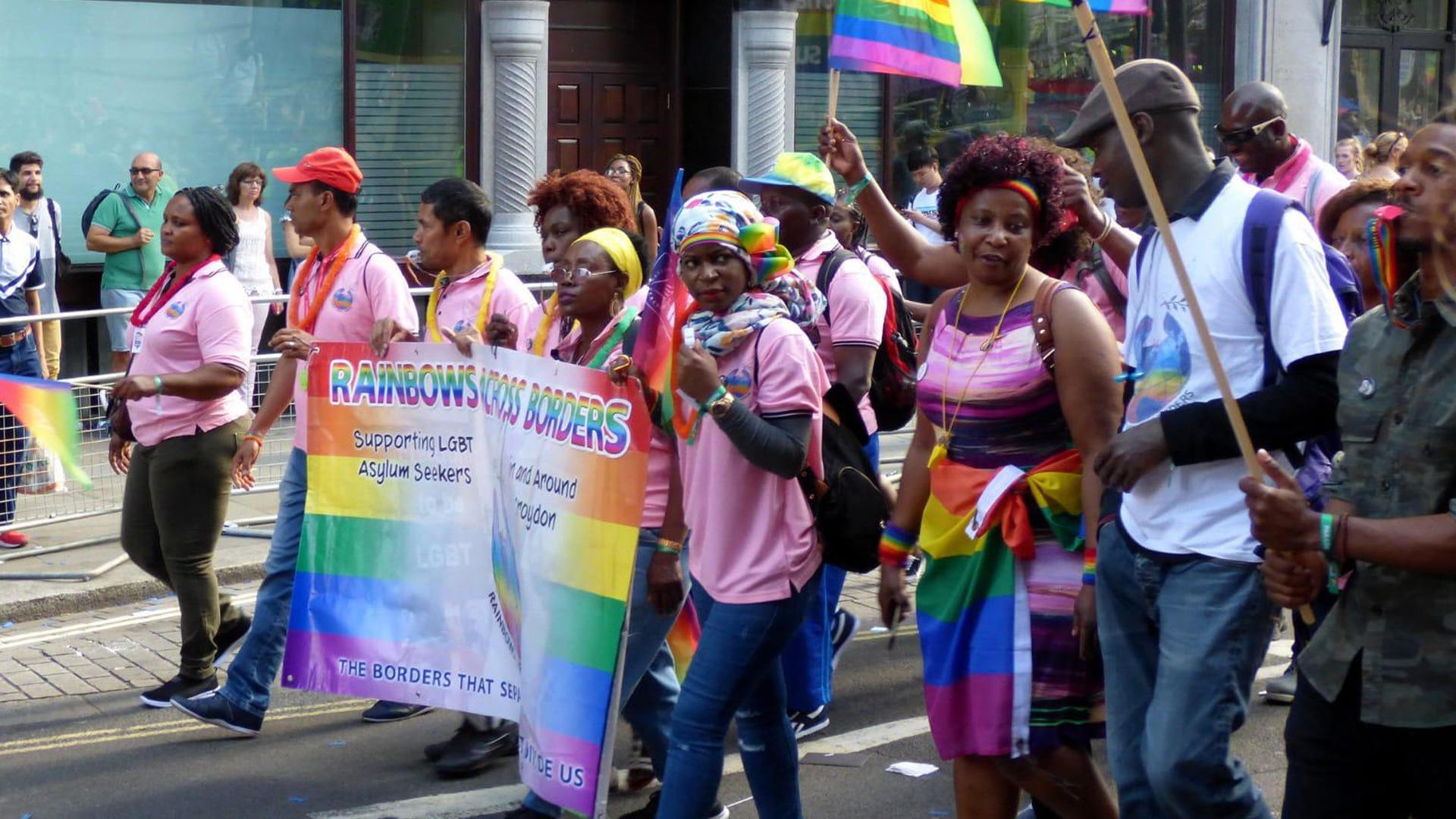
Cover image from Pride in London in 2017. Image was changed from this image after publication.
Follow us on X (aka Twitter), Facebook, YouTube, Vimeo, Instagram, Mastodon, Threads, BlueSky and Patreon.
Please consider a tax-deductible donation to help sustain our horizontally-organized, non-profit media organization: