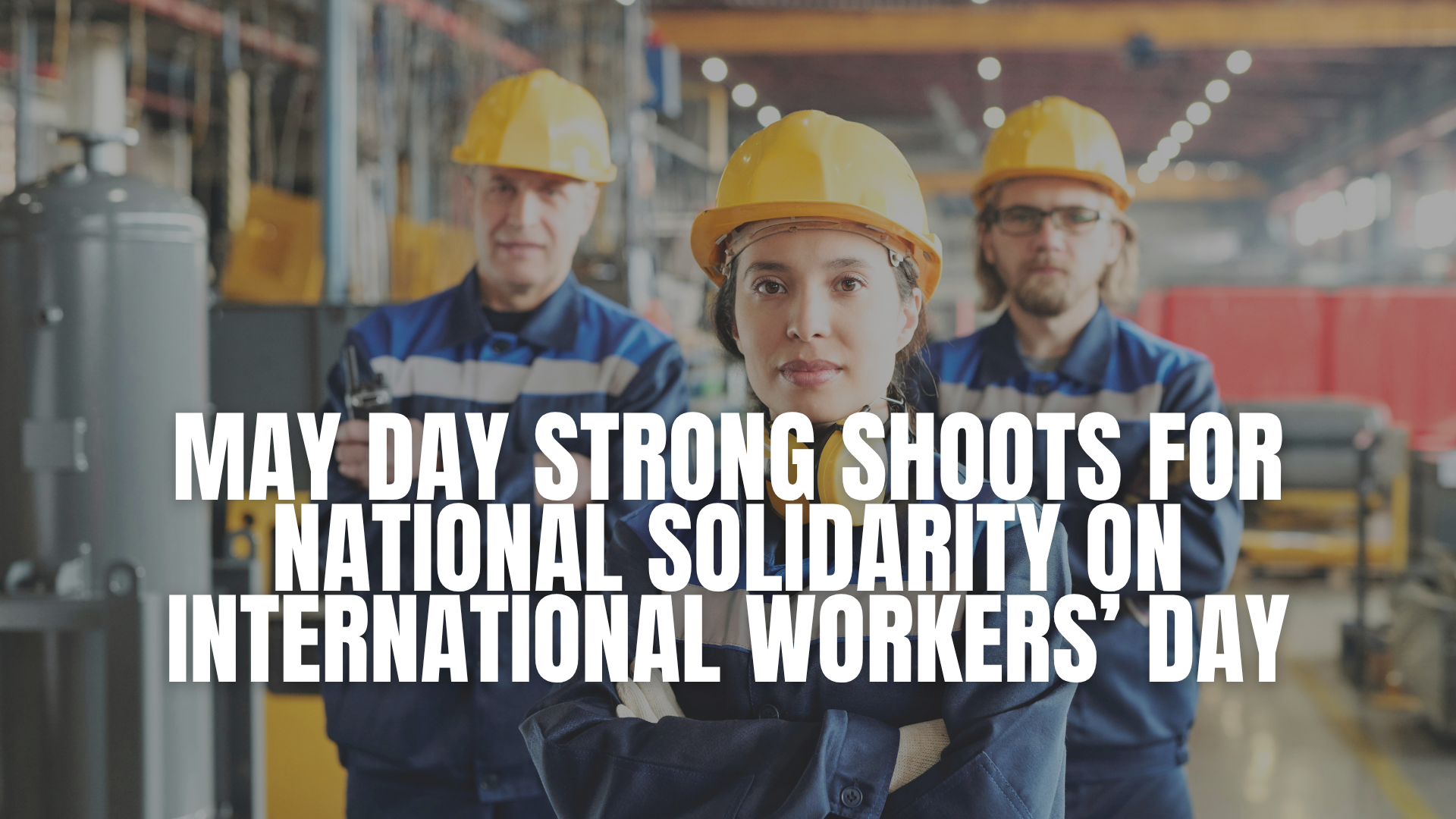
May Day Strong Shoots for National Solidarity on International Workers’ Day
Will the broad coalition of unions, nonprofits and activist groups make a long-term impact?
On Wednesday, April 29, a coalition of activist groups and labor unions known as May Day Strong is hosting its “final mass call” to galvanize the working class across the United States for International Workers’ Day, or May Day, 2026. The national day of actions is aimed at abolishing ICE, ending war, taxing the rich, and protecting voters’ rights, as stated in the invite to the online event. Among the coalition members are more than a thousand national and local unions and organizations spanning half of the political spectrum — from “center to left.”
Unicorn Riot interviewed one of the May Day Strong organizers, Jackson Potter, vice president of the Chicago Teachers Union, to find out who’s behind the organization, and how its mission and strategy compare to those of the organizers of the first May Day strike in 1886.
On May 1, 1886, more than 300,000 workers walked off their jobs; in Chicago, where the Federation of Organized Trades and Labor Unions had demanded an eight-hour workday at the national convention two years before, 40,000 went on strike — “with the anarchists in the forefront.” According to the Industrial Workers of the World (IWW), on the first May Day “anarchists and anarchism became respected and embraced by the working people and despised by the capitalists.”
How? “Their fiery speeches and revolutionary ideology,” says IWW.
So, in 2026, will the ideology espoused be ‘revolutionary?’ Or will more liberal demands prevail?
This year, two of the organizations collaborating with May Day Strong are Indivisible and the 50501 Movement, both criticized for the weekend “block-party” style of their No Kings rallies.
When asked about their involvement, Potter said his “experience has been a very positive one,” with Indivisible “going out of their way to talk about why it’s important not just to have protests on Saturdays.”
The Trump administration “will continue to ratchet up pressure,” Potter said, “and if we aren’t doing the same thing on our side, and figuring out ways to shut shit down … they’re going to outmaneuver us.”
According to Potter, the organizers of the No Kings rallies have been “pretty collaborative” in planning for May Day, even “doing a handoff through their network to May Day organizing.”
What, then, are the demands? And do they extend beyond the goals of the unions to, as autonomous anarchist collective Crimethinc put it, include “the struggles of the unemployed and precarious with those of the employed?”
Potter believes so.
“We saw what they did to Minneapolis, and we saw how Minneapolis built a movement to respond on Jan. 23, with the ‘no work, no shopping, no schools,’ so we’ve catapulted with that demand nationwide.”
The demands for the government, meanwhile, are to “tax the rich, put our families before billionaire fortunes” and “expand democracy, not corporate power.”
Of course, as we pointed out in our conversation, the demands are vague; we wondered, would they be effective?
For Potter, the breadth of the goals is intentional — to provide a larger framework and collaborative opportunities for local groups doing the work everyday.
Although “there is a move at the federal level, when we have that common contract expiration at the next presidential election interval in 2028” — and “we can all throw down and say, ‘we need national healthcare, we need childcare for all, we need free college, we need to completely transform this system” — May Day Strong is “not trying to be overly prescriptive.”
May Day Strong, he said, provides “the broad outlines,” while states and municipalities “figure out how these outlines make sense for them.”
So, what types of actions are expected for the upcoming International Workers’ Day?
Nurses are on strike in New Orleans; graduate students are striking in Chicago; direct actions are planned for the airport in San Francisco; and 12 school districts have been shut down in North Carolina.
Nationwide, across three thousand-plus events, there will be “pretty impressive displays of people’s unwillingness to cooperate with a regime that doesn’t care about them,” Potter said. “They’ll be in the streets. It’s going to be disruptive. It’s going to be similar, I think, to what we saw in Minneapolis on Jan. 23.”
Beyond May Day, the coalition is planning actions at FIFA and other large-scale events, as local groups continue their work on the ground.
The question, though, remains as to what effect a single day of actions will have on the long-term health and safety of the poor and working class. The first May Day celebration changed labor laws, creating the eight-hour workday. The question now is: what will workers achieve on May Day 2026?
About the author: Phil Mandelbaum is an award-winning journalist, a co-creator of the content services division of The Associated Press, a nonprofit and political strategist, and an organizer and artist, also known as awkword.
Follow us on X (aka Twitter), Facebook, YouTube, Vimeo, Instagram, Mastodon, Threads, BlueSky and Patreon.
Please consider a tax-deductible donation to help sustain our horizontally-organized, non-profit media organization: