Minnesota Students Arrested After Locking Down to Morrill Hall, Demanding Sanctuary Campus
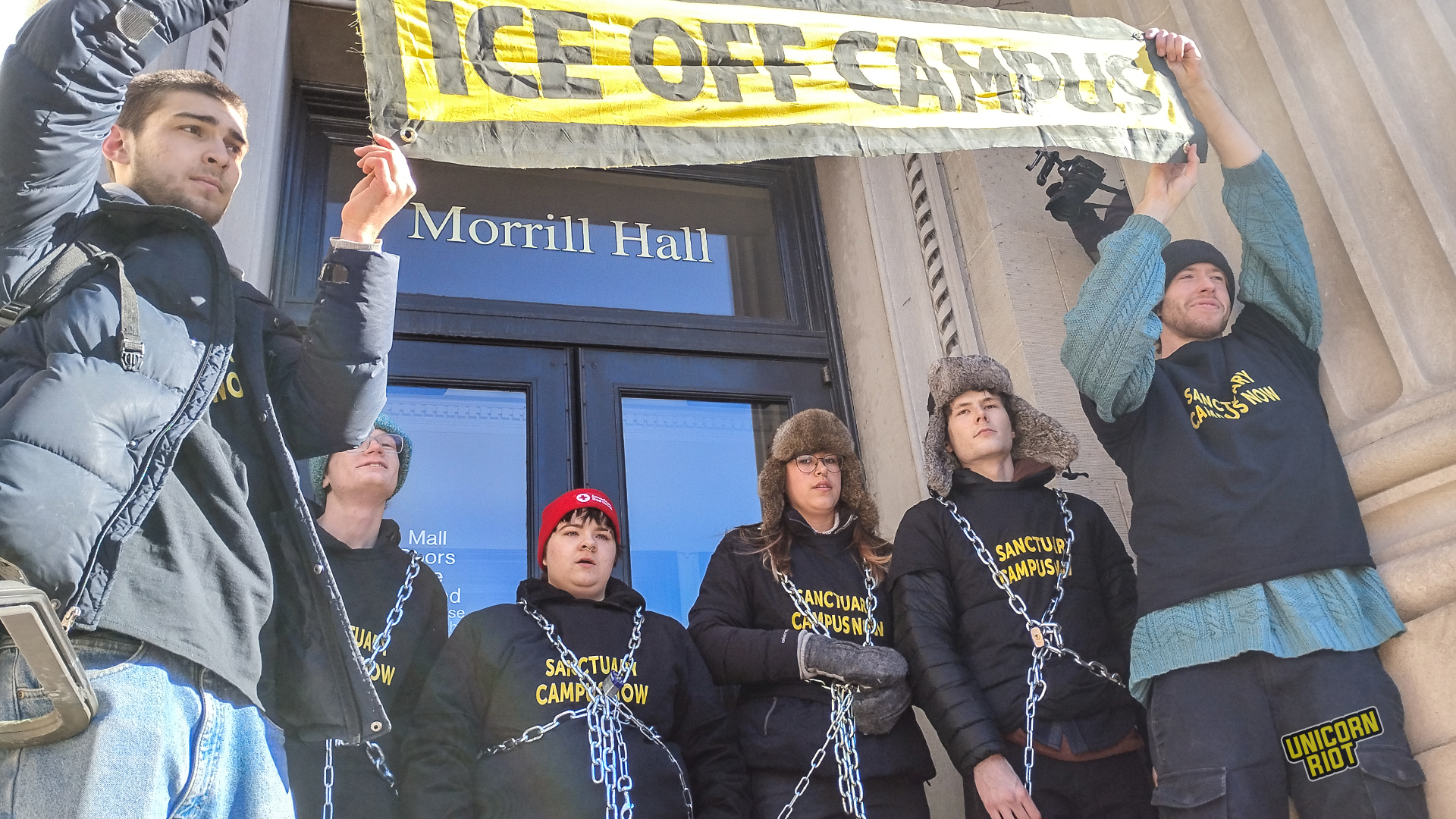
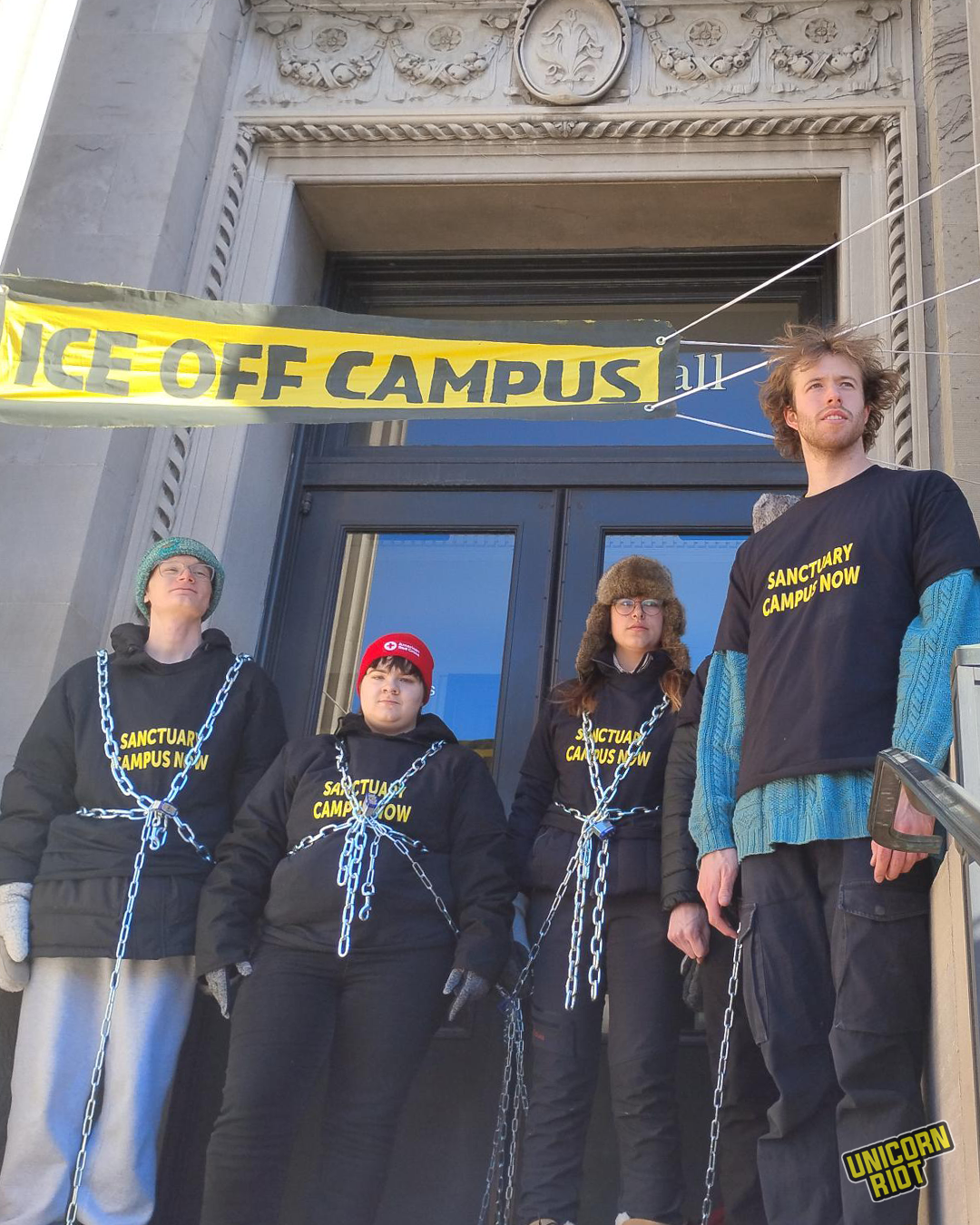
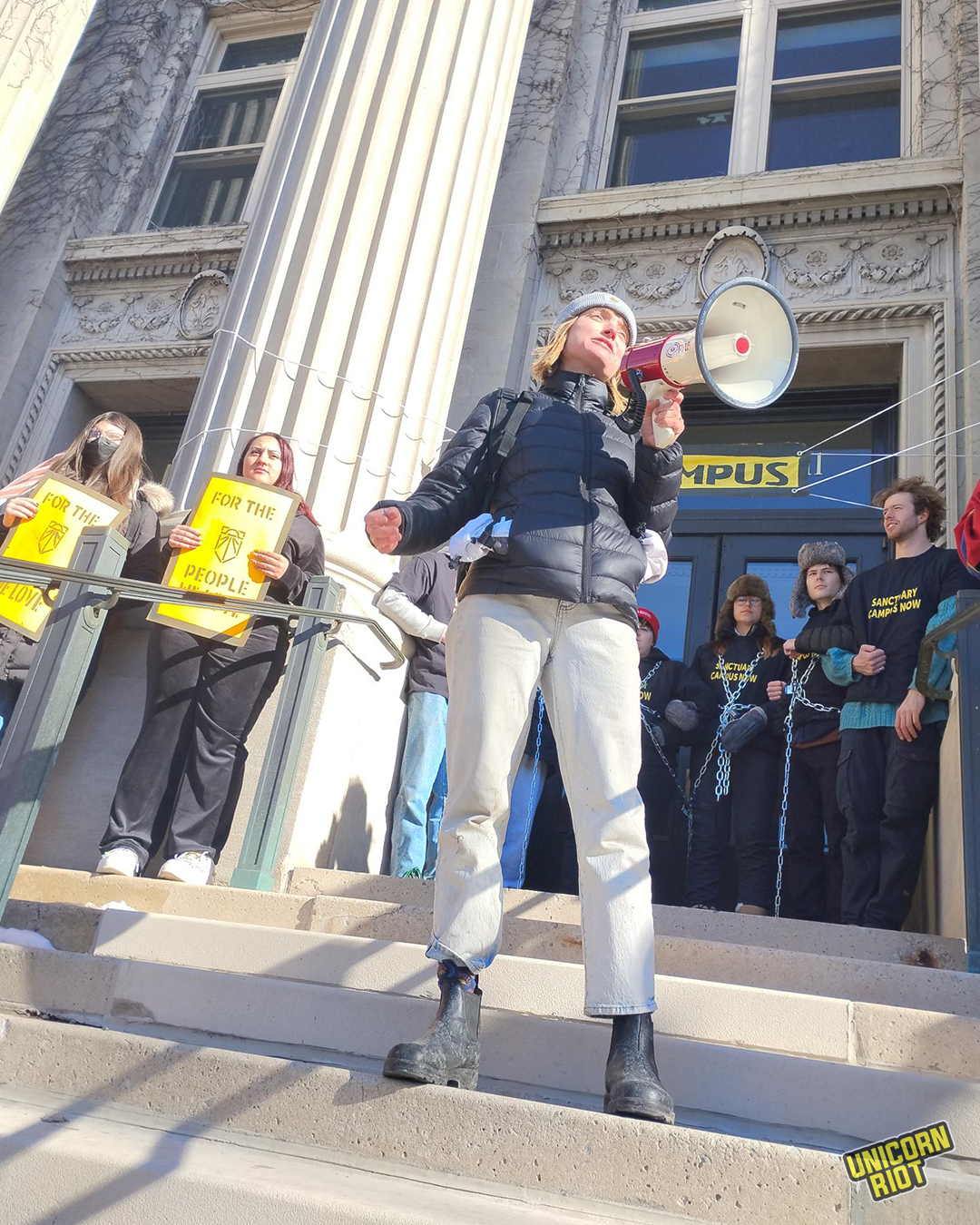
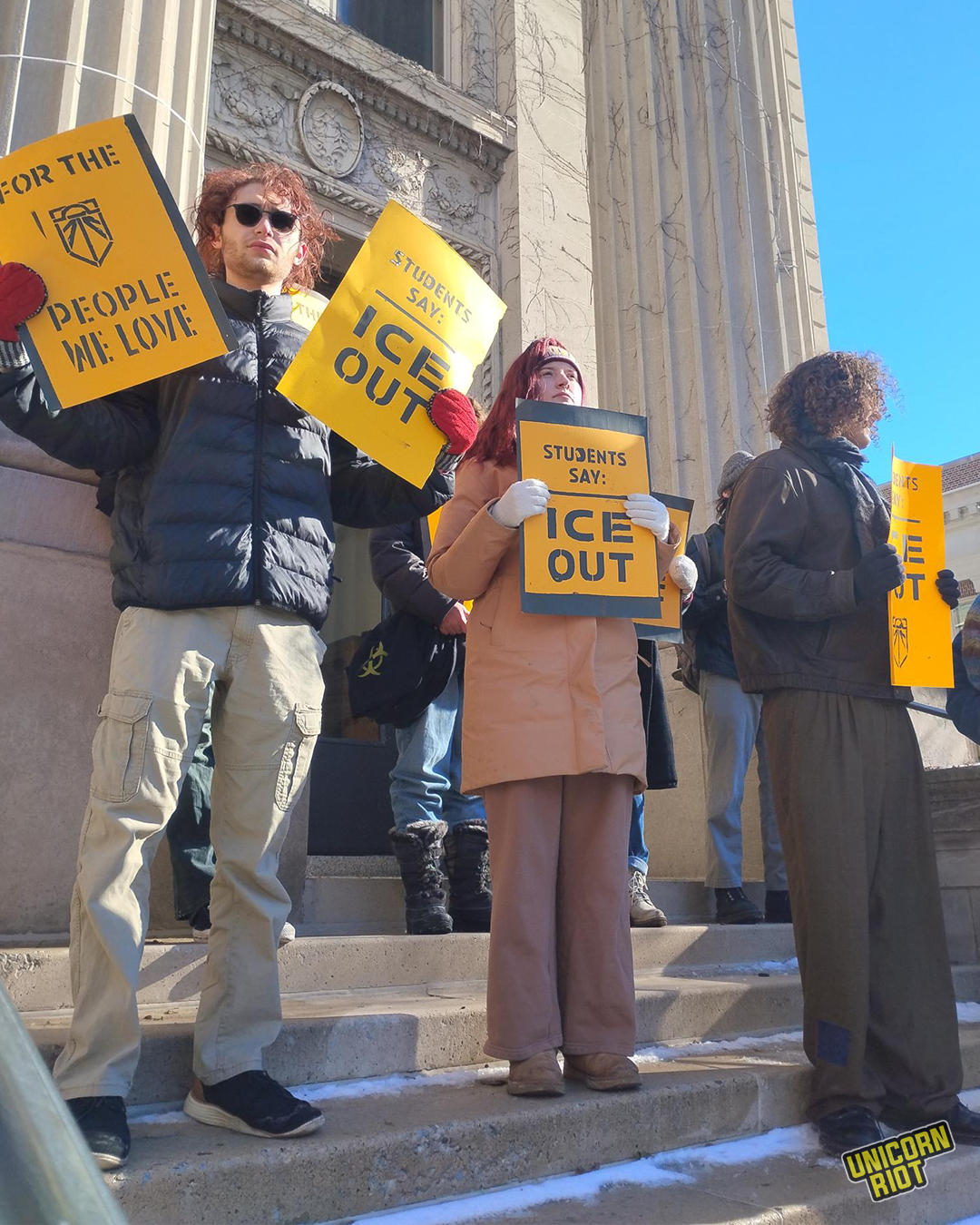
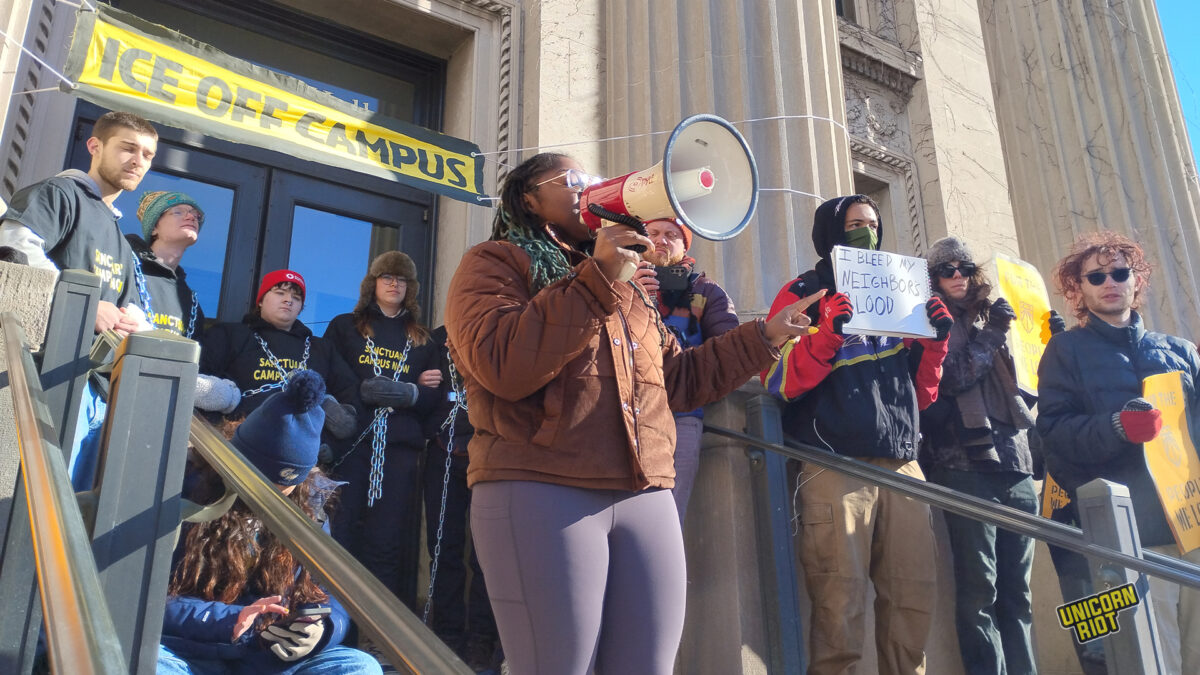
Minneapolis, MN — Six students took the icy steps of Morrill Hall around 1 p.m. on February 6. Four of them chained themselves together, saying they would not leave until they met with University of Minnesota President Rebecca Cunningham. They called on the university to cut ties with Immigration and Customs Enforcement (ICE).
“I’m talking to my friends,” said one of the students. “I’m hearing stories from people who are locked in their dorms every single day since they’ve gotten [here] because they’re so scared of ICE.”
By 2 p.m., most demonstrators had left, with some briefly departing to bring baked goods back to the four remaining students. A university administrator, flanked by University of Minnesota Police, approached the group and warned them they would be arrested and could face academic discipline if they did not disperse. Peterson, a double major in political science and journalism and concerned about his academic standing, chose to leave.
The remaining three students were taken into custody by 2:30 pm.
“I am here to show up and speak out for the students that can’t be here, for the students who are afraid to leave their dorms, their apartments, for the staff and faculty who are afraid to be here, for the students who fear academic consequences from the administration,” said Logan, a freshman majoring in biomedical engineering. “Rebecca Cunningham and the university administration have the power to do something, and they’re refusing.”
Miles Martig, a sophomore majoring in geography, also spoke about fear among students. “We are, you know, my housemates in our community housing are afraid to keep the windows open,” said Martig. “Rebecca Cunningham is acting like everything is normal, and the provost is acting like everything is normal.”
Juliet Murphy, a member of Students for a Democratic Society (UMNSDS), later addressed the crowd. She quoted English poet John Donne, adapting his line “No man is an island” to criticize what she sees as a gap between its progressive image and action.
“It can never truly separate itself from the city in which it dwells. Its campus is scattered throughout the city’s neighborhoods.”
“Nonetheless, there is still an idea among university administrators that our school is an island,” Murphy shouted through a megaphone.
In January 1969, 70 Black students with the Afro-American Action Committee staged a 24-hour sit-in at Morrill Hall, demanding better support for Black students and the creation of a Black Studies curriculum. In October 2024, students temporarily renamed the same space “Halimy Hall” in honor of 19-year-old TikTok creator Medo Halimy, who was killed by an Israeli airstrike in Gaza.
Yesterday, four students chained themselves together on the Morrill Hall steps, calling on the university to cut ties with ICE.
“President Cunningham in particular seems to subscribe to the idea, because ICE has not made any significant incursions onto campus, and because no one has been taken yet, there is no problem and we’re safe. She believes that the university is an island, and that that island, her island, can never be breached.”
Murphy’s tone sharpened as she continued.
“But it has already been breached. ICE vehicles creep through Dinkytown, black bugs eyeing crowds as they stalk toward their next victim. ICE helicopters are constantly overhead,” said Murphy. “ICE agents reside on campus, merely blocks away from where we’re sitting, blocks away from dorms and the lecture halls where we students live and sleep and work and learn.”
ICE activity, she said, was not distant or abstract. Just blocks away, beyond the fortified perimeter of the Graduate Hotel — where riot police had taken positions during previous protests and noise demos — ICE maintained a presence that the university administration appeared unwilling to address. Protests have picked up after federal agents shot and killed Renee Good and Alex Pretti, in the span of three weeks.
“I’ve seen lines of state troopers and police officers blocking streets in Stadium Village, trapping protesters before running at us full force, batons swinging, shooting pepper balls and staring down at us from the roof of the Graduate Hotel,” Murphy said. “Shoving our peers to the ground just as recently as yesterday night. It is a violence that is happening here, and it is happening now, and it’s happening only a few suites away, endorsed by this administration, and they’re doing it all in the name of protecting the very ICE agents that they claim to be doing all they can to protect us from.”
The students’ demands were extensive but specific:
- An official statement declaring ICE unwelcome on campus
- Visible signage asserting private property rights and barring entry without judicial warrants
- A ban on ICE use of university parking facilities
- A commitment from University of Minnesota Police to enforce these policies
- Comprehensive training for staff
- Activation of lockdown protocols if ICE trespasses
- Refusal to share student information without court orders
- Repeal of restrictions on campus demonstrations
- Requirements that businesses leasing university property prohibit ICE agents
- Online course options through the end of Operation Metro Surge
Yuki Rodgers, an undergraduate psychology student who had attended her first Young Democratic Socialists of America (YDSA) meeting just one day earlier, also spoke.
“I’m sick and tired of us acting like this is normal. It is not,” said Rodgers. “We cannot sit around and do nothing any longer. And if you think that this doesn’t affect you, think again. You hurt all of us.”
Ward 2 City Council Member Robin Wonsley arrived later to show support. She said student organizers with YDSA and UMNSDS had set a national standard for protest as Minneapolis became a focal point during what she described as a Department of Homeland Security occupation.
“Y’all are constantly raising the bar on how we should be meeting moments like this,” Wonsley said. “Whether it’s standing in solidarity and demanding a free Palestine, whether it’s demanding that we acknowledge the lives and the values of Black lives in our country and on campus.”
Wonsley criticized what she described as performative resistance from state and city leaders.
“Governor Walz’s saying great words. Mayor Frey’s delivering great, strongly worded letters to the [Trump] administration,” said Wonsley. “We know that is not sufficient to actually fight back against this fascism.”
Correction: The initial publication of this article incorrectly dated the Feb. 6 action as Feb. 7. Additionally, the spelling of the name of Miles Martig has been correctly changed and student’s names after request.
Follow us on X (aka Twitter), Facebook, YouTube, Vimeo, Instagram, Mastodon, Threads, BlueSky and Patreon.
Please consider a tax-deductible donation to help sustain our horizontally-organized, non-profit media organization:

2025-2026 Unicorn Riot Coverage of the DHS / ICE Crackdown Campaign in Minnesota:
Click the image to see all UR coverage of federal law enforcement operations in MN.

Watch Unicorn Riot’s videos from ICE in Minneapolis in playlist below.