Tempi Trial Starts After Three Years of Anger and Unanswered Questions
Larissa, Greece — Three years after the deadliest train crash in Greek history, which claimed the lives of 57 people, the long-awaited trial against those responsible began. Court proceedings were halted following their start after a horrid day of technical failures and adjourned to April 1.
The Tempi trial is expected to be one of the most significant trials in post-dictatorship Greece, as the victims’ families seek justice and political accountability. Their criticism has repeatedly sparked mass protests across the country over the past years, as Unicorn Riot has consistently reported. On February 28, 2025, more than one million people demonstrated nationwide in what became the largest protest in Greece since World War II.
The case concerns a head-on collision between an intercity passenger train and a cargo train on the Athens–Thessaloniki line. The two trains were traveling on the same track for 12 minutes at speeds of 140 km/h and 100 km/h, respectively. Government officials initially attributed the disaster to a “human error.” However, it was soon revealed that along much of the Athens–Thessaloniki route, light signaling, remote management, traffic control, and communication systems were not operational, functioning only on a limited section of the line.
As a result, train engineers relied on radio communication with the stationmaster to move between stations. The railway workers’ union had previously warned about the poor state of the infrastructure. In the aftermath, Greece’s minister of infrastructure and transport, Kostas Karamanlis, resigned amid public pressure, and the railway line remained closed for several months following the crash.
The train crash tragedy, which the victims’ families describe as a crime, has evolved into a fierce political conflict, marked by allegations of a cover-up and accusations against the highest levels of government. Among those criticized is Prime Minister Kyriakos Mitsotakis, who has been accused of attempting to conceal aspects of the case, mishandling the crisis, and failing to respond adequately to the victims’ demands for further investigations.
Failed Start – Trial Adjourned to April 1
The big trial was set to start on Monday, March 23 in Larissa, the regional capital of Thessaly, which is where the stationmasters were responsible for coordinating the trains on the deadly night of February 28, 2023.
The location was criticized for being far away from the homes of the relatives whose request that it be moved either to Athens or Thessaloniki was rejected by the Supreme Court of Greece.
A conference center in the University of Thessaly was transformed into a courthouse specifically for this case. The justice ministry has claimed this to be the largest court room in Greece with around 450 seats. More than 1 million Euro are said to be invested for the transformation of the building.
For the trial that is estimated to last at least two years, 36 people are charged, around 250 lawyers are involved, and the files comprise around 60,000 pages.
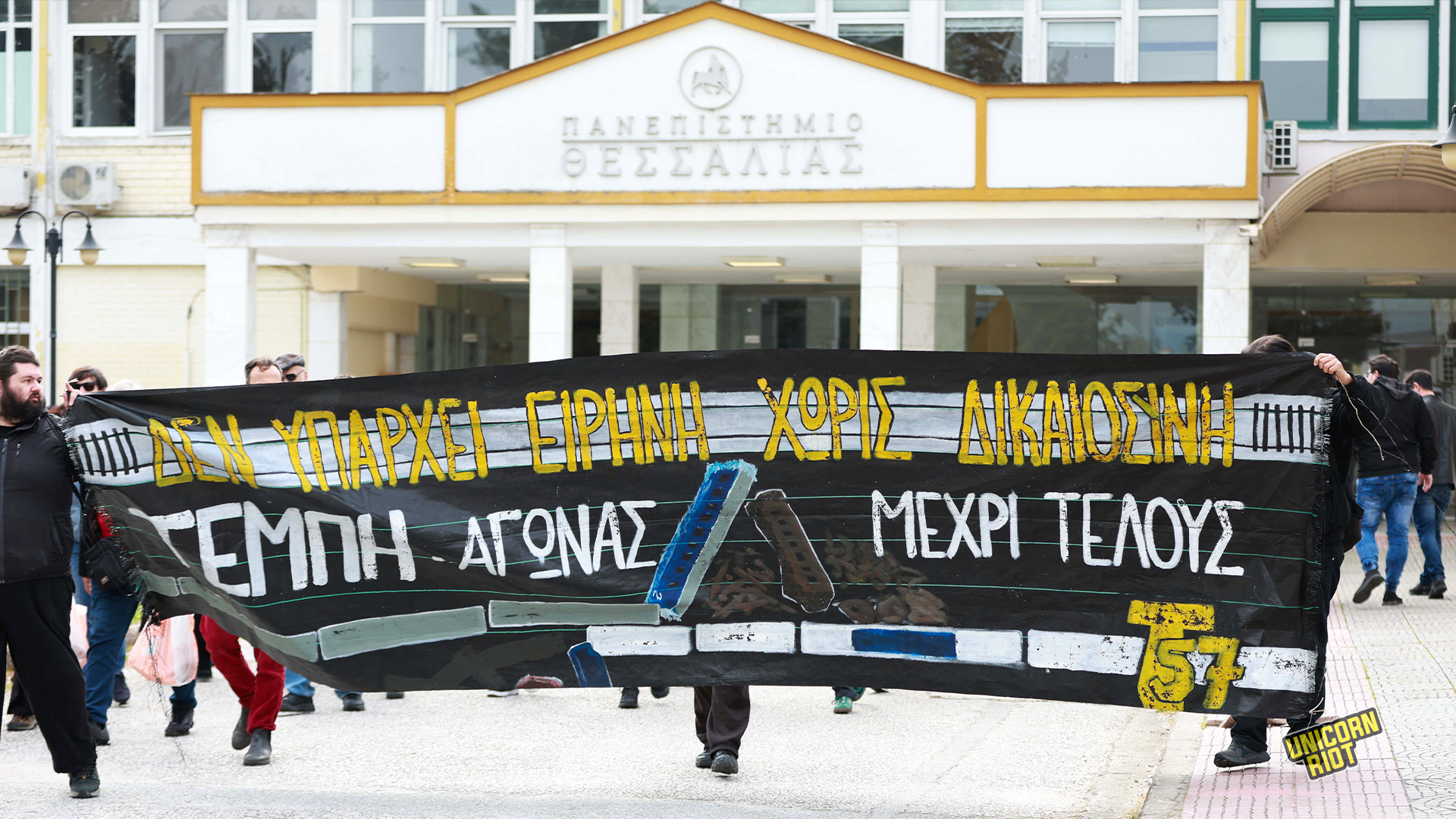
Under the presence of large police forces, relatives of the deceased and survivors of the train crash arrived at the courthouse with the support of hundreds of protesters who came in buses from around Greece.
The day was marred with issues. Relatives and their lawyers criticized the lack of room and technical failures. Many relatives were forced to sit on the defendant’s dock and lawyers had no proper working desks. The microphones were not working and lights were flickering.
The presiding judge asked members of the media to leave the courtroom, citing legislation that prohibits the recording of image and sound inside courtrooms. Journalists refused to leave the room.
Zoe Konstantopoulou, lawyer for Panos Ruci who lost his son Dennis Ruci in the train crash, raised the issue of ensuring public transparency, with the judge responding that the matter would be revisited once the formal procedures are completed, allowing everyone the opportunity to speak.
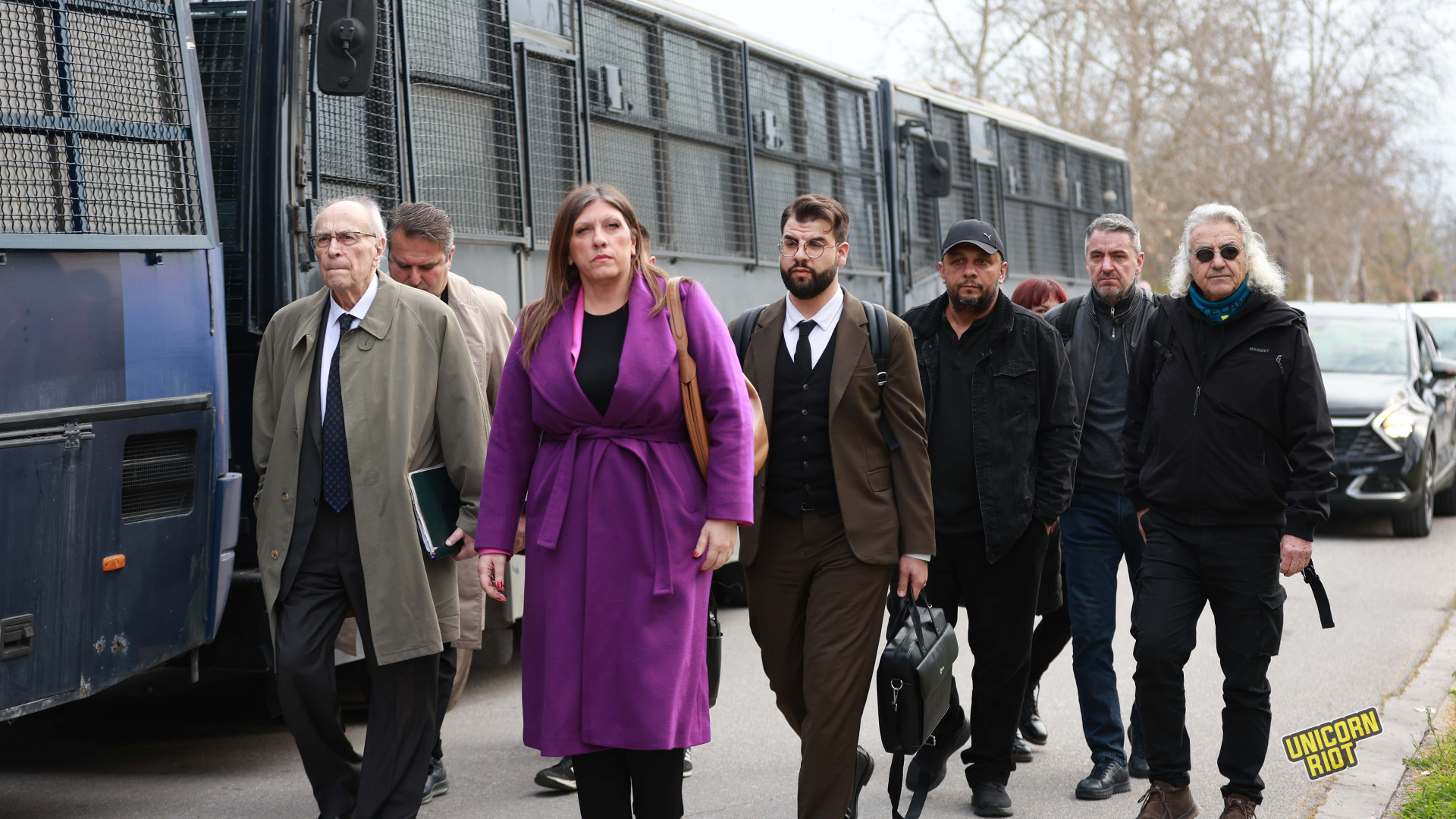
Maria Karystianou, mother of the victim Martha Karystianou, called out, “Why does publicity frighten you?”
“They crammed us into a single room — conditions are suffocating, unacceptable in every respect. Why did they do this? The venue must be changed immediately. The trial must proceed as it should. The truth must come to light,” said Eleni Vasara, the mother of victim Agapi Tsaklidou. “The mockery and government deception continue. Three years on, and the deception is still ongoing.”
During a pause, Panos Ruci spoke after exiting the courtroom. He described the extremely difficult conditions inside, stressing that the trial has essentially not even begun.
Visibly frustrated, he said that under the current setup, proceedings cannot properly start, as people are packed tightly together with no space.
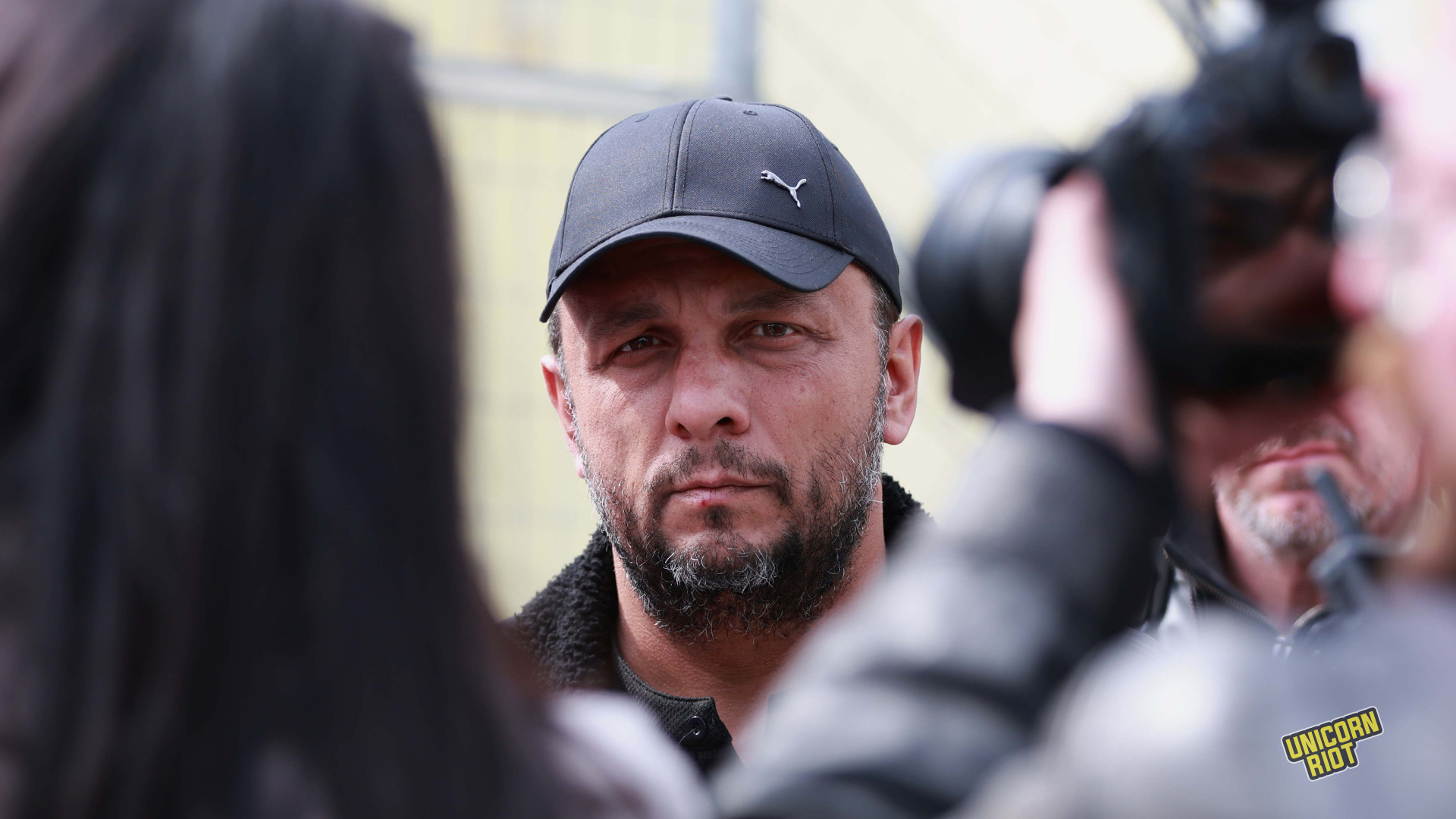
After five hours marked by tension, heated exchanges and many pauses, the judge Georgia Stefanidou adjourned the trial to April 1 and promised to take measures for better conditions.
The Association of Relatives of the Tempi Victims, along with student unions, political organizations, and various collectives, called for a gathering to show solidarity for the victims and demand accountability from the courts.
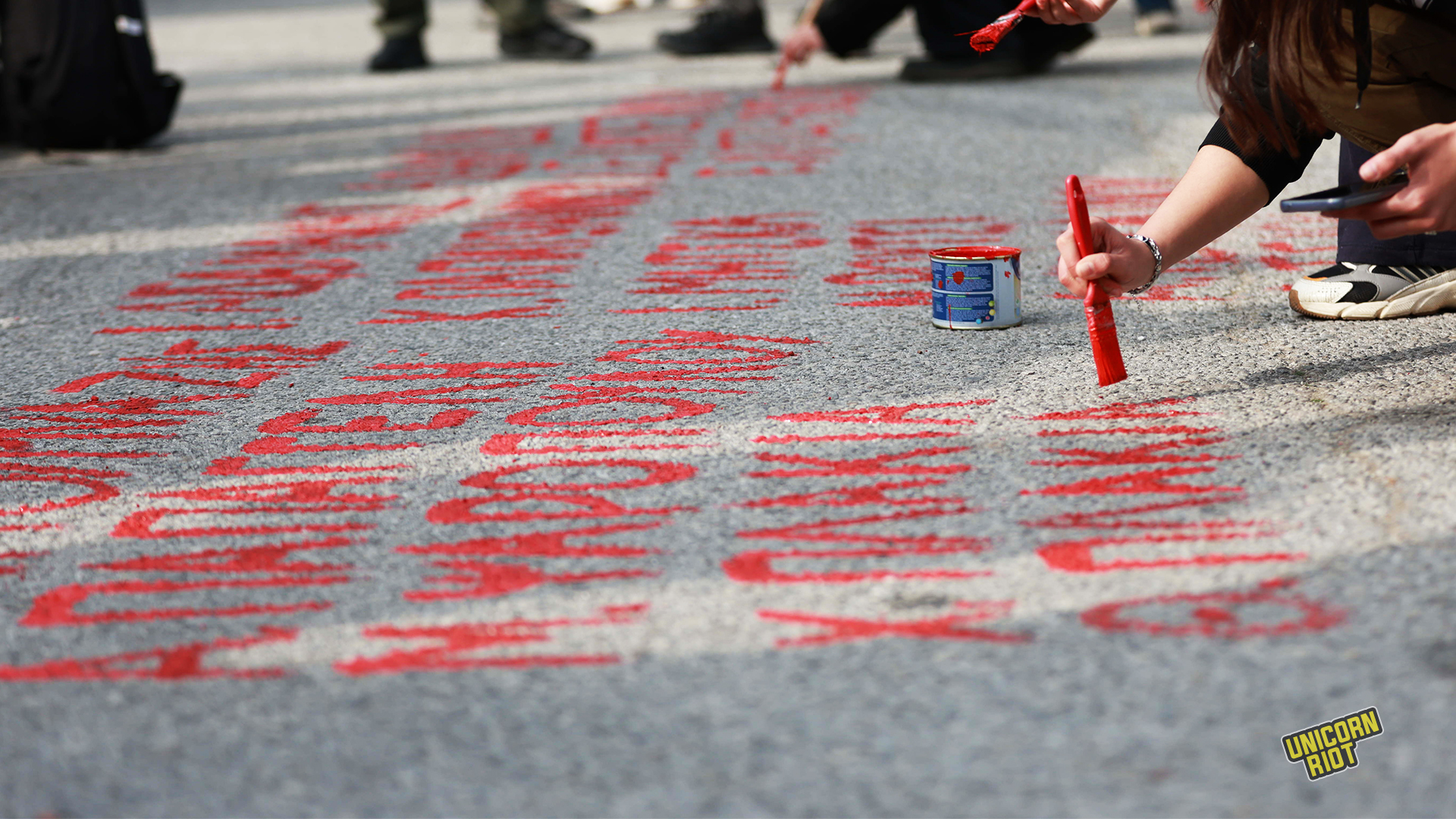
Demonstrators created a powerful tribute to the victims outside the courthouse by painting the names of the Tempi victims on the ground using the same red color that has become a symbol of the movement for justice.
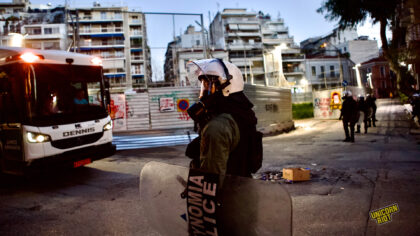
A large police presence was visible outside the courthouse with police in riot gear holding shields amid lines of police busses.
“They brought in ten riot police vans from the early hours of the morning,” said Giannis Skokas, President of the Larissa Labor Center. “This is their idea of ensuring the smooth conduct of the trial. We will continue to stand by the victims’ families until the very end, so that justice is served.”
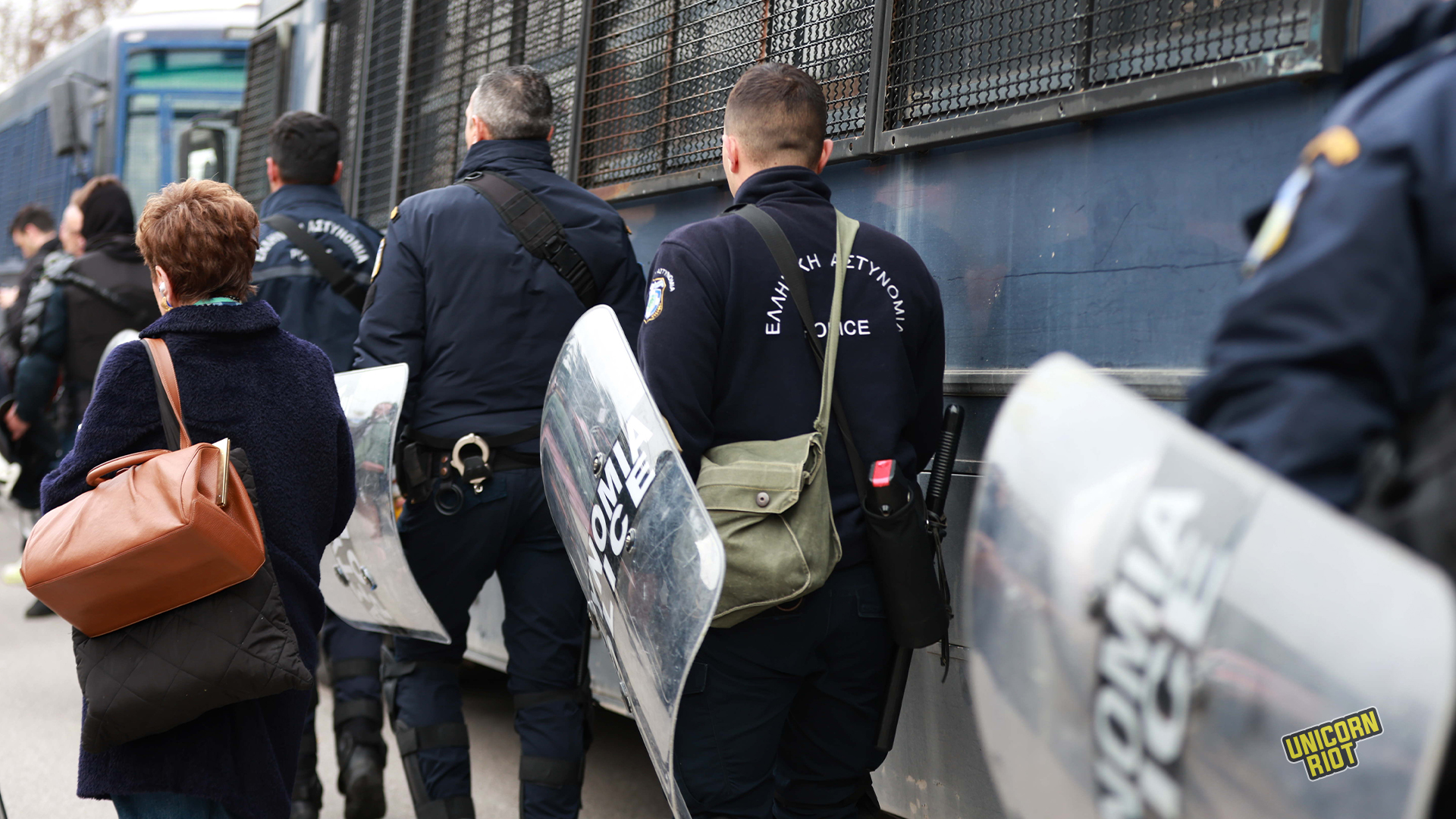
Estela Valasi, a photoreporter who was on site for Unicorn Riot, described the scene and their feelings with the following words: “Long hours of hardship and intense emotional strain for the families of the victims. Inadequate courtroom conditions and numerous interruptions of the proceedings. A large crowd of supporters from all over Greece, with banners and chants. An overwhelming police presence and riot police vehicles everywhere.
The slightly cloudy Monday carried all the grief and determination for justice felt by the relatives of the Tempi victims and survivors. Three years after the crime, the state apparatus remains unprepared to function with respect. I feel numb and admire the struggle they are waging against this shameful indifference.”
The Case File and Indictment
Last September, 80 relatives of the victims, accompanied by their lawyers, went to the prosecutor’s office of the Supreme Court of Greece to submit a memorandum requesting additional investigative actions.
According to their complaints, the initial investigation had been closed hastily by the appellate investigating judge, while the proposal of the Larissa prosecutor was issued through fast-track procedures without key evidence being examined.
Not part of the case files was the question of the explosion that triggered a fire, which according to the relatives and independent research resulted in more deaths. Independent investigations found traces of highly inflammable xylene and the relatives asked for an investigation of the contents of the cargo train. Safety regulations would be violated if it transported xylene.
The memorandum failed and the trial began with important individuals and companies either excluded from responsibility or facing lesser charges.
“This trial is starting late, and important defendants are missing, such as Karamanlis. There are no charges against Hellenic Train, and there are no charges regarding the children who were burned in the explosion” said Pavlos Aslanidis, the president of the Association of Victims’ Relatives of the Tempi disaster, as he made the rounds on Greek TV.
Among the 36 defendants are 11 executives from the Hellenic Railways Organization, or OSE, 16 from its subsidiary ERGOSE, the CEO and the technical director of Hellenic Train, the General Director of Transport at the Ministry of Infrastructure and Transport, the head of the directorate of rail transport, the former president of the regulatory authority for railways (RAS), a 60-year-old station master on duty the night of February 28, and two station masters from the afternoon shift at Larissa Railway Station.
Of those charged, 33 face the felony of endangering transport safety, an offense that can carry a sentence of life imprisonment, along with a number of misdemeanor charges.
In contrast, the executives of Hellenic Train are being prosecuted only for misdemeanor offenses, despite evidence of responsibility both for the transport of hazardous materials and for fire safety in the trains, specifically regarding seats in the carriages where charred bodies were found.
Due to the complexities of the case, the judges will have a challenge navigating the complicated chain of responsibilities, stretching from operational errors up to systematic and administrative failures of the railway system which has been in crisis for years.
Since 2005, OSE has undergone an extensive privatization process. The organization is responsible for managing the railway infrastructure, while ERGOSE handles construction and modernization projects. Hellenic Train operates the train services, renting access to the network from OSE, and is a private company owned by the Italian state railway group Ferrovie dello Stato Italiane. The RAS is formally independent and is tasked with overseeing whether companies comply with regulations, granting operating licenses, supervising safety, ensuring fair competition in access to the network, and imposing sanctions or fines when necessary.
A recent investigation published by Solomon, Reporters United and the Forensic Architecture Initiative Athens grouped the defendants into five categories:
1. Larissa station operators, which includes the station master working Feb. 28, 2023. The accusations range from mishandling the train control to inadequate staffing. The station master claims that because of his heavy workload and outdated communication system he failed to inform the driver of the inter-city train.
2. The OSE management, including ex-CEOs and board members. They are accused of mismanagement and failure to oversee the update of communication channels, safety systems and remote control, as well as having placed inexperienced station masters into critical positions. The OSE officials shift their responsibility to other organizations and the ministry of infrastructure and transport.
3. ERGOSE officials who were responsible to put into practice the contract 717 (modernization of signalling and security infrastructure). They are being accused of failing to coordinate the success of contracts to install signaling and remote control. The consortium of companies got successive extensions without finishing their contract or being penalized.
4. Two officials from the Transport Ministry and one official of the control agency RAS are charged for the lack of legislative measures and proper supervision of the Greek railway system. The defendants argue that the ministry has no direct intervention power into the operation of OSE and ERGOSE, which function in autonomy. Ioanna Tsiparikou, the accused RAS official, states that the ministry did not do enough to control the situation.
5. Two officials from Hellenic Train are being charged for failure to install the GSM-R radio system on the trains. GSM-R (Global System for Mobile Communications – Railway) is a digital radio system functioning like a mobile network for trains which enables secure communication between train drivers, control centers, and signal operators, as well as the transmission of crucial data for control systems. It ensures fast and reliable information exchange, especially in emergency situations.
As the criminal trial is set to start on April 1, an administrative court granted a Tempi victim’s family €400,000 in damages while for the first time recognizing the Greek state’s responsibility in the deadly disaster.
Unicorn Riot will follow the trial and provide crucial developments along the way.
Cover photo contributed by Estela Valasi.
For more media from Greece, see our Greece archive page.
Parallel Crimes: Novi Sad, Tempi and the Architecture of Neglect in the Balkans [Feb. 2026]
‘I have no oxygen’ – Train Crash Leads to Greece’s Biggest Post-War Social Movement [April 2025]
‘It was a crime, not an accident!’ – Deadly Greek Train Crash Sparks Justice Movement [April 2023]
Follow us on X (aka Twitter), Facebook, YouTube, Vimeo, Instagram, Mastodon, Threads, BlueSky and Patreon.
Please consider a tax-deductible donation to help sustain our horizontally-organized, non-profit media organization: