The Fight Against Google’s Minnesota Data Centers
Mankato, MN — Minnesotans gathered on July 25 in the basement of Mankato’s Grace Lutheran Church for a panel on the hyperscale data centers seemingly popping up across the North Star State.
Roughly 80 attendees from the Mankato area and further filled the underground room, frequently adjusting themselves on metal folding chairs throughout the three hour event as the whirring air conditioner kept the space nearly refrigerated.
Aubree Derksen of Pine Island, who has been heavily involved in the fight against the planned Google data center in her small, rural community just shy of 4,000 residents, was the event’s first speaker. Pine Island is 20 minutes north of Rochester on U.S. Highway Route 52 in southern Minnesota.
Derksen described the work that goes into investigating data center development, a seemingly monumental task when the local government signs non-disclosure agreements, otherwise known as NDAs, with the companies that own and develop them. As a result of such agreements, she has to use roundabout methods to root out project details, including calling utility companies to ask about new high voltage power lines and submitting multiple data requests with different government authorities to build a picture of what’s happening.
“Learn from us,” Derksen said. “Because this is not fun.”
The event, cloistered underground, appeared to drip with a paranoia familiar to conspiracy theorists scanning the horizon for black helicopters through shuttered windows. In this case, however, the conspiracy is not imagined. In both Pine Island and Hermantown, the projects were kept secret by all parties involved until they were announced in the Star Tribune following months of lobbying by Google in the state legislature for favorable conditions before any plans were announced.
Beyond hiding entire projects from the community until they are well underway through NDAs, Google and other companies erecting hyperscale data centers across the state and the rest of the country consistently obfuscate environmental impacts and the real effects these facilities have on communities. Hyperscale sites are massive structures housing thousands of servers for cloud computing and generative AI, exceeding 10,000 square feet.
Underscoring the cloak-and-dagger nature of these developments, each was given a codename in advance of Google claiming ownership: Project Loon in Hermantown and Project Skyway in Pine Island.
Smaller data centers, such as the dozen already spread around the Twin Cities, typically have an energy capacity less than 20 megawatts. Hyperscale data centers planned for the state have capacities well above 100 megawatts, with the largest being 400 megawatts with the previoualy planned Geronimo Power data center in Nobles County.
For scale, 100 megawatts is enough electricity for 100,000 households, according to the International Energy Agency.
According to court records, Project Skyway is projected to consume upwards of 2,700 megawatts.
“While data centers are hardly new, hyperscale ones are in a different league,” the Minnesota Center for Environmental Advocacy (MCEA) said in a June statement regarding a recent court victory against a data center in Faribault. “They are AI-driven industrial campuses that can consume millions of gallons of water a day for cooling, draw enormous amounts of electricity, generate significant noise and light pollution, and, if enough are built, put serious strain on our state’s already stressed groundwater supply and clean energy goals.”
The opaqueness of these operations when dealing with the public is not due to a lack of knowledge. Rather than figuring such things out on the fly, these things are planned well in advance.
“They know exactly what’s being built,” Bryan Schneider said during his portion of the presentation. Schneider, who was one of the event’s six speakers, has managed data centers in the past and currently works at the Minnesota State University, Mankato, data center.
“They know every floor tile, every ceiling tile, every light that’s going to be in there. […] They know everything. But if you don’t know about it, it’s being withheld.”
Bryan Schneider
Related: Data Centers, the Climate Crisis, and Community Defense
Project Skyway (Pine Island)
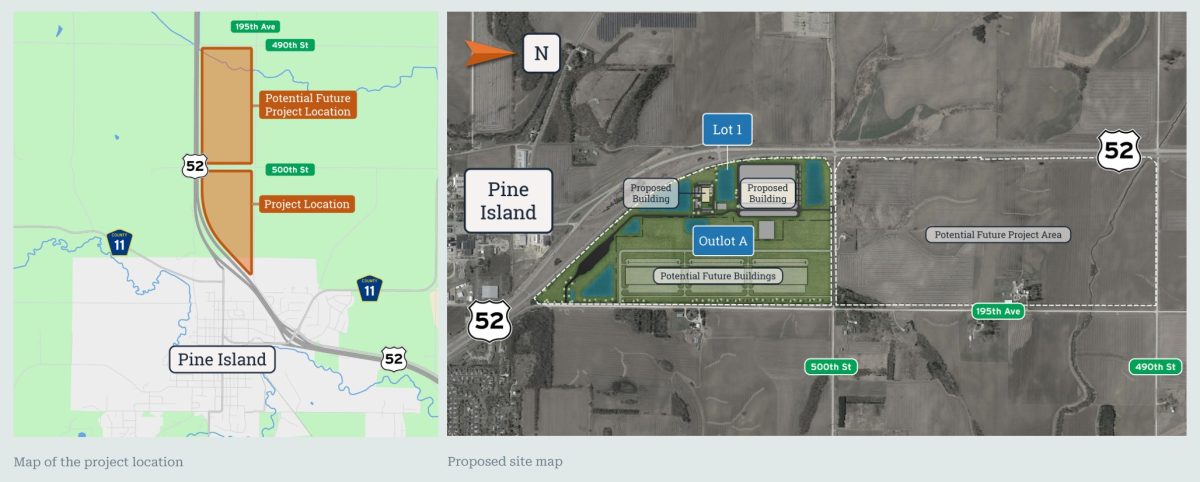
Project Skyway consists of two proposed parcels demarcating two phases of the project on the northern edge of Pine Island, cumulatively taking up roughly one square mile of land. The southern portion, where the first phase of the project is set, is owned primarily by trusts and has no residential properties on it. The much larger area to the north, proposed for phase two, is a patchwork of smaller plots with several residential homes mixed in with farmland.
Matching a pattern with cities building hyperscale data centers, Pine Island’s local government signed NDAs with the developer, Ryan Companies, keeping details of the process secret from the public.
The city began working on the proposal when it was first proposed in November 2024, and residents only began finding out about it the following September before the city adopted an alternative urban area review (AUAR), which allowed all involved parties to hide the fact that it was a data center that was under review. Since the local government wasn’t studying the environmental impact of a data center, the AUAR allowed them to conduct a much more generalized review to “understand how different development scenarios will affect the environment of their community before the development occurs.”
Despite legal challenges, the city gave Ryan Companies a conditional use permit based on the AUAR that allowed them to immediately begin construction of the data center.
In October last year, the MCEA sued Ryan Companies and Pine Island to stop the development on the grounds that the AUAR was insufficient as an environmental review, alleging that the city was aware that it was going to be a data center during the process.
In May 2026, the Goodhue County District Court issued a temporary restraining order against Ryan Companies until the court rules on the case, preventing them from using the conditional use permit.
The Minnesota Court of Appeals ruled on a similar case brought by MCEA on June 8 that the city of Faribault failed to provide an adequate environmental review when it approved permitting for a hyperscale data center being developed by Archer Datacenters.
The next hearing for the case is scheduled for February 22, 2027.
According to Derksen, however, the court injunction only paused a single data center.
Project Skyway’s first phase includes four potential buildings, which until recently activists thought could have included office buildings, Derksen said during her speech at Grace Lutheran Church. As the lawsuit has proceeded, she said, it was revealed in court documents that the other structures are also data centers being set up by at least one other Google subsidiary.
“One data center over here, three more over there,” Derksen said.
The three additional data centers were not affected by the injunction because they were being considered by the Minnesota Public Utilities Commission and were not included in the environmental review.
Project Loon (Hermantown)
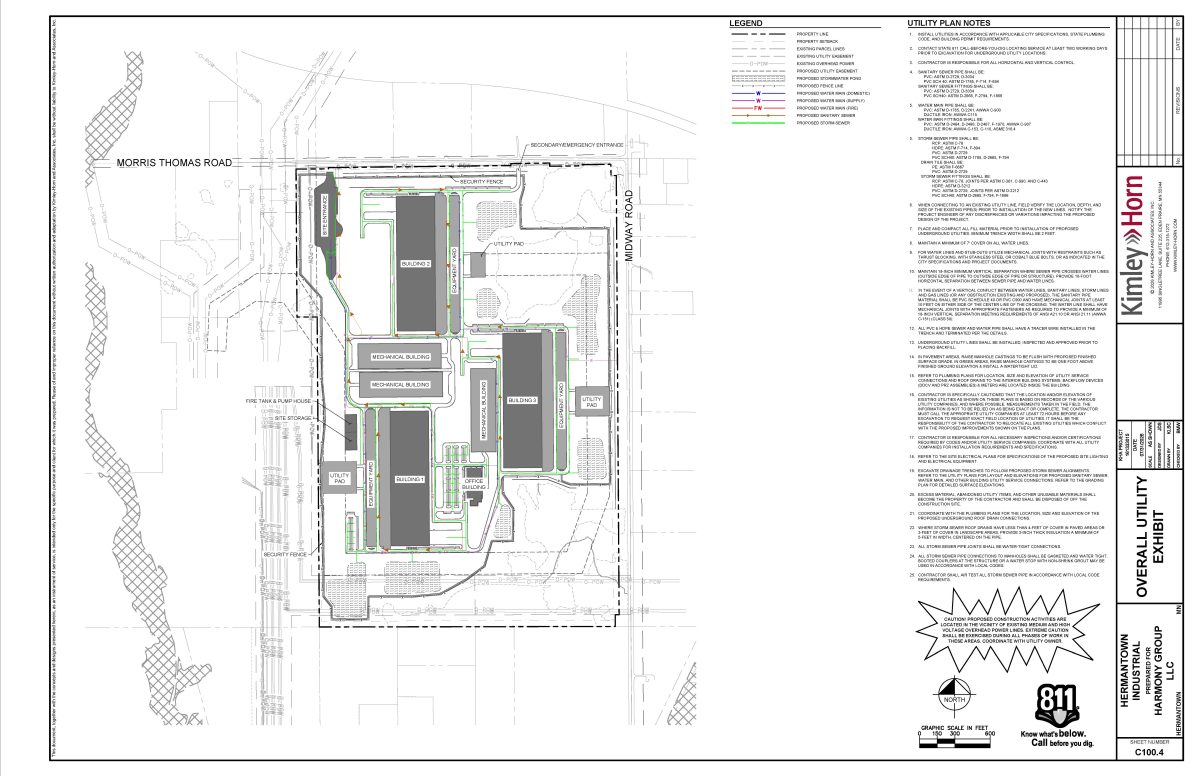
Nearly 200 miles north of Pine Island is Google’s planned hyperscale data center in the Duluth suburb Hermantown, referred to as Project Loon.
“Efforts to keep the proposed Hermantown data center a secret, revealed in documents obtained by public data requests, are some of the most extreme examples we found in keeping the public in the dark about a data center,” Rebecca Gilbertson, a Hermantown resident and activist with the group Stop the Hermantown Data Center, said.
In the leadup to the data center’s development, Hermantown’s local representatives with both the city and county signed 12 NDAs with Mortenson Development – the company chosen by Google to develop the structure – between May and December of 2024, according to the website Stop the Hermantown Data Center.
In a move that Pine Island would later echo, in May 2025, Hermantown opted for an AUAR instead of conducting an environmental review that would adequately consider data center specifications. The review was conducted for “Hermantown Industrial,” which it classified as a “proposed light industrial development” with no mention of a data center.
MCEA sued the city later that year, claiming in the civil complaint that the city was aware that Hermantown Industrial was, in reality, “a large data center,” which it said is evidenced by correspondences from city staff and the developers “with various government entities to determine the infrastructure and resources needed to support a data center in Hermantown.”
The project itself was finally revealed as a data center in September 2025, by the Minnesota Star Tribune, not by the city, the developers or even a local newspaper.
“Most residents don’t get the Star Tribune,” Gilbertson said. “I actually found out from my neighbor.”
The company paying for the development, Harmony Group, LLC, which is owned by Google, was not actually registered in the state of Minnesota until three days after the initial story broke, according to Gilbertson.
In April, residents of Hermantown through the group Stop the Hermantown Data Center sued the city for “improperly changing its 2045 comprehensive plan and [rezoning] the neighborhood where the data center is proposed to be built to allow the controversial project to move forward,” Minnesota Public Radio reported.
Future for Data Centers in Minnesota
Recent polling in July conducted by KSTP revealed that a clear majority of Minnesotans oppose the construction of data centers, with 60% at least somewhat opposing and 27% at least somewhat supporting.
On the topic of subsidies for data centers, the amount of Minnesotans at least somewhat opposed approaches 70%, and those in support shrink to 20%.
The top reasons for opposing the construction of data centers include resources, AI concerns and costs, according to KSTP’s polling data.
Nationally, opinions on data centers are not quite as negative as in Minnesota, but recent polling from Politico shows it shifting in that direction. In July, 41% of respondents voiced opposition to data centers, a 13-point increase since January.
Minnesota is an early adopter of hyperscale data center regulation, but is it enough to curb the worst impacts of these structures?
Minnesota’s 2025 data center law, which passed through a contentious legislative session with relatively bipartisan support and was signed into law by Governor Tim Walz on June 14, 2025, falls short on the environment.
A key component of the bill is pre-application evaluation for hyperscale data centers that consume at least 100,000 gallons of water annually and require a new permit or a permit amendment. During the process, the Minnesota Department of Employment and Economic Development may request information from the data center project to determine its impact on local water sources. The entire process is completely optional.
The only other environmental measures in the bill requires that unspecified agencies or departments “reasonably consider” various impacts on water conservation, without defining what exactly that means or who will be doing it.
“All of these things are already required under Minnesota laws and regulations or are unenforceable,” CURE’s Government Relations and Policy Director Sarah Mooradian said.
The most recent legislative session concluded in June without any new regulations on hyperscale data centers, despite pressure from constituents.
Earlier this year, the city of Eagan passed a one-year moratorium on new data centers in the city, making it the first in the state to do so. More recently, in June, the city of Minneapolis passed a shorter, five-month moratorium.
Cover image contributed by L. Cam Anderson.
[Correction: A previous version of this article misspelled Derksen’s name and misstated the amount of data center buildings in Project Skyway. It also did not include the upper estimate of Project Skyway’s power consumption and misstated multiple dates.]
Follow us on X (aka Twitter), Facebook, YouTube, Vimeo, Instagram, Mastodon, Threads, BlueSky and Patreon.
Please consider a tax-deductible donation to help sustain our horizontally-organized, non-profit media organization: