ICE Agents Alter Tactics, Work With Impunity While Violating US Citizen’s Rights in Minnesota
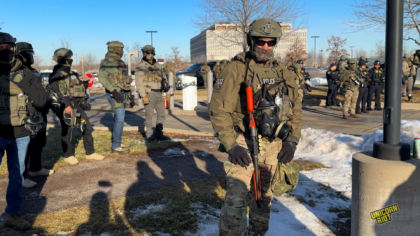
Twin Cities, MN – Under the Trump Administration’s quota-driven mass deportation plan, separation ordinances and legal protections no longer appear to matter. On January 7, an ICE agent shot and killed an observer near 33rd Street and Portland Ave., only the most recent in a series of abuses of power that have steadily mounted in recent weeks. The Minneapolis Police Department once again appeared on the scene for “crowd control” after federal agents sprayed chemicals on residents who responded to the shooting – part of a larger pattern in Minnesota of integrated police actions between federal, county and local law enforcement.
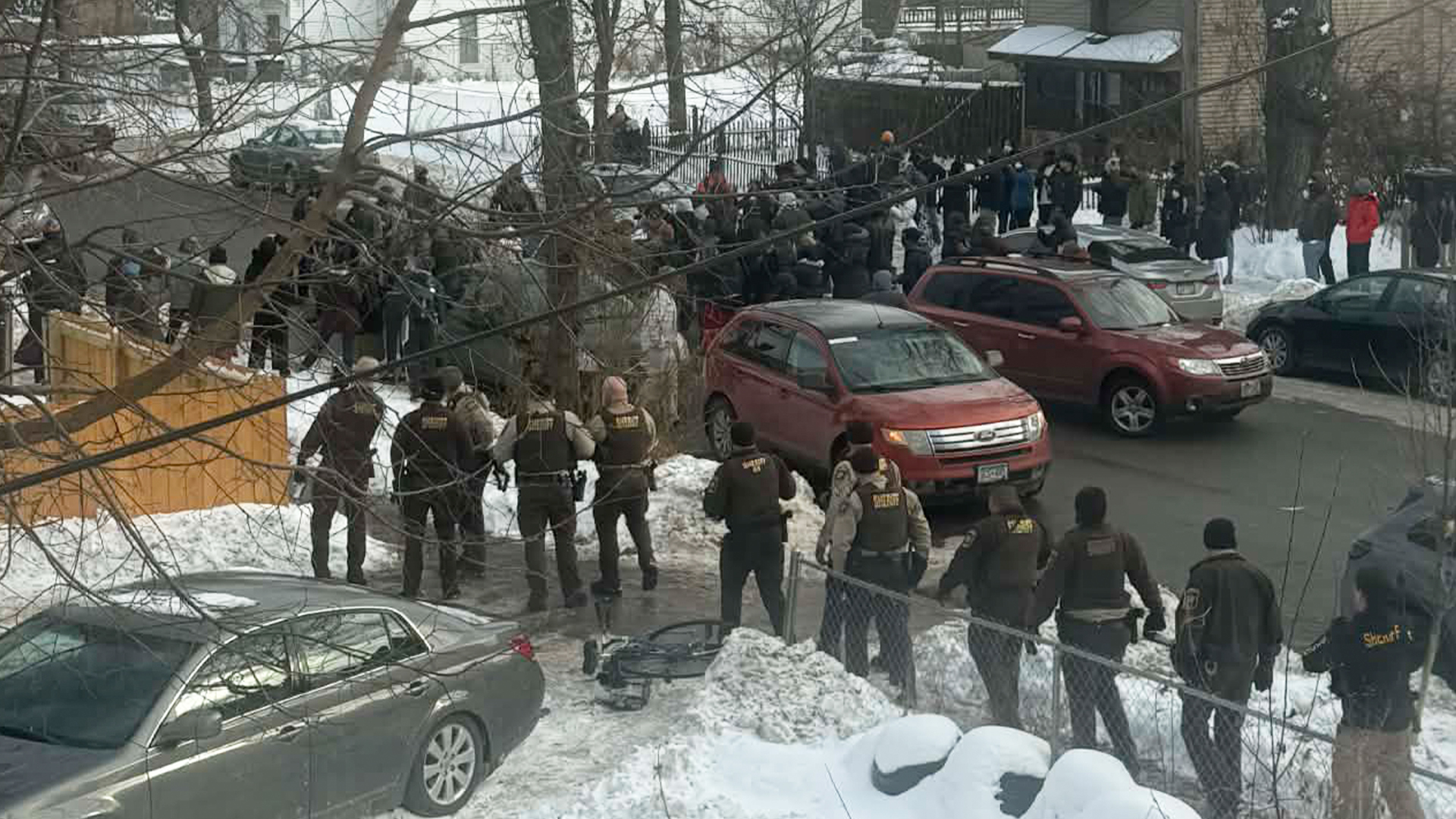
The Hennepin County Sheriff’s Office have recently been working hand-in-hand with federal agents. Together they detained a U.S. citizen and responded to a 9-1-1 call from a DHS agent while protests broke out as agents dragged a pregnant woman through the snow on December 15.
Additionally, a former cop-turned-construction worker with a third-party removal protection status who previously turned down offers to work with gangs inside El Salvador’s corrupt police force, now faces deportation back to El Salvador despite a legal status meant to bar it.
Community Member Detained After Observing Agents Dec. 26
On Dec. 26, federal agents followed Joseph Boman into the Minnoco gas station at the corner of Penn Avenue and West 68th Street in Richfield, Minnesota.
“I’m getting gas and two officers in a black Nissan pickup just pulled up next to me taking photos,” Boman said.

Boman, an observer acting as part of the Twin Cities sprawling activist community, filled up his tank and left Minnoco.
He trailed a couple of ICE vehicles who entered the restricted area at Whipple Federal Building at Fort Snelling, where migrants are detained for a maximum of 12 days before being transferred to a county jail while awaiting deportation.
Boman pulled into the private parking lot across the street where Hennepin County Sheriff’s deputies were waiting to arrest him.
Activists stationed outside Whipple are tasked with observing any unconstitutional actions from federal agents and they were not aware that Boman was arrested.
Videos and photos obtained by Unicorn Riot show a black Nissan trailing Boman as he enters Minnoco and the same black pickup truck entering Whipple.
“They have to get other law enforcement agencies involved, and the Hennepin County Sheriff’s [Office] is one of the departments in the area that is willing to work with ICE because Minneapolis Police, they’re hands-off,” Boman told Status Coup days later. “They’re not touching anything that ICE is trying to get them to do. So [federal immigration agents] have to rely on the sheriff’s [office].”
Federal agents appear to be attempting to sidestep an updated ordinance that restricts Minneapolis police from cooperating with ICE.

Roles of MPD & Hennepin County Sheriff’s Office, ICE & DHS Questioned
While in Minneapolis conducting detainments on Dec. 15, a DHS agent contacted the Hennepin County Sheriff’s Office for crowd control after reporting that an agent had been pelted with snowballs.
Two ICE agents were attempting to arrest a pregnant woman at the corner of 29th Street and Pillsbury Avenue when crowds surrounded the duo. Elda Barreto and Mayra Guevara said they witnessed agents breaking a car window before wrestling a pregnant woman to the ground.
“They were starting to resist inside and they broke the window,” Guevara said. “Then they start taking them out, and that’s when they start fighting on the snow and push[ed] them.”
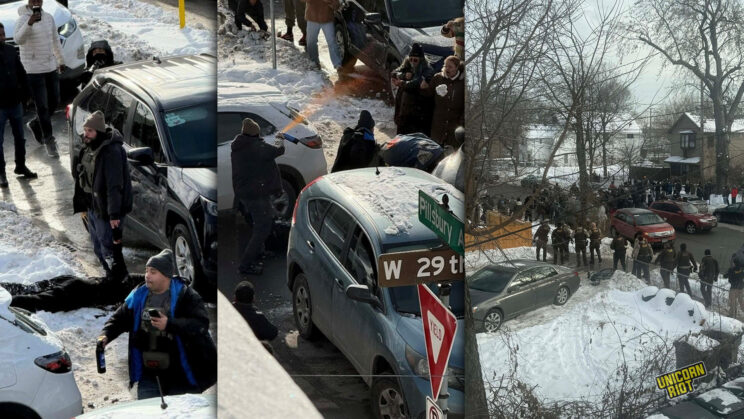
A DHS agent called Hennepin County Dispatch to request assistance, claiming calls to MPD were ignored. “I got forwarded to Minneapolis and they’re not answering their phone,” a DHS agent said during a call published by Hennepin County Sheriff’s Office uploaded to social media.
Immigration activists suspect a new trend has emerged following the city’s update to its two-decade-old separation ordinance: Hennepin County Sheriff’s assisting ICE and DHS.
Around the country, 287(g) agreements with local law enforcement bolster ICE activity.
Minneapolis Police were criticized for doing crowd control work during a raid by the Homeland Security Task Force in early June at a business on the corner of Lake and Bloomington where the community responded to what they thought was an immigration raid. A City Auditor report said that Minneapolis didn’t violate the city’s outdated separation ordinance.
MPD has taken a backseat since updating their separation ordinance against ICE. After the raid on 29th and Pillsbury, Minneapolis Assistant Chief Katie Blackwell sent a memo telling MPD cops they aren’t allowed to assist federal agents with immigration enforcement.
“Members of the MPD shall not self-deploy to any related immigration enforcement activity,” the memo reads. “We remain committed to supporting public safety and maintaining trust within our communities.”
While Minneapolis police appear to have tightened internal restrictions on cooperation with ICE, St. Paul police have taken a different direction. On Nov. 25, St. Paul cops appeared alongside federal agents on Rose Avenue in the Payne‑Phalen neighborhood using pepper spray and other chemical irritants against protesters, press and elected officials.
Family Says Immigrant Taken in St. Paul Despite Protection Status
[Paragraphs (14) removed along with embedded video for safety concerns – May 8, 2026]
Vehicle abandonment appears to be a common tactic used by ICE agents. On Dec. 9, agents pulled over a woman at the intersection of 38th Street and Hiawatha Avenue. Photos obtained by Unicorn Riot show a red Mitsubishi sedan left running, with no responders called. The Minnesota Department of Public Safety did not return requests for comment.

[Paragraphs (4) removed for safety concerns – May 8, 2026]
Limited Access to Legal Assistance for Immigrant Detainees
People held in ICE detention and those facing immigration court proceedings do not have a right to a government-appointed attorney (commonly known as a public defender) if they cannot afford one, unlike in criminal cases. Congress provides limited funding for immigration legal services, but those programs reach only a small portion of people in detention.
Congress set aside $29 million a year to fund programs that provide legal services to immigration services. Minneapolis set aside $500,000 to expand immigrant legal services through the Office of Immigrant & Refugee Affairs. St. Paul has set aside $175,000 to the Immigration Defense Fund and $125,000 to support the Naturalization Support Fund.
Advocacy groups and federal data show that immigrants transferred to remote detention centers in states such as Texas, Louisiana and Arizona are far less likely to obtain legal representation, in part because those facilities are located hours from major cities and nonprofit legal providers. Multiple studies, including reports from Human Rights First and the American Immigration Council, have found that detainees held in these states are more likely to be deported because cases move faster and access to attorneys, family support and evidence is severely limited.
[Paragraph removed for safety concerns – May 8, 2026]
Another intensifying trend under Trump’s second term is the use of third-country removal to deport migrants, including those with legal protections like asylum or withholding of removal, to countries other than their own. By rapidly deporting migrants under these “third-country” arrangements, the administration has created a system in which speed and political agreements increasingly outweigh due process and human safety.
Clint Combs covers activist movements, local government and national security. Follow him on Bluesky or the site formerly known as Twitter. Contact him at ClintonCombs@proton.me or securely via Signal (username): Combs0294.79.
Correction: The cross street of the fatal shooting was incorrectly put as avenue due to an editing error.
Update [May 8, 2026]: Edits were made to delete paragraphs from the article to help alleviate safety concerns for a family impacted by the immigration system.
2025-2026 Unicorn Riot Coverage of the DHS / ICE Crackdown Campaign in Minnesota:
Click the image to see all UR coverage of federal law enforcement operations in MN.

Watch Unicorn Riot’s videos from ICE in Minnesota in playlist below.
Follow us on X (aka Twitter), Facebook, YouTube, Vimeo, Instagram, Mastodon, Threads, BlueSky and Patreon.
Please consider a tax-deductible donation to help sustain our horizontally-organized, non-profit media organization: