The American War in Laos Still Claiming Victims 50 Years Later
In a remote village in the mountains of Xieng Khouang province in northern Laos a small temple is under construction. Its concrete walls are unpainted, and window and door frames sit unfinished. Inside the temple rests a 500-year-old golden Buddha statue, flanked by two columns of old brick. The statue’s eyes gaze outside at the rice paddies that surround the village.
Out of sight of the Buddha’s field of vision is the original temple – now a large mound of bricks and rubble. A local shop owner says the temple was bombed during the war by the Americans. Another local resident is asked what else was bombed during the war. “Everything,” he says. “Everything.”
Beyond the rubble, buried just below the surface across the vast mountain ranges and farmlands of Laos are millions of unexploded bombs, still claiming victims 50 years after the end of the war.
Laos was caught in the crosshairs of the American-led global crusade against communism during the Cold War. The war in Vietnam engulfed neighboring Cambodia and Laos. Vietnamese communists were pushed across the border to escape the brutal bombing missions of the U.S. They built the expansive Ho Chi Minh trail which brought supplies, weapons, and troops from the north of Vietnam to the south.
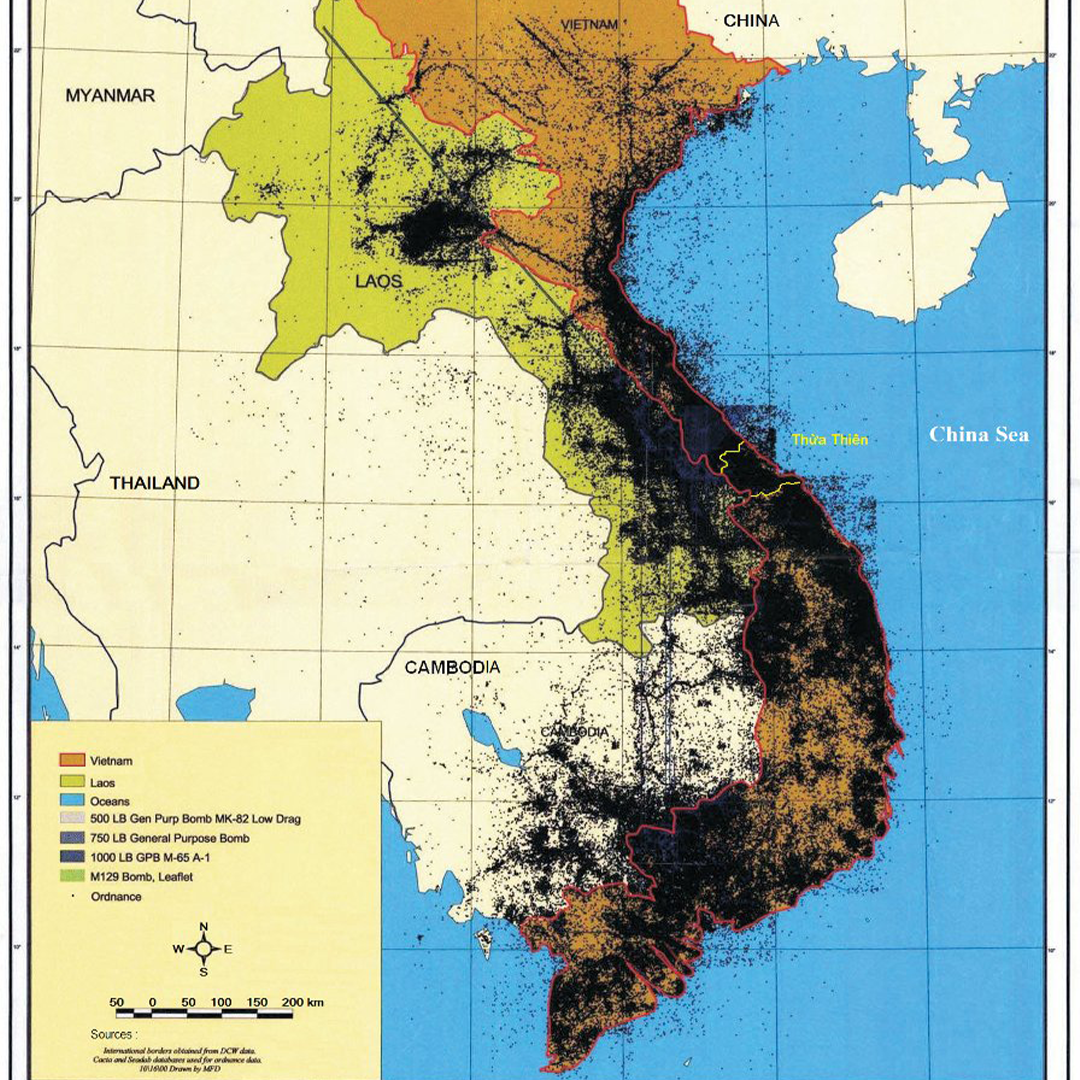
The American war in Laos lasted from 1964-1973 in an effort to destroy both the Ho Chi Minh trail and offer air support for a clandestine counterinsurgency force of fighters from Hmong and other ethnic groups the CIA recruited to fight the communist Pathet Lao forces.
While the CIA’s secret army, led by General Vang Pao, recruited child soldiers and trafficked drugs, the war and massive bombing campaigns were kept secret by presidents Johnson and Nixon and Secretary of State Henry Kissinger, all of whom repeatedly lied to and deceived the American public and Congress.
There’s no accurate count, but an estimated 200,000 people were killed in the war, and over 750,000 people, or about a quarter of the country’s population, became refugees during the conflict.
Today painful reminders of the American war are ubiquitous and constant. “The suffering was unbearable,” says May Sinoun, a 107-year-old resident who lives in a traditional Lao home in the dusty, quiet capital city of Xieng Khouang province, Phonsavan.
Sinoun recounts how her husband was captured by enemy fighters when he went to deliver a message to a village chief. “He was tied to a tree, and killed, shot and stabbed. My younger brother was also killed,” she says. The bombing of Phonsavan was constant. One bomb was dropped on a school she was in and killed four of her friends in front of her. She was one of two survivors. She points to numerous parts on her arms, shoulders and back, areas she says she still suffers pain daily from the bomb’s shrapnel.
With her children in tow, she fled. “When we were living in the forest, in the mountains, hiding in caves, the planes bombed all night. At first, they burned houses, flying past and setting homes on fire. After that, we had to flee to Vietnam,” she says.
Phonsavan was turned into an inferno. Just to the south, Muang Khoun, an ancient city historically famed for its regal wealth and vast sprawling stupas, was completely leveled.
“The whole village fled, moving from place to place, farther and farther away. So, we walked for 23 days to reach Vietnam. When we arrived, people came to receive us, taking families into their care,” she says. “Many people died along the way. Planes kept bombing. Husbands lost wives, wives lost husbands, children were separated from parents. Some died, some were injured. Some people were taken away. Those who were badly injured or disabled suffered greatly.”
Not all who hid from the bombs in Xieng Khouang province survived.
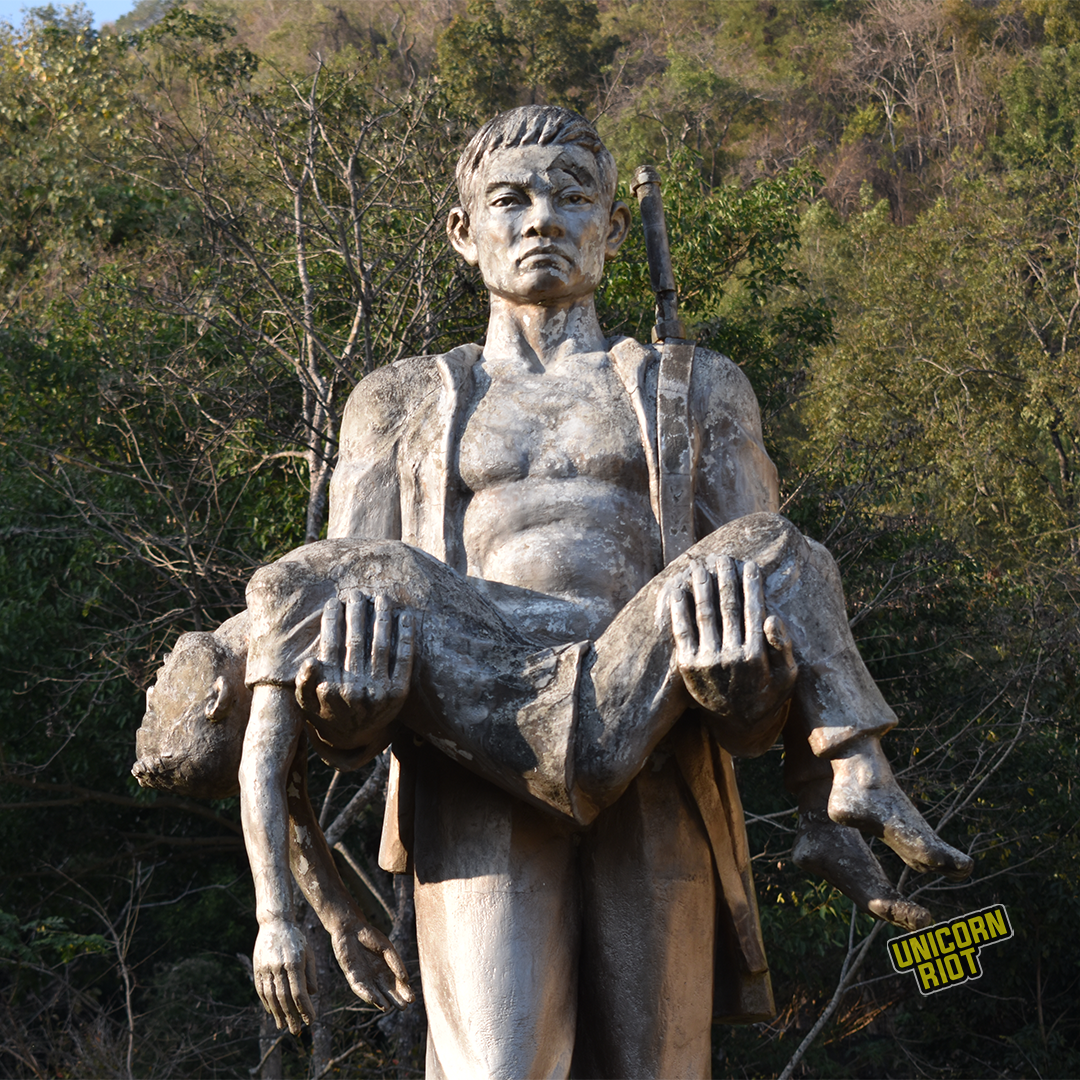
A statue of a man holding a dead child greets visitors at the foot of the mountain where Tham Piew Cave is. The cave served as a refuge for villagers after their homes were destroyed by American bombs. On November 24, 1968 an American jet fired a missile into the cave, killing 374 men, women, and children. Inside the dark cavern is an endless array of stone cairns, and Buddhist and animist offerings to honor the dead.
Laos was saturated with bombs, napalm, and cluster munitions by the U.S. In total, over 2 million tons of ordnance was dropped across Laos in over 580,000 bombing missions. That’s equal to a planeload of bombs unleashed every eight minutes, 24 hours a day, for nine long years. The vast majority of victims of the bombings were civilians. Laos is now known as the most bombed country in history, per capita.
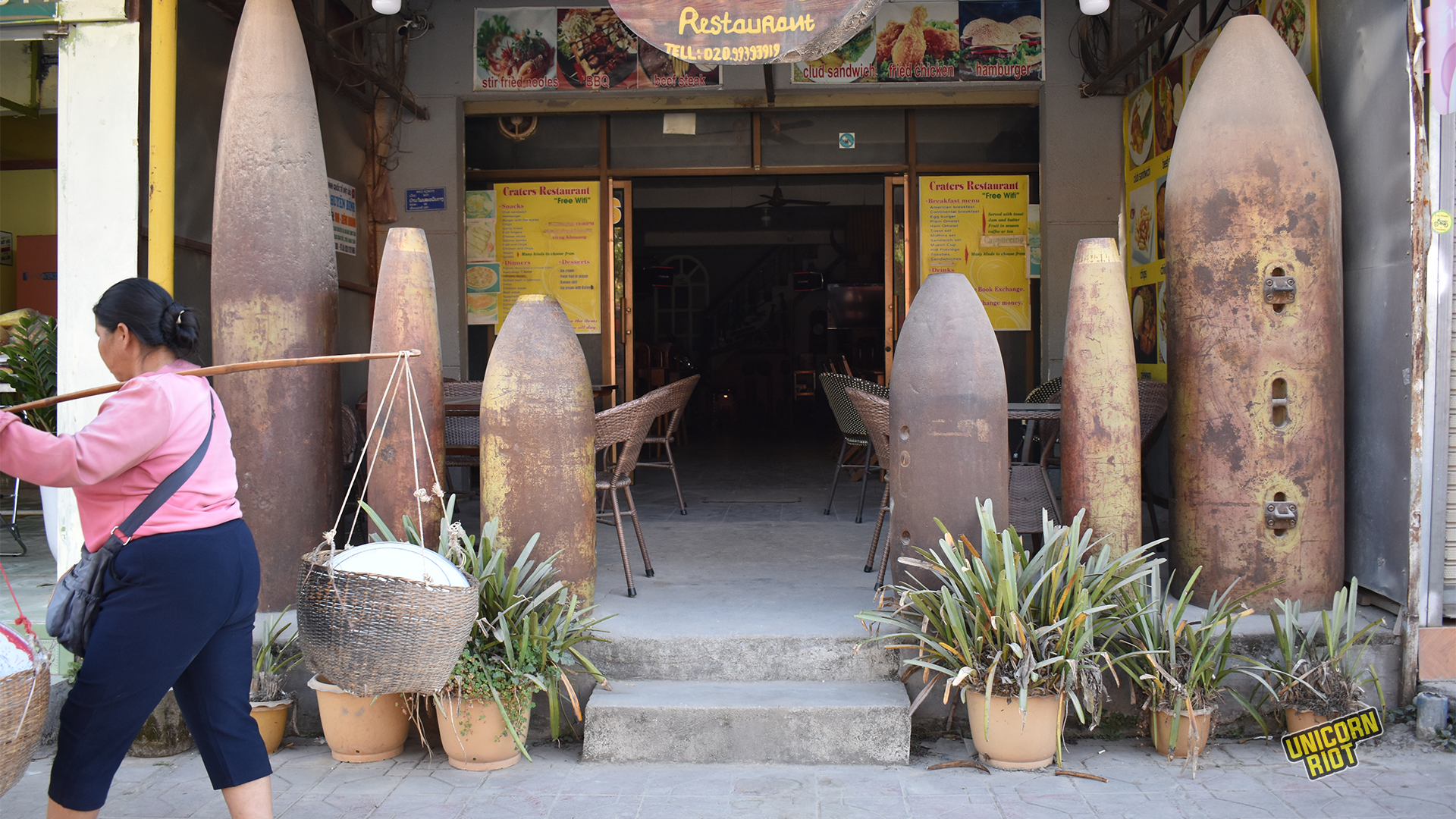
Other grim reminders of the war saturate the landscape. On the crumbling back country roads of the province, defused bomb shells are used as building structures and garden beds. In Phonsavan one can see bomb shells used as decoration at restaurants and shops.
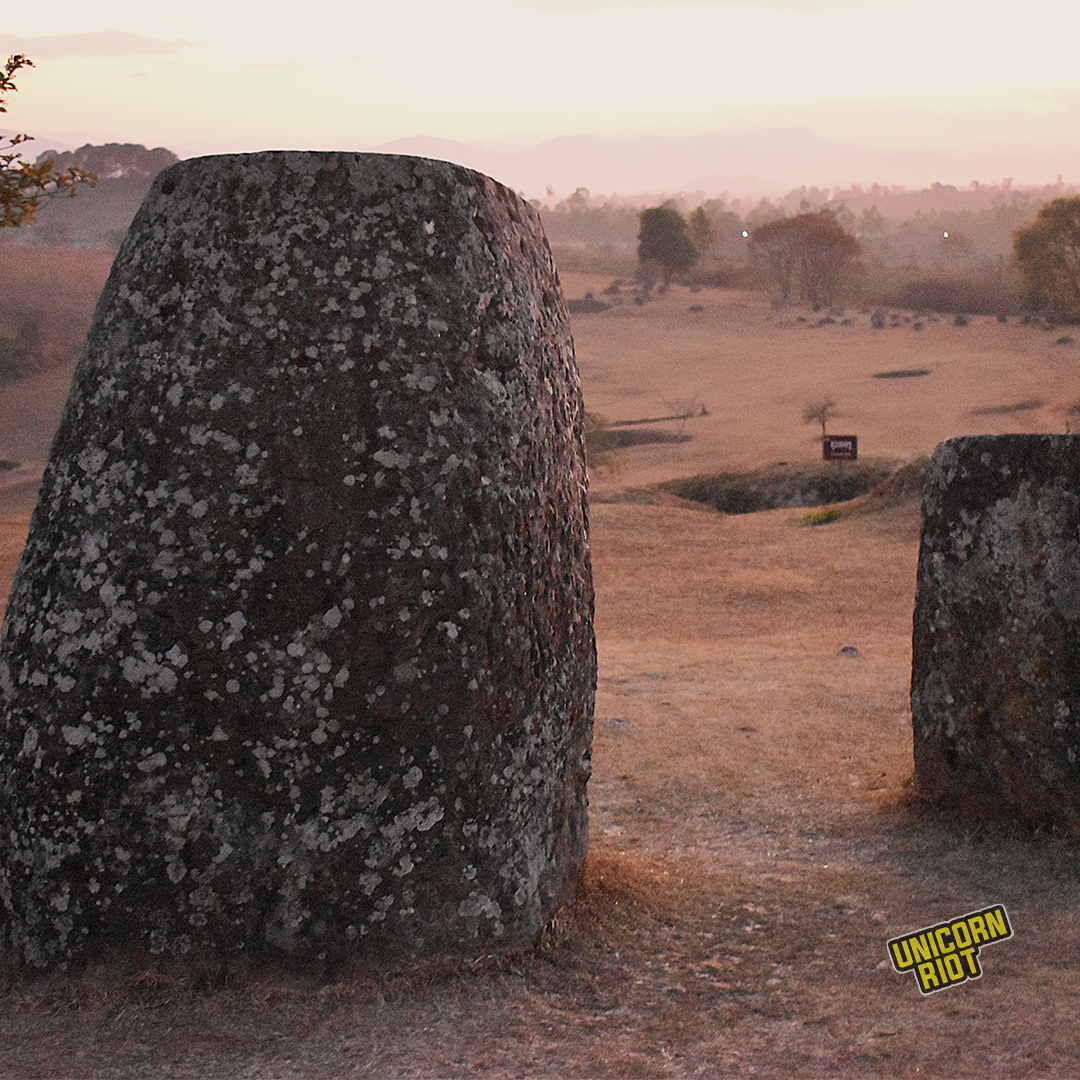
The ancient Plain of Jars UNESCO World Heritage Site, with its stunning array of thousands of massive stone jars dating between 1,600-3,200 years old, wasn’t even spared by the U.S. Air Force. One of the jar sites favored by locals for its stunning sunsets was the site of a fierce battle during the war. B-52s left deep scars in the fields with bomb craters and destroyed jars.
American military power in Vietnam, Laos, and Cambodia eventually came crashing down, but at the cost of over 4 million lives. In 1975, the Pathet Lao declared victory. The daily bombings finally stopped.
“When the planes left, the danger did not.” says Sera Koulabdara who runs the organization Legacies of War. “Today vast amounts of land remain contaminated with unexploded ordnance (UXO),” she says.
Over 30% of the bombs the U.S. dropped failed to explode on impact. They have haunted Laos ever since and have claimed over 20,000 lives, and injured over 30,000 people. The casualties across Southeast Asia from UXO are around 200,000. That number slowly climbs every month.
Sera Koulabdara grew up in southern Laos. She had an acute awareness of UXO from a young age. Her parents dedicated their lives to assisting UXO victims. Her mother sewed special clothes for survivors who lost limbs. Her father was a doctor. A painful memory from her childhood is of her friend who was injured by a UXO blast. In order to save her friend’s life her father had to do an emergency amputation of her leg. She vividly remembers the screams of her friend’s mother, and looking at her father’s blood-soaked clothes.
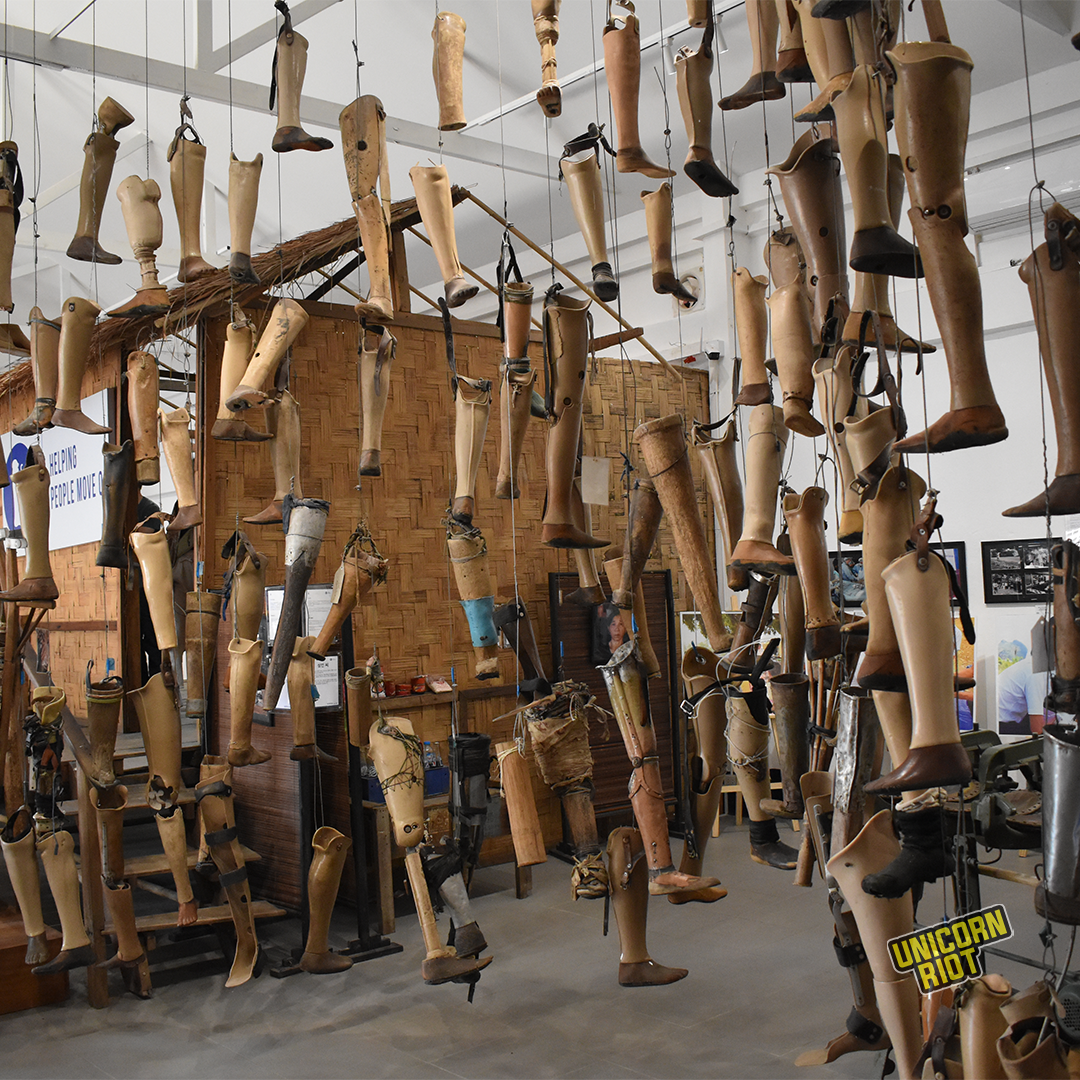
Cluster munitions are the major killer in Laos. “They have been proven to be an ineffective weapon on the battlefield but a deadly weapon proven to kill or maim innocent civilians,” says Koulabdara. She says that 97% of cluster bomb casualties globally are civilians, and 60% are children.
The cluster bombs the U.S. dropped over Laos were designed to open up mid-air, then release countless submunitions – “bombies” as locals call them – that would explode and release shrapnel in an area as large as five football fields, says Koulabdara.
The shrapnel from some of the bombies was made out of plastic and fiberglass to make it impossible for doctors to detect anything from x-rays.
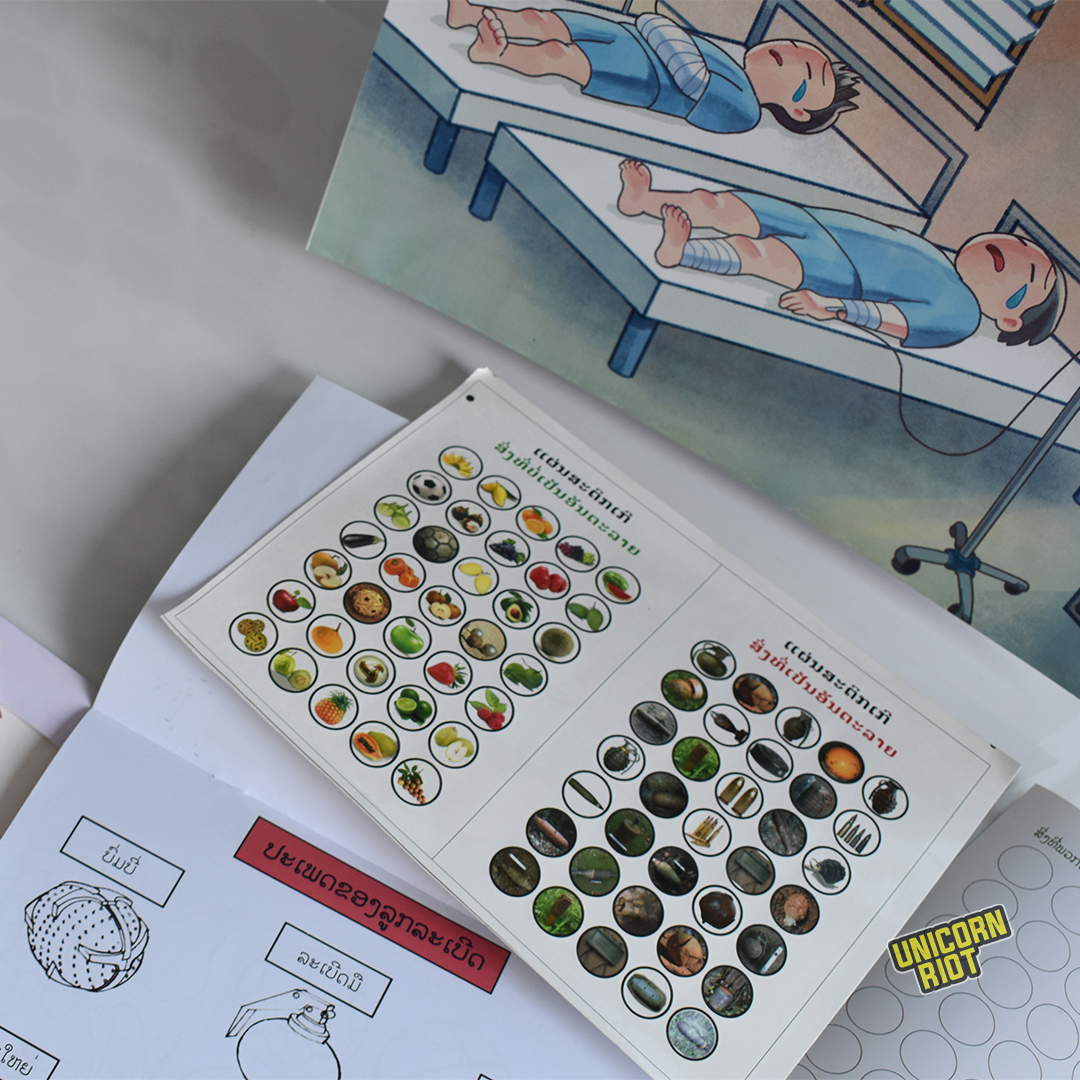
The government of Laos is dedicated to cleaning up the deadly mess left behind by the U.S., and has made it a national priority. An entire ministry was formed to clean up the bombs. Thousands of government and NGO workers in Xieng Khouang province alone work tirelessly to tackle this issue. The government is also a global leader in the Convention on Cluster Munitions which bans the production and use of cluster bombs. There are 124 states that committed to the treaty, but the U.S. has refused to sign on.
A slew of NGOs work with the government in its fight against UXO. Mines Advisory Group (MAG), the U.K. based NGO that assists communities impacted by landmines and UXO, has a major presence in Laos. MAG trucks filled with local workers who are sent out to clear bombs are a routine site in Xieng Khouang province. One Japanese NGO that tackles this arduous work is Terra Renaissance. They have an office just down the road from where May Sinoun lives.
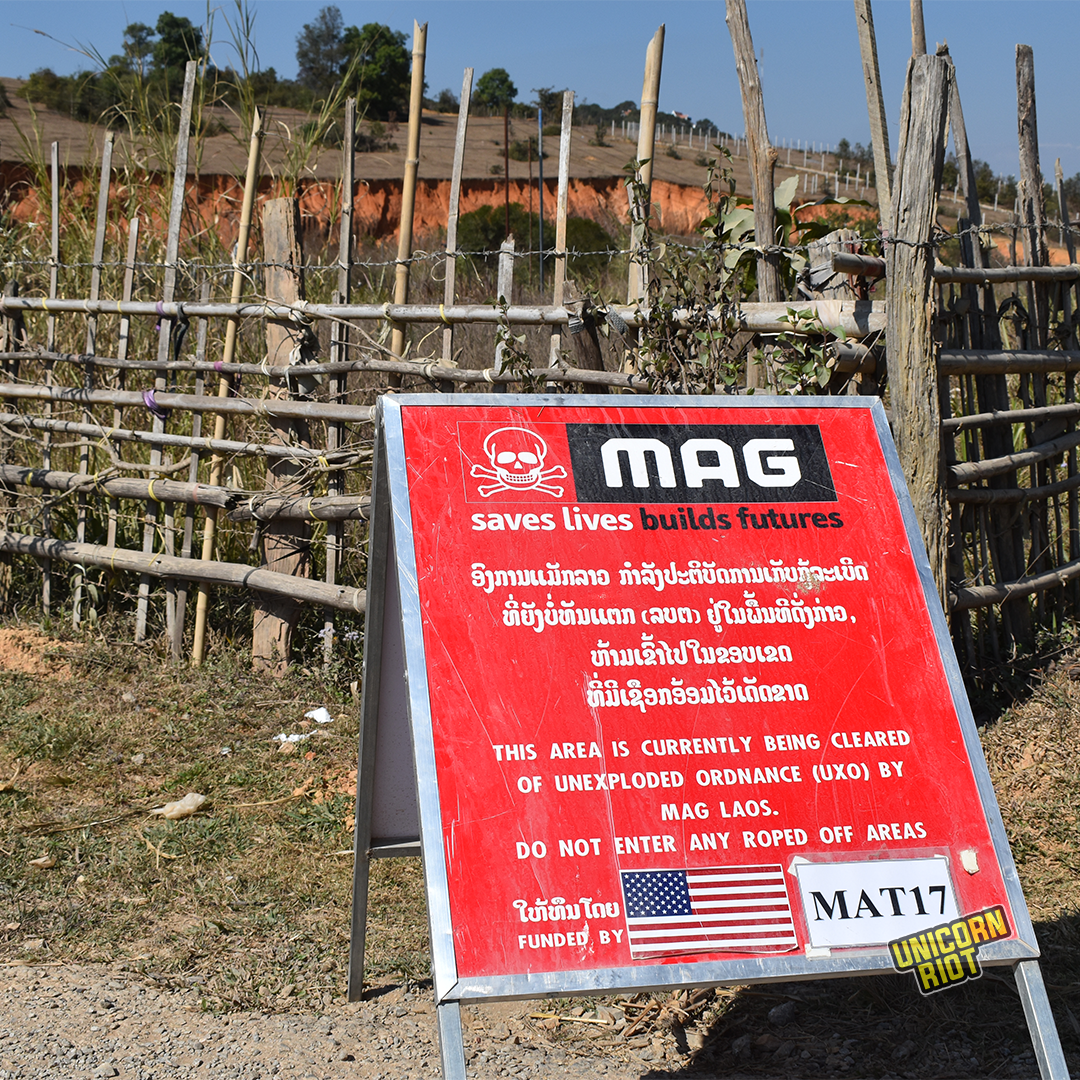
Uthen Phonekhampan who works for Terra Renaissance says that much of what the NGO does is educational work. For now they focus their efforts on 25 schools and 22 villages. They use a combination of songs, puzzles, games, and pictures to teach young children about the different kinds of UXO, and what to do if they find any. The difficulty, he says, is that the bombies are everywhere, and many can be mistaken as toys or fruit. Children and farmers are the most at risk.
“I come from a farming family,” says Phonekhampan. “It’s difficult to do agricultural work. Digging the ground and burning can be very dangerous,” he says. Last year, his mother found a bombie while she was farming. A team was sent out to defuse the bomb, but he and his parents were shaken by the incident. One wrong move could have spelled tragedy.
Some areas in his village were cleared of UXO but not everything yet. Crews check the ground 20-50cm but not beyond that. If anyone needs to dig deeper for construction, they need to register with the government, he says.
There are some UXO incidents that weigh heavily on his conscience. Tragedy befell Nakhamphaeng village in November 2021. “We were preparing to do activities and the accident happened one day before we implemented the activity,” he says. Four children found a bombie, and one grabbed it and threw it away. It detonated in the process, injuring all four. “After implementing our activities in school, kids learn to report the bombies. This education can save lives,” he says.
In addition to educational and preventative work, Terra Renaissance also helps UXO survivors become self-sufficient. The NGO built a school, and set up cooperatives in chicken farming, tree planting, sewing training, and harvesting honey. “The plan is to give training and support so victims can stand on their own,” says Phonekhampan.
People in Laos have found creative ways to make a living out of the ashes of the war. One small village has built an entire micro industry over the years out of the war remnants. Villagers melt the aluminum of UXO down and forge it into spoons, chopsticks, keychains, even little elephants. Vendors at markets across Laos sell the items. It’s hard to find a restaurant in Phonsavan that doesn’t use spoons from the village.
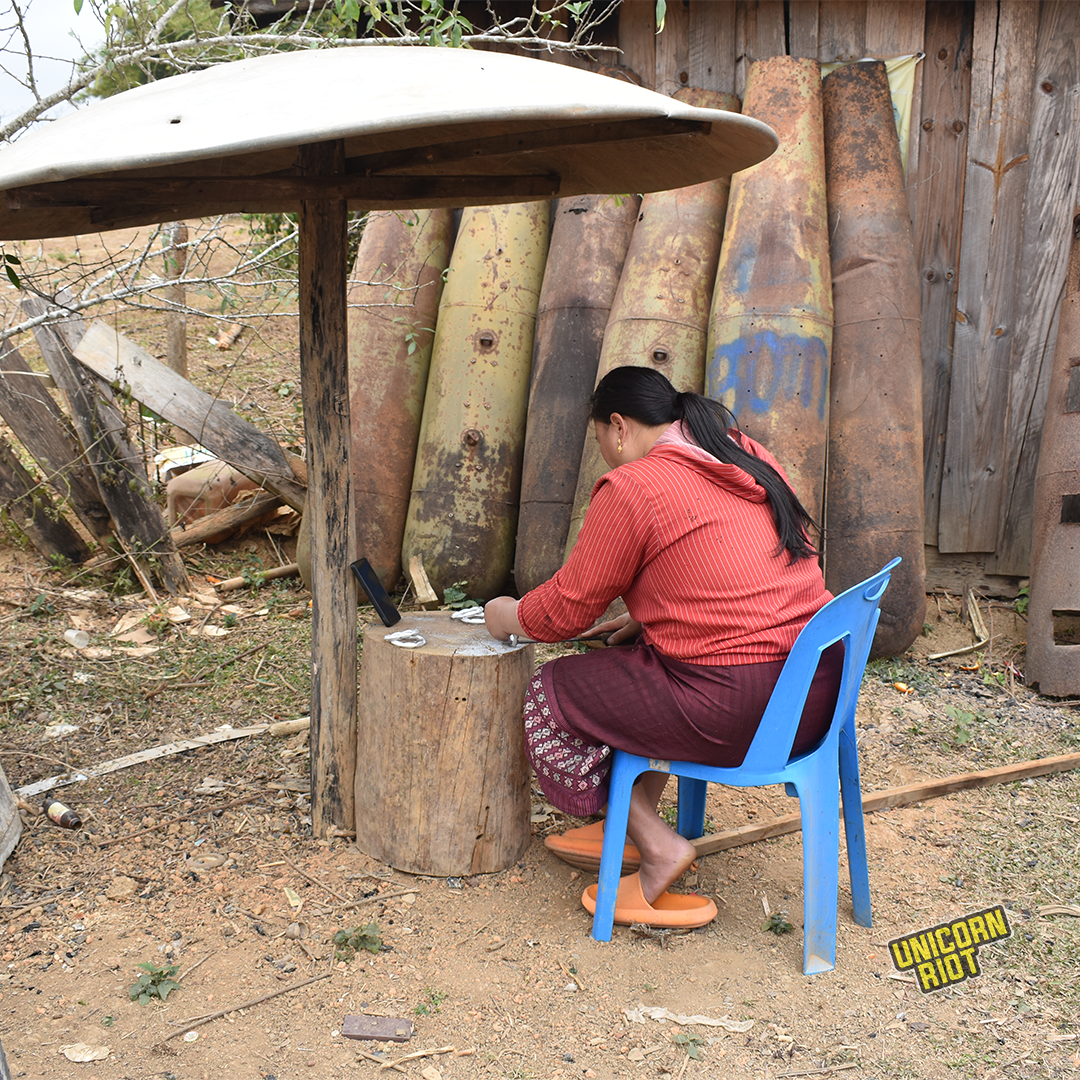
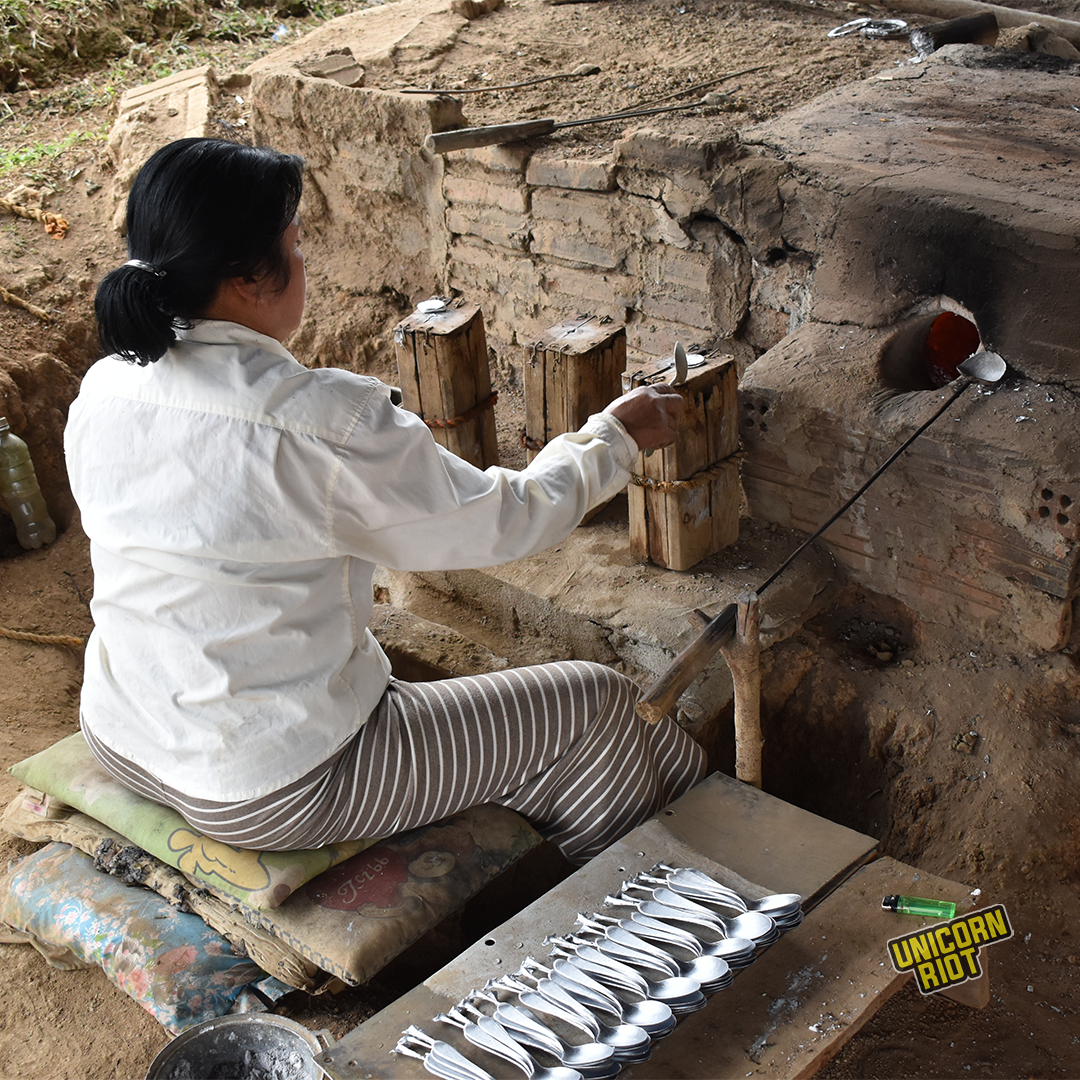
“We have been doing this since the year 2000, but the older generations, the grandparents, started even before that,” says Sengphet Khounpasert, who manages one of the shops. It’s a modern version of beating swords into ploughshares. “This is a source of pride and joy for us,” he says.
Since the war ended, finding UXO, defusing them, and selling the scrap metal has been a very dangerous source of income for those brave and desperate enough to do the work.
Eliminating the menace of UXO is a monumental task beset by incredible obstacles. U.S. President Trump gutted much of the funding for UXO cleanup in Laos during the freeze on foreign aid. While groups like Legacies of War have been successful at securing millions of dollars to fund the cleanup, the amount of money the U.S. gives in aid pales in comparison to the money put into the war effort. The U.S. spent on average 2 million dollars a day to bomb Laos – that’s 19 million dollars adjusted to current inflation rates.
Uthen Phonekhampan gives a harrowing estimate on how long it will take to clean up all of the bombs in Laos if it continues at the current rate. “One thousand years,” he says. Still, he continues the necessary educational work he hopes will save more lives.
Sera Koulabdara knows that the struggle ahead is long, but she sees how it changes people. “Clearing UXO is not only about removing bombs from the ground. It is about restoring trust in the earth beneath your feet. It is about giving families the freedom to farm, build, and dream without fear,” she says.
Legacies of War has connected Lao youth in the diaspora, American activists, and U.S. military veterans who fought in Southeast Asia, with the people of Laos to take concrete action to address the never ending legacy of the war. “We have witnessed the extraordinary power that emerges when people come together across borders, generations, and experiences. The challenge of UXO is immense and yet, we have hope. We created a space for dialogue, empathy, and healing that is nothing short of transformative,” she says.
In the village of Muang Khan, which sits just south of Tham Piew Cave, a dozen MAG workers are gathered outside the open air market. They’re part of an all-woman team that is tasked with finding and defusing bombs. They exchange jokes, and chew on bits of tamarind, casting the shells and seeds in the dirt. This is their last moment of relief before weeks spent in the field, far away from their families, looking for bombs. One of the workers says she is scared at times to do the work, but it’s important, and it has to be done.
Their supervisor gives the sign to leave, and they quietly load into their work trucks. As day turns to dusk, they slowly drive off into the mountains, risking their lives so that Laos can some day, finally, be at peace.
Follow us on X (aka Twitter), Facebook, YouTube, Vimeo, Instagram, Mastodon, Threads, BlueSky and Patreon.
Please consider a tax-deductible donation to help sustain our horizontally-organized, non-profit media organization: