Trump’s AI National Policy Framework: An Attack on States’ Rights?
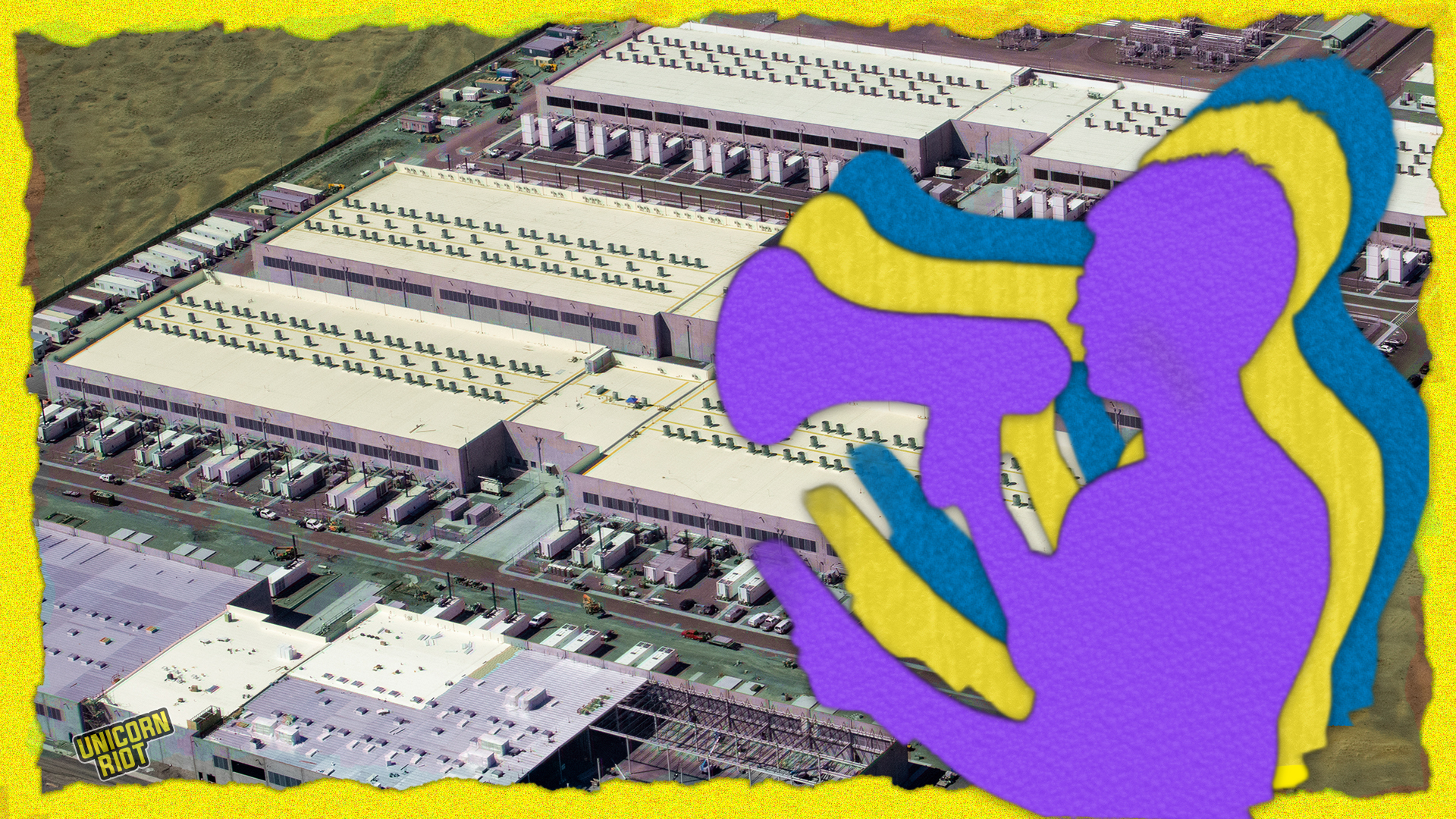
This week, Oklahoma City banned AI data center development until the end of the year, caving to community pressure. A similar moratorium was passed by the Tulsa City Council a mere month ago. And these decisions are increasingly being made at the local and state levels across the country. At least 11 states — including South Dakota, New York, Maryland, and Georgia — have temporarily banned or placed restrictions on the development of AI data centers, according to a regularly updated tracker published by Visual Capitalist.
As a result, and because of supply chain holdups, nearly half of the AI data centers planned for 2026 in the U.S. have been delayed or canceled. And the outlook isn’t any better for 2027 and beyond.
As we detailed in Data Centers, the Climate Crisis, and Community Defense, this is the environment in which U.S. President Donald Trump released his new national policy framework for AI, which would ban states from regulating AI development on their own land, as well as protect AI companies from any liability when someone uses their model to cause harm or break the law.
These facets of the policy framework are not readily accessible on the whitehouse.gov or ai.gov site; a Google search produces a pdf that buries them on the bottom of the last page.
“Trump’s attempt to force unregulated AI down the throats of the entire United States is not only on the wrong side of history and democracy, it’s on the wrong side of a growing cauldron of popular rage,” New York University professor and popular podcast host Chenjerai Kumanyika told Unicorn Riot.
“The hundreds of thousands of jobs that corporate leaders have stolen while drunk on AI hype, the chatbots talking our children into [killing themselves], the violent colonialism and extraction of data centers — and the tech leaders attempting to block any form of accountability. People see what’s going on. We are witnessing the birth of a massive multi-partisan movement against what we are being told is inevitable.”
Chenjerai Kumanyika
Corynne McSherry, legal director for the Electronic Frontier Foundation, pointed out some of the positives of the administration’s latest federal AI framework, including “the suggestion that Congress should leave the issue of whether AI training is fair use to the courts” and the acknowledgement that Congress could prevent the government “from exerting pressure for generative AI to align ideologically with government interests.”
However, she told us, “the framework proposes a few ideas that would be disastrous, such as barring states from enacting protections for their residents” — and, “given the high level of the framework, the devil will be in the details.”
So, how would it work? “The federal minimum wage is $7.25. The minimum wage in New York State is $16,” said Hagen Blix, co-author of Why We Fear AI. “Imagine a world in which states didn’t have the right to set a local minimum wage.”
For now, at least, it’s only a proposal; “thankfully, non-binding,” as Slate tech writer Nitish Pahwa put it. And, he added: “If Trump were to actually try to preempt all state-level AI regulations, he would receive quite a bit of blowback — from his own supporters.”
Stephen C. Rea, senior researcher at Critical Internet Studies Institute, agreed, adding: “It’s a contradictory position to take for an admin that has also argued states are the only ones that can regulate reproductive health care.”
Related: Data Centers, the Climate Crisis, and Community Defense
Cover image contributed by Phil Mandelbaum using photo by Taylor Vick.
About the author: Phil Mandelbaum is an award-winning journalist, a co-creator of the content services division of The Associated Press, a nonprofit and political strategist, and an organizer and artist, also known as awkword.
Follow us on X (aka Twitter), Facebook, YouTube, Vimeo, Instagram, Mastodon, Threads, BlueSky and Patreon.
Please consider a tax-deductible donation to help sustain our horizontally-organized, non-profit media organization: