‘My Husband Rapes Me Every Night’: How a Volunteer-Led Organization is Ending the Cycle of Violence in Bhavnagar, India
Content advisory: The following article contains descriptions of extreme sexual violence.
Bhavnagar, Gujarat — I look at her arm. It’s riddled with black puncture wounds that look like they’ve been used to let all the air out of her.
That is what she tells me has happened to her. I reach out for it, gently at first to ensure I’m causing no pain, then firmer, a squeeze of haplessness.
There’s nothing else I can do for Gauri, whose account of rape by her husband has spilled into my phone recorder and into the increasingly shrinking distance between us over the past hour.
Muskan Gill, a volunteer with the SNEHA Foundation, sits nearby, ready to jump in with a translated verb or idiom, Hindi from Gujarati, should she need to. (Note: “Sneha” is a shared word in many Indian languages which generally means “love”.) The rest of the fortnight, my basic level of Gujarati and very good Hindi carry me through, but — Gauri is different. Her account requires multiple levels of linguistic uncoupling, simply because it is multiply layered.
It tells the story of the whole block, in Sundargarh.
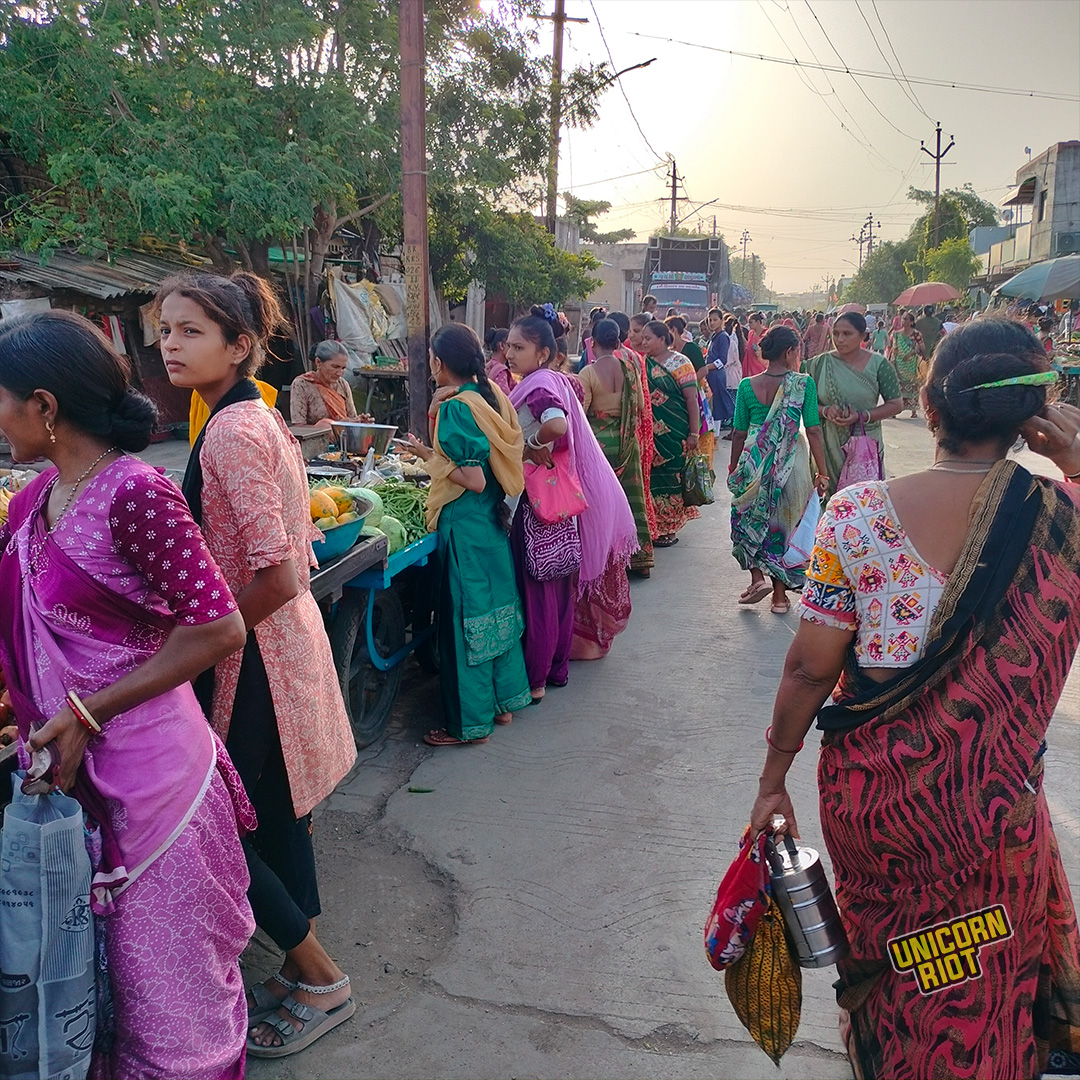
Sundargarh is a large locality, in the small city of Bhavnagar located in the very large Indian state of Gujarat. It is close enough to the sea to drive to it, inducing exultation — on the way — at the stockpile upon stockpile of white salt dredged in by workers from an extremely saline Gulf of Khambhat, the bay that supplies a major portion of Gujarat’s, and the country’s, salt. From a distance, they flicker like mirages.
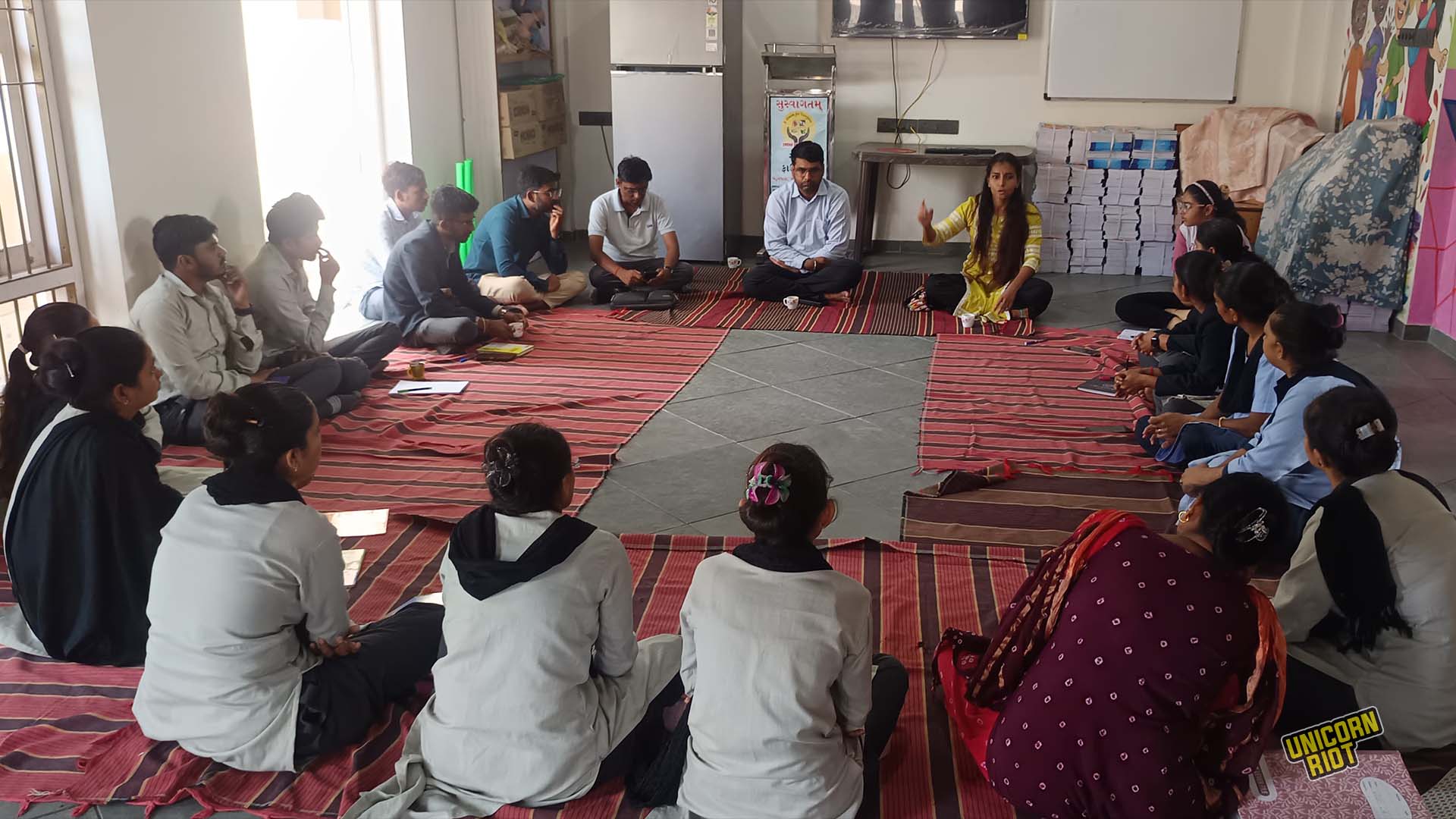
Some homes in Sundargarh — at least the ones SNEHA Foundation works with — are built like that: mirages you must get closer to, to restructure. That is what Gurprit ji does. When Gurpritsingh Gill, a 38-year-old ethnically Punjabi man born and raised in Bhavnagar, Gujarat, decided against joining his father’s business to open an NGO, he was mocked. But there were many mirages to manage, he tells me — many he wanted to.
“They thought it was frivolous — friends asked how I would make any money.”
Gurpritsingh Gill
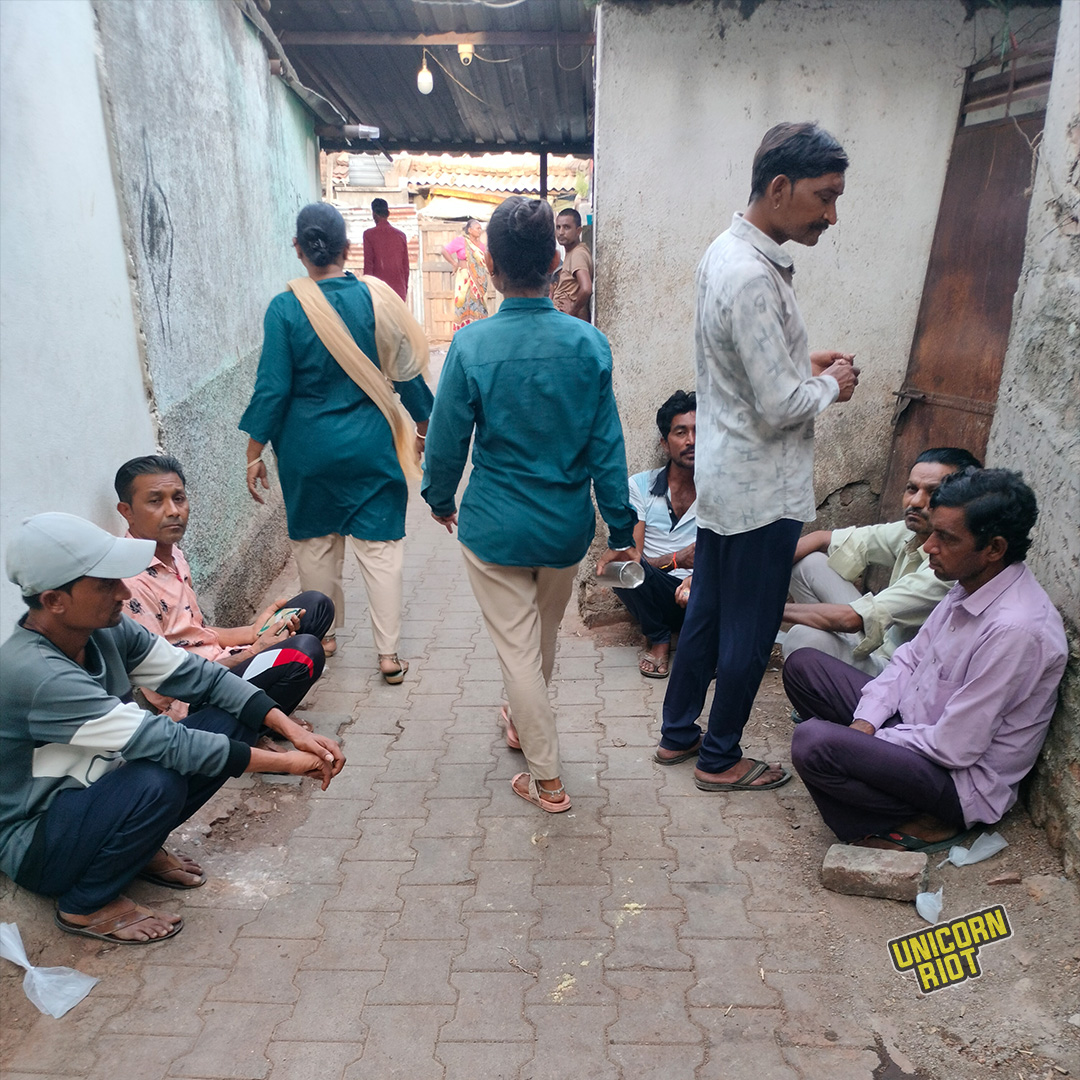
Without expressly articulating it, the implied insult of de-masculinity hangs in the air. I see it too, in unique ways: over the hours that we sit, chatting, in office rooms or take strolls along Sundargarh’s tiny misshapen gullies, we are interrupted by women who want an audience with him. They want to confide in him about husband, in-law, unpleasant home — I watch as they listen, despairing at first, then hopeful, when he finishes his treatise, advising police action, familial intervention, stern NGO word on their behalf. Once — after I’ve been there some days — Gill asks me to inquire after a woman case worker he has hired on his staff: she has been sporting intermittent bruises that concern him. He knows, he tells me, that her family isn’t supportive. I ask — but elicit nothing.
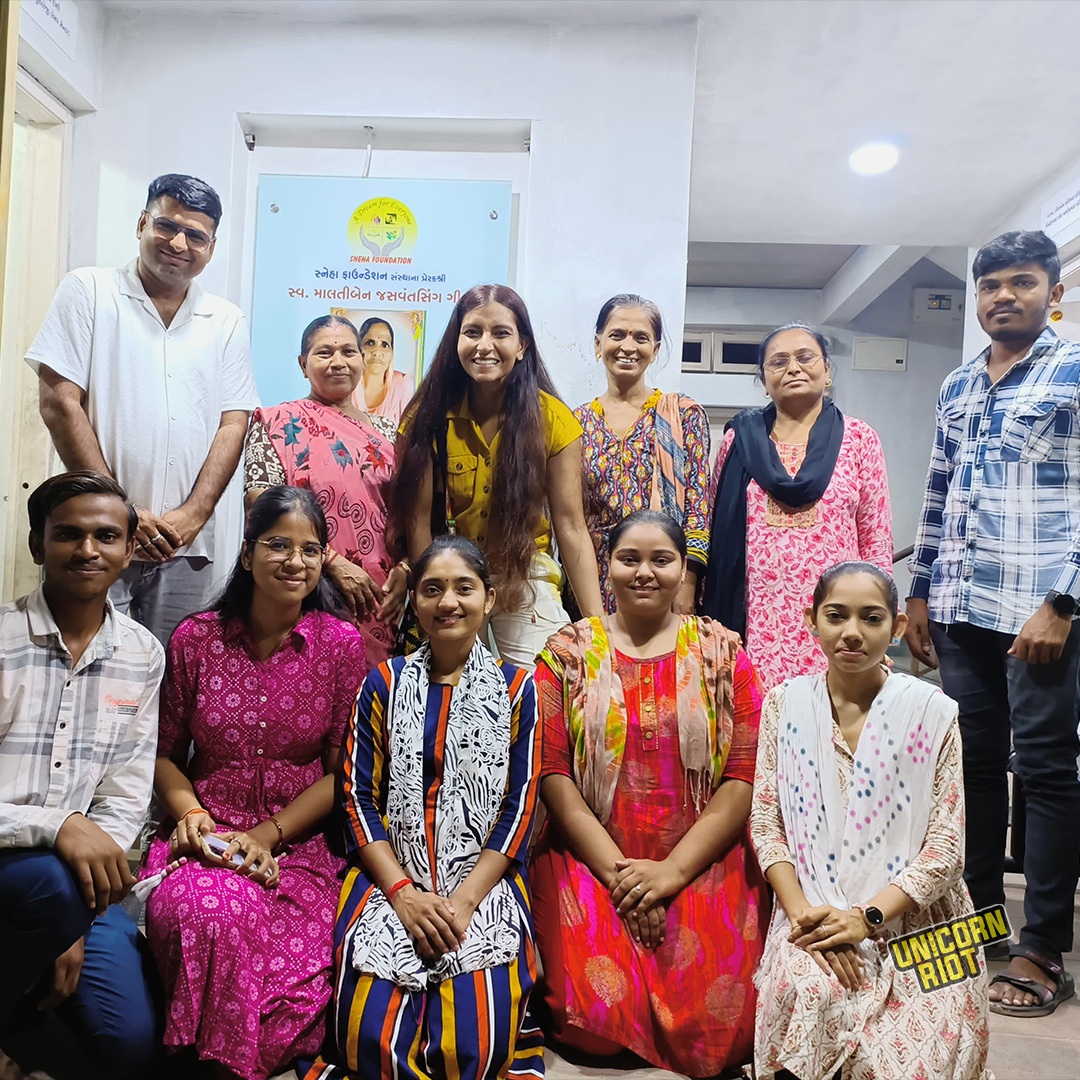
Another time he tells me of his failed interventions when I try to compliment him on how easily-accessible he is to the families in Bhavnagar — the reserves of empathy he must be able to draw on. “Hardly,” he smiles wanly.
“I wish I always knew how to help, but there are many times I struggle. Once, one of the women in the ‘community’ we were helping by putting her son in school came to me and told me she’d been raped. Women who were her neighbors told me the same story: her husband beat and raped her most nights, and they heard her cries most nights. I asked her if she would be willing to go to the police with me the next morning. She said yes. The following morning, when I showed up at her house while her husband was away, with a group of women case workers from SNEHA, she had changed her mind.”
Gurpritsingh Gill
No matter how much he pushed and prodded, he says, over several weeks, Shipra ben pretended the conversation had never happened. (Note: it is common parlance in Gujarati to add the ben- suffix to women’s names as a sign of respect.)
Colonial Ghost of India’s Marital Rape Problem
Shipra’s about-face is not so much a betrayal as it is a symptom of a glaring legal crisis India has been staring at for nearly two centuries. India, the world’s largest democracy, does not criminalize marital rape – despite being a signatory to the UN Convention on Elimination of All Forms of Discrimination against Women (CEDAW), which includes marital rape.
Under Section 375 of the Indian Penal Code (IPC) — the IPC, established in 1860 under British colonialism, is the main criminal code of India that outlines offences and corresponding punishments — the section that defines rape is written an exception to what counts as rape: “Sexual intercourse or sexual acts by a man with his own wife… is not rape.”
In the absence of legal nomenclature, then, how can the crime be verbalized as a “crime” by the marital rape survivor?
There are inherent contradictions between Section 375’s “marital rape exception” and India’s Constitution that was drafted after its independence from Britain. Created to be an extremely progressive document that took from the most egalitarian sections of other world democracies’ constitutions at the time, the Indian Constitution (of 1950) has been subjected to many amendments, since, to safeguard citizens. Here’s the conundrum: Article 21 of the Constitution outlines “the right to refrain from sexual activity for all women, irrespective of their marital status, as a fundamental right.”
This constitutional infringement, then, has been increasingly protested in the last decade — post the horrific bus gang rape and murder of a 23-year-old woman inside a New Delhi bus in 2012. In the wake of the incident that galvanized the world’s horror, India’s collective outrage took to the streets. In 2013, protest movement efforts culminated into the Nirbhaya Act, named after the government-accorded moniker for the woman who’d died. Nirbhaya means fearless in Urdu.
Officially named the Criminal Law (Amendment) Act, it professed to spell much-needed legal reform based on the recommendations of a three-member judicial committee known as the Justice Verma Committee, which had been formed to identify loopholes.
Yet, even as the government overhauled the rape law based on the committee’s recommendations, it refused to consider one of its most controversial ones: that India finally remove the marital rape exception.
Since then, however, petitions challenging the unconstitutionality of the exception have been filed at various lower and high courts. What is vital to note, is that the exception — consistently touted by India’s current Hindu majoritarian government as a “cultural holy grail” — has origins in British law.
The IPC — which is the longest-serving and continuously surviving criminal code in the common law world of today — was enacted by the British Indian government in 1860 during Britain’s colonization of India. It was influenced heavily by English Justice William Blackstone’s Commentaries on the Laws of England, which stated: “The very being or legal existence of the woman is suspended during the marriage, or at least is incorporated and consolidated [into her husband].”
This made its way into what was then-called the British Indian Penal Code, under Section 359 of which were the words: “Sexual intercourse by a man with his own wife is in no case rape.” The influence of the colonization of India on the marital rape exception becomes apparent when we consider that multiple Commonwealth countries — former territories of the British Empire — today retain the spousal exception to rape laws. Of the 52 Commonwealth countries in the world (PDF), 32 “permit, or do not expressly exclude” marital rape, 21 expressly criminalize marital rape, while one criminalizes the offense with a “lesser punishment.”
Even in the UK, marital rape was only criminalized as recently as October 1991. Since 1947, India has continued to shed abject vestiges of its violent colonial past post-independence. Women like Gauri, Shipra, and countless others oscillate, therefore, between a citizenship that should be fully theirs and a vocabulary that they’re told is not theirs.
How Cycles are Broken, in the Face of Legal Indifference
When I speak to Gauri in a small anteroom in the building that is also the NGO’s office, she tells me of the crisis she relives every day but stops short of calling it rape; the vocabulary is absent, the crime is not. “My husband and his family want a boy. So far, we’ve only had two daughters.”
Her daughters are not young — one, a teenager, the other almost 20 — “I married young and we had children young.” Yet, in her early forties and with her pleas of wanting no more children ignored, Gauri says she is coercively injected with hormone medication to stimulate her fertility journey.
Her arms and legs, and nearly every patch of bare skin unhoused by salwar kameez (note: this is a common South Asian dress-and-trousers ensemble), are punctured by tiny black bumps that, she says, are injection sites. Her husband and his parents insist that a son must be born — “they don’t value my daughters.”
Her older girl, she says, lives in a hostel close to her place of work; that place is often Gauri’s refuge when she wants to escape her husband and in-laws. She needs that, she says, because, most nights of the week, her husband forces himself on her.
For Gauri, who leaves the conversation in tears and embraces Muskan from SNEHA, and I who hold her in a six-armed huddle, marital rape is not merely the act of penetrative rape that her husband perpetrates on her; for her, it is also his refusal to wear protection, the household coercion to undergo a fertility journey in her forties, the routine beatings meted out to her on occasions of rebellion.
Gauri’s experience is vital to both how SNEHA has integrated understandings of marital rape into their day-to-day functioning — as well as into a growing body of world research that is currently expanding these definitions.
Data from a multi-country study conducted by the World Health Organization (WHO) found that the negative experiences of sexual coercion among the married young women surveyed included “…unintended pregnancy and non-use or inconsistent use of condoms.”
Another cross-sectional study (PDF) conducted in the Indian states of Gujarat and West Bengal found that research studies underestimate the extent of sexual violence in marital relationships – and that questions focused only on “forced sex” and not on use of contraception or reproductive agency, among others, led to that underestimation. In fact, if “forced sex,” the study claimed, was not also associated with physical abuse, then marital rape survivors were less likely to report it as such.
Gurpritsingh Gill coalesces. “We have instances of marital rape and domestic violence that are so chronic and so interwoven into the household fabric that many of those women can’t complain because they don’t know any different. Some of the women don’t complain because they’ve been told what happens within the home stays within the home. Some are worried for their children and what will happen to them if they’re turned out of the house with no money.”
His experience is in line with a study conducted in 2011 among approximately 900 married young women in southern India: women with skilled occupations were found to be less at-risk for intimate partner physical violence than women with no jobs. If that study hypothesized that increasing women’s job skills would offer protection from violence and increase her social networks, then Gill has been doing just that since the organization’s founding in 2008.
During my two-week-long visit, I look at pamphlets and promotional material the NGO has been creating — and one day, find myself looking at enthusiastically produced sheets for potential Corporate Social Responsibility (CSR) partners. India is the first country in the world to legally incorporate CSR for companies, whereby the latter must engage in activities of social progress.
For SNEHA, money raised through CSR is a huge component of how they fund their programs. The sheet I look at proposes to “train young women [through]…Sewing Machine Training and Beauty Parlour Training…to break the cycle of struggle.”
That last bit is important to Gill and his colleagues and case workers at the NGO; “we have observed that there is a chain. The harsh truth is, that we may not be able to help a lot of the older women, whom one has known to have lived with marital violence. Try as we might, many of them are set in their ways and won’t complain or approach the police. I’ve had the police commissioner of the area personally tell me to notify them of reports of domestic violence. But how can I, when the women, then, back away?”
Instead, Gill says, the aim is to ensure that future generations don’t suffer. “Multiple girls and boys in the locality grow up watching their fathers beat their mothers, rape their mothers, repudiate her agency, her ability to leave the house. Girls grow up thinking that’s ok… that if they’re beaten, raped, there is no recourse, the boys — they grow up to be perpetrators of violence themselves.”
I find this borne out in the weeks I spend renewing friendships I’ve forged over past visits and being invited to endless cups of chai and food at women’s homes.
When Latika ben and I talk, she is garrulous, ready to explicate her troubles: yes, her husband can be a violent man, he has an extramarital affair with a younger woman, she tells me readily; certain nights, if he hasn’t been able to make his dalliance, he will return home to beat her — then rape her. Early on, she had attempted to stage a protest, shriek, etcetera, she says not anymore: not since he smashed a glass in her face and told her, her body was his for the taking, that she should just lie down “and take it.”
We talk for a long time, interspersing dark conversation with light walks around her slum where pigtailed adolescent girls keep time with our footsteps; I ask her, if she recognized it was rape immediately. She hesitates, she doesn’t have a stolid response: “What can I do? He is my husband.”
Usha ben is far more reticent — her young son is playing right outside the window. Multiple times, she stops mid-sentence of her recounting violence to changing the subject when little Naresh pops a curious head in. “I love my children,” she maintains. “Therefore, I cannot leave him.”
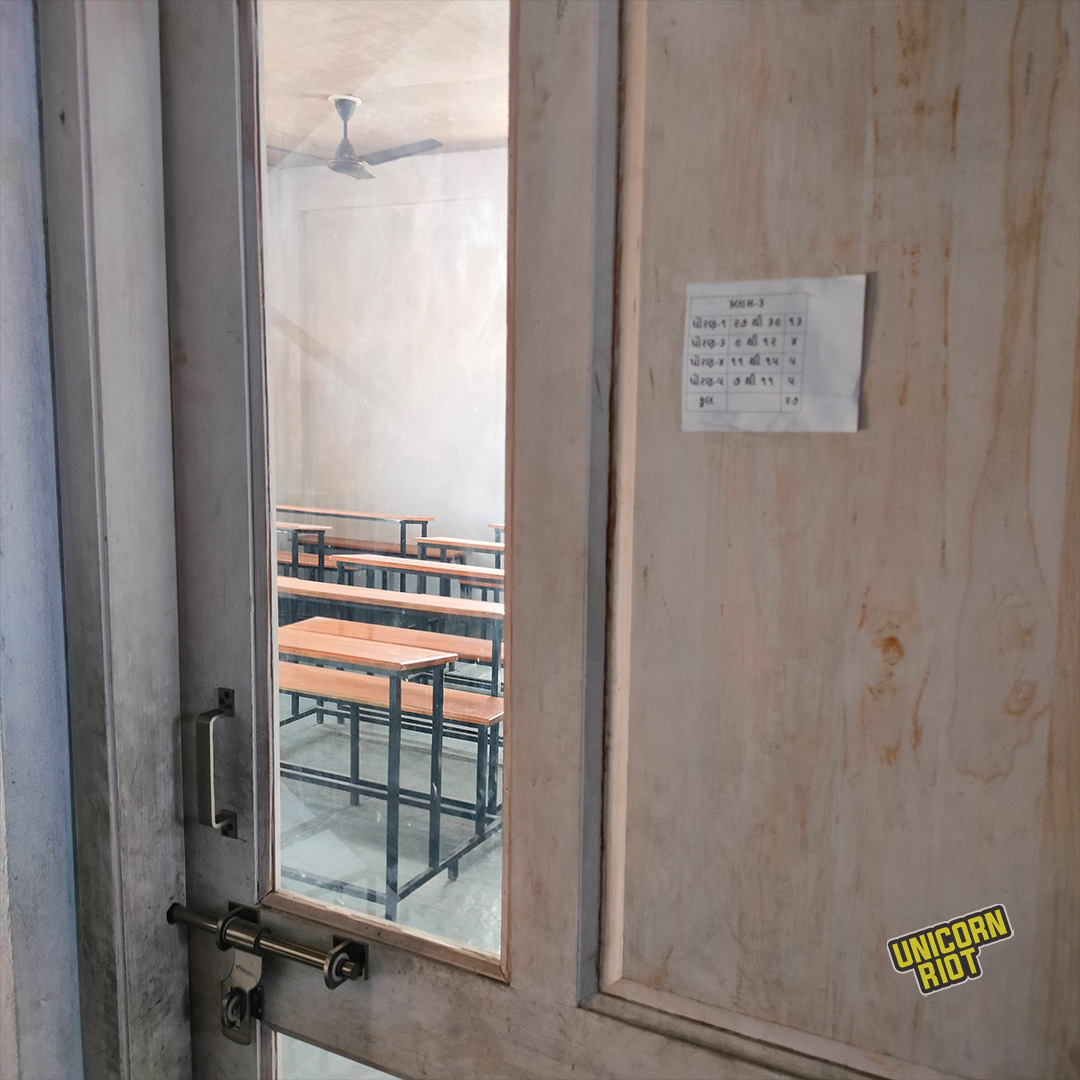
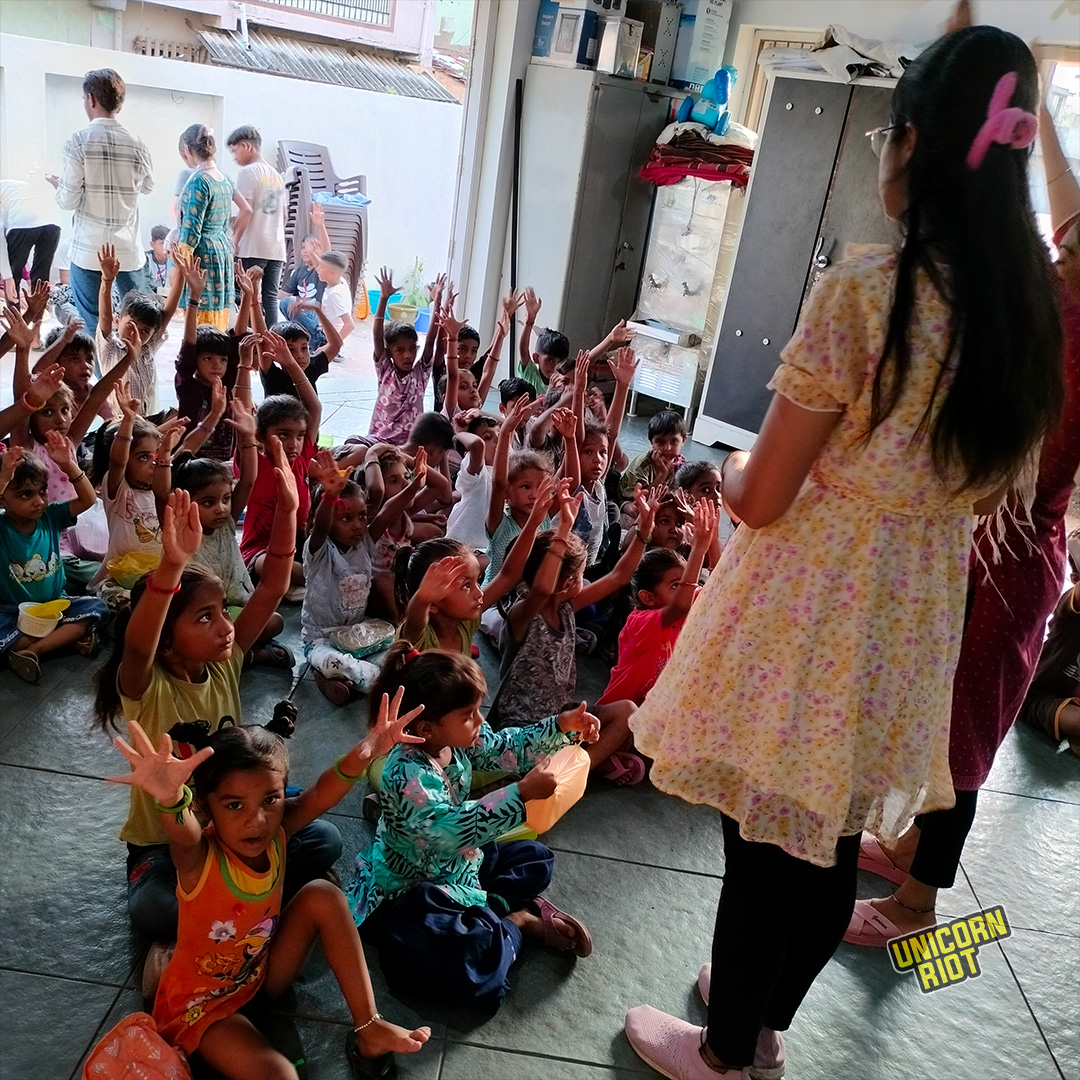
That children are often constantly around to witness the patterns of violence at home and the ways in which they are muzzled, is also a fact that SNEHA’s team acknowledges: “Many of the daughters, when they become adults and begin to earn a living, help move their mothers out of those homes. They become their support systems,” says Muskan Gill, who conducts tutoring sessions for some of the children of these families for a couple of hours in the evening, six days a week.
Her tutoring is another vital cog in the wheel of SNEHA’s functioning; along with the skills programs for young women, the NGO in 2025 launched a primary school serving grades 1 through 5 to better upend that “cycle” that Gill and his team care about. To ensure they’re able to hear students one-on-one about their experiences at home, tutoring sessions like the ones Muskan holds are important.
One of the male teachers tells me he has had a hard time wrapping his head around young boys spewing expletives in class: “Despite my warnings, he wouldn’t stop. Later, upon further investigation, I found out why – he has a troubled time at home, constantly hearing his parents argue, watching his father beat his mother. Once I was able to get to the bottom of the cause, I was able to be more empathetic.”
His strategies, he tells me, have included thinking up hobbies for the children to participate in, or new sporting activities that will draw their energies elsewhere.
“The thing to realize is that these places in Bhavnagar are just a microcosm of larger systemic problems. And we must get creative,” offers Gurpritsingh Gill.
Fighting the Law with the Constitution
Outside legal channels, if a marital rape NGO must scrabble together band-aids at the grassroots level, marital rape activists now storm the Indian judiciary for a legal intervention that can filter down to Gauri and Latika and Usha — and, for the women and girls to come, after demanding full citizenship.
Currently, multiple petitions are being heard by state high courts and India’s Supreme Court that challenge the validity of the marital rape exception. Delhi-based NGO, RIT Foundation’s petition was one of them.
In 2022, however, a two-judge bench of the Delhi High Court delivered a split verdict on the matter — while one warned against “judicial overreach,” the other deemed the exception to be “unconstitutional…(and) undermining married women’s fundamental rights.”
RIT Foundation founder-president Chitra Awasthi now states that she plans to appeal the decision at the Supreme Court. “The biggest counter to removing the marital rape exception, from opponents, is that it ‘will be misused.’ Well, what law isn’t? The potential ‘misuse’ of a law is always there. IPC Section 302 that lists punishment for murder, is ‘misused’ too – does that mean we should stop trying cases of murder?” Awasthi’s reference to “misuse” is politically relevant right now: as petitions decrying the marital rape exception have mounted in court, a growing number of men’s rights activists (MRAs) as well as online trolls have called such a movement “dangerous” and “a recipe for disaster.”
An MRA group called “Save Indian Family Foundation” actually alleges that this is “an attack on Indian families by feminists,” a viewpoint reinforced by India’s right-wing Hindu nationalist government that says allowing marital rape to be “punishable” might “destroy the institution of marriage.”
Awasthi also counters the MRA claim that there is enough potential to punish offenders of marital rape under the existing Protection of Women from Domestic Violence Act (PWDVA), 2005.
“That is a civil statute, not a criminal one. So, there are definitely loopholes. Who’s going to address them?”
RIT Foundation founder-president Chitra Awasthi
Awasthi, who was inspired to file the petition after her foundation began to hear the traumatic stories of women who had undergone marital rape and were unable to access legal redress, has a point.
India’s PWDVA does aim to protect women in “domestic relationships” against, among other kinds, sexual violence. However, that Act provides civil remedies, which means (PDF) “no arrests can be made based on a complaint filed under the Act.”
Then, there is the contradiction with Articles 14, 15 and 21 of the Constitution that safeguards certain fundamental rights of Indian citizens that RIT Foundation, in its petition, has argued the exception violates. While Article 14 offers equality before law to all, — a right that RIT argues is violated by a distinction between married and unmarried women — Articles 15 and 21 are also violated, in that they safeguard a woman’s right to personal liberty, dignity, and life.
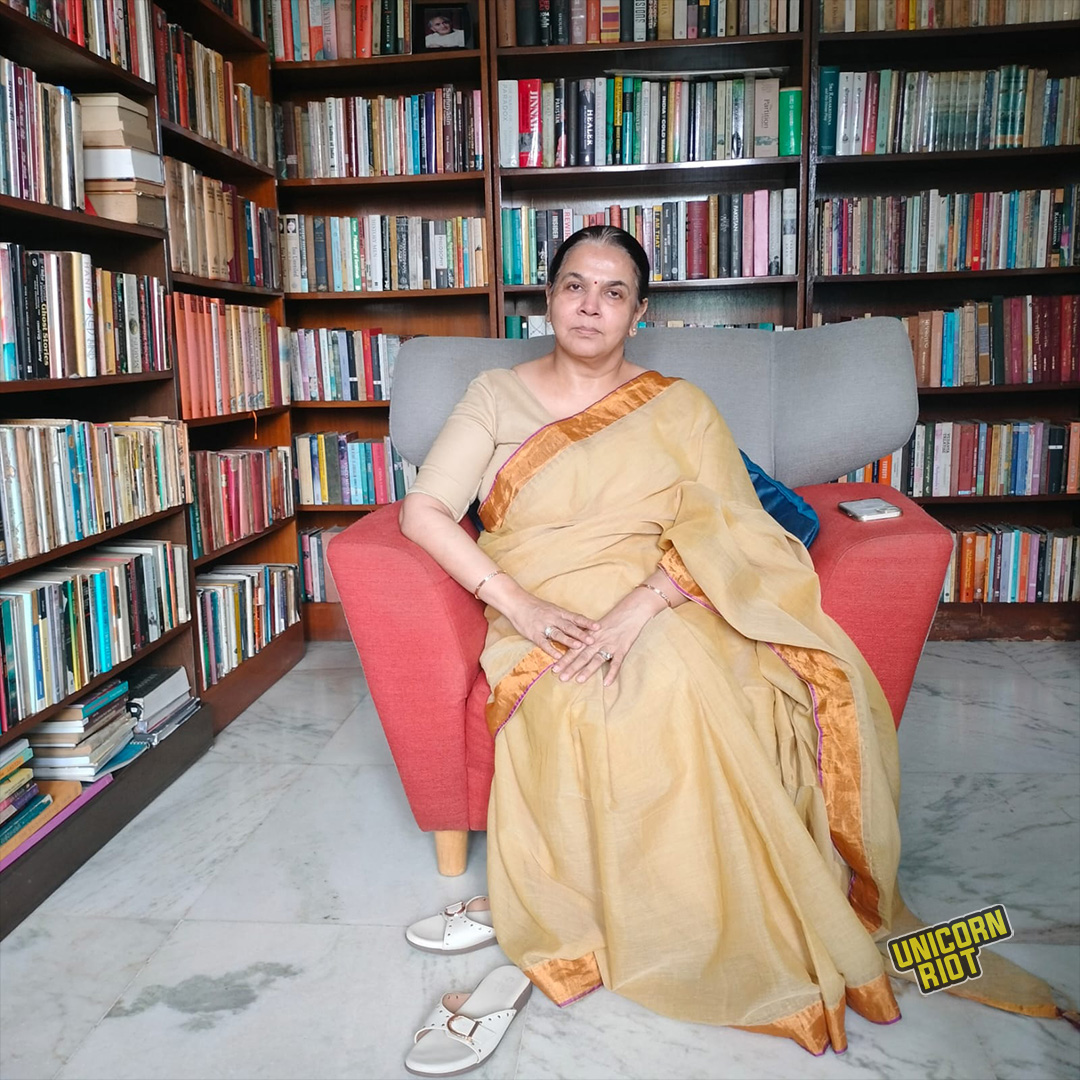
When I ask Awasthi a broad-strokes question about what she thinks is at the heart of the marital rape problem, she suggests it is “entitlement” and a “power game.… The idea is that you are superior to the other living being in the bedroom and must remain so. If you cannot see that person’s suffering, something is actively wrong with you.”
As both judges who presided over Awasthi and her co-petitioners’ case vs the Union of India stated, “what looms before us is Lord Hale’s ghost” — a ghost that aligns with Awasthi’s claims of “entitlement.” The English jurist Matthew Hale, whose Law of Coverture (PDF) that treated the wife as property of the husband and Implied Consent underlay Section 375 of the British Indian Penal Code, appears to still haunt us today.
Chitra Awasthi is hopeful things will change, if not in her lifetime, then after — she says — provided public momentum continues. One hopes for the sake of Gauri, Latika, Usha, and numerous silenced others, it won’t come to that.
(All names and locations of survivors and their families have been changed.)
Urmi Bhattacheryya is a freelance journalist in India, primarily reporting social justice issues, and stories of sexual violence against women and children. She is also the author of the book After I Was Raped – published by Pan Macmillan – that charts the aftermath of long-running rape cases in court, in the lives of five survivors in India. The book was longlisted at Tata Literature Live, and shortlisted for Best Debut, Times of India AutHer Awards. Currently, Urmi researches the phenomenon of marital rape and the articulations of consent across India, a country that does not, yet, criminalize marital rape. Find her on X (Twitter) @Urmi_1990 and on Instagram @Urmi6.
Please consider a tax-deductible donation to help sustain our horizontally-organized, non-profit media organization:

Follow us on X (aka Twitter), Facebook, YouTube, Vimeo, Instagram, Mastodon, Threads, BlueSky and Patreon.