NYC Activists Maintain Boycott Against ‘Blood Money Rave’ Boiler Room
The fight for nightlife goes on as Boycott Room, a group of DJs, organizers and activists that have been calling for a coordinated boycott of the event series and video platform Boiler Room took another stand with protests and a counter-rave on July 10 and 11 in New York City.
Since July 2025, the grassroots group has been organizing their own events and boosting campaigns against the nightlife juggernaut, after the platform was sold to event-company Superstruct — owned by KKR, a conglomerate containing Israeli tech businesses and has ties to defense contractors. This recent development for Boiler Room has been one of the most divisive events in recent dance music history, met both with solidarity and skepticism.
Out of Superstruct’s roster of 80+ festivals and nightlife entities, including festivals like Flow, Field Day and Sónar, Boiler Room has borne the brunt of the criticism. What began as a DIY video platform, filming London-based bedroom DJs on a webcam in 2010, quickly evolved into one of the most influential actors in dance music, a pedigreed curator of global underground scenes with the power to make or break careers.
Despite its undeniable popularity and mostly positive reception, there have been many critical voices towards the platform’s aggressive relocation of nightlife from the often exclusive confines of the club to our screens and mobile devices. From journalists like Thomas Venker describing it as having “perfected the ultimate evil cocktail of only the most awful aspects of electronic music culture,” to academics such as Ben Assiter who believes their DJ-facing format was “contributing toward an individualized cult of the DJ.”
Boiler Room has also faced numerous controversies over the years, with accusations of racism, sexism and poor comment moderation to exploiting local scenes, misusing government funds and not paying artists.
By the time it was acquired by ticketing platform DICE in 2021, for industry insiders and fans alike, the platform had already lost a lot of its underground cultural cache.
To many fans, the KKR acquisition felt like the final nail in the coffin, galvanizing a newfound global solidarity between artists, promoters and party goers, with DJs cancelling their gigs, signing open letters against Boiler Room coming to their city and setting up protest raves.
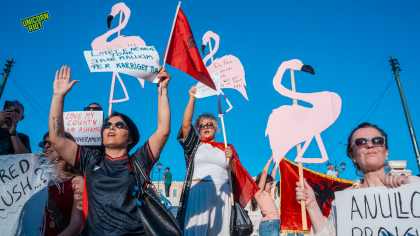
During Saturday’s protest in New York, a protester shut down the music at the Boiler Room event while wearing a shirt that said, “Boiler Room is owned by Israeli arms investors [KKR],” before being ushered off stage by security.
The night before, at least five protesters performed a die-in during the Boiler Room event under the K Bridge in NYC which featured JID and Kenny Beats. The protesters donned shirts relaying their cause and handed out flyers with their reasoning as well as faces of Palestinians killed by Israel. A video posted by Boycott Room shows protesters being jumped on at least once and some pushed as they lay on the ground among the attendees.
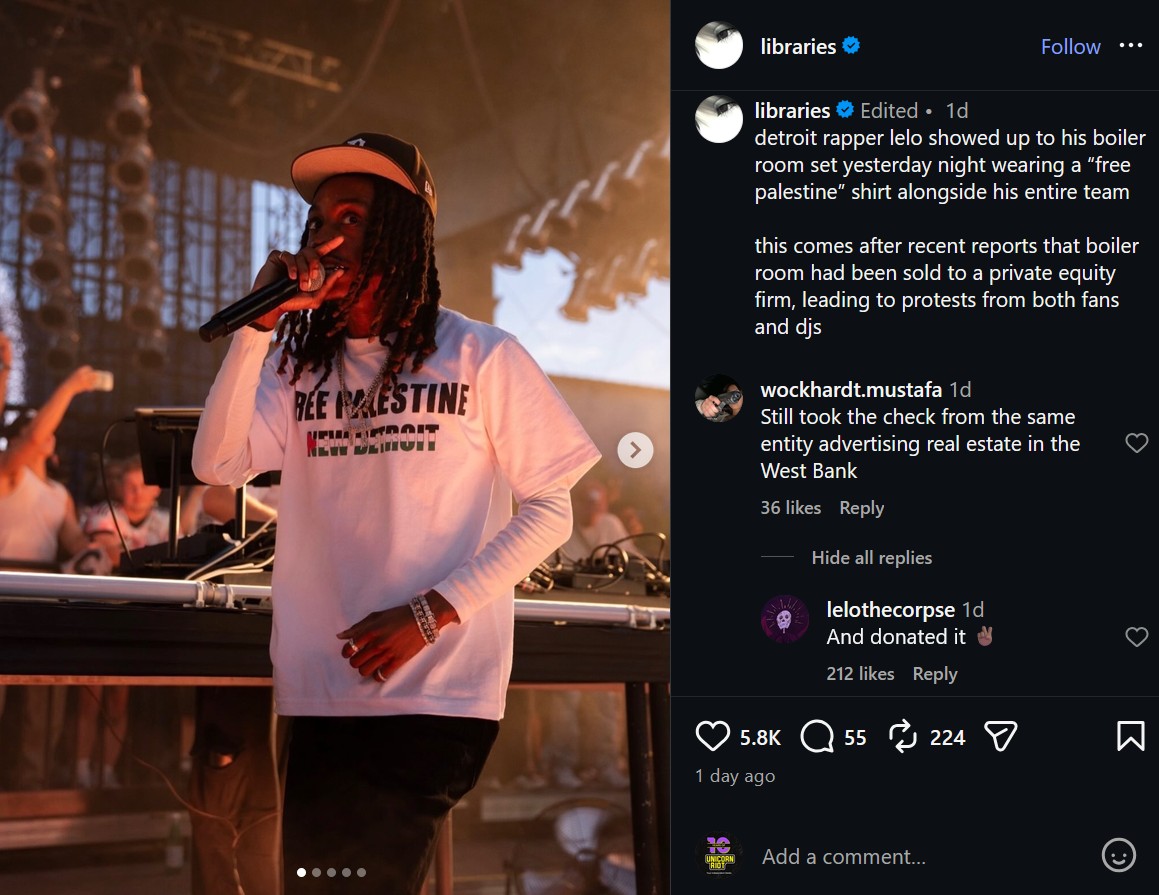
Relatedly, Detroit rapper LELO performed during Friday’s event while wearing a shirt that said “Free Palestine New Detroit.” Many of LELO’s crew were also wearing the shirt while on stage. On an Instagram post on July 12, LELO replied to a comment that said he “still took the check from the same entity advertising real estate in the West Bank” by saying that he took the check “and donated it.”
The Toronto Writers Against the War on Gaza and the Wet’suwet’en land defenders were one of the first groups to call for a boycott in January 2025, emphasizing KKR’s links to the Coastal GasLink pipeline.
Groups like Ravers for Palestine and DJs Against Apartheid amplified the news of Boiler Room’s new ownership on social media and led a thorough educational campaign through punchy infographics. A number of DJs started canceling their Boiler Room gigs in light of the acquisition, with names like Ikonika, Beatrice M., Mia Koden, BasicDisarm, jtamul and 8ULENTINA leading the charge.
On March 25, 2025, Boiler Room issued a statement distancing themselves from its new ownership, while expressing solidarity with the Palestinian people, which only seemed to fan the flames.
Perhaps the statement rang hollow considering the brand’s ambiguous position towards Palestine, from organizing events in the West Bank and fundraisers, while having links to Israeli armed forces, as Matt Unicomb traced down in a 2021 article.
On her podcast, DJ and cultural journalist Chal Ravens, said that the main problem with the statement lies in the very paradox of Boiler Room’s position, who, despite expressing solidarity, cannot actually divest and boycott; “Boiler Room cannot distance itself from their owner, it doesn’t really matter what they say,” she said. “The profits that they make inflate the value of the portfolio that they are part of and will eventually contribute to KKR cashing out and making even more money off of it, which they’ll use to invest in the next thing they invest in.”
In the United States, artists chose not only to cancel their Boiler Room gigs, but also set up strike funds and solidarity networks. “Movements like ours always start on the local level,” DJs Against Apartheid said.
Mutual-aid gatherings were created. The Bay Area Solidarity Strike (B.A.S.S.) put together a counter-event and raised money for the DJs who pulled out of Boiler Room’s event in San Francisco, which in turn inspired someone from the group to create a similar structure for their Brooklyn event called the Big Apple Strike Fund.
“This is how you show people that an alternative model of nightlife is possible: by getting together with your peers and making something happen, and making clear that this is something anyone can emulate for their own local scene,” they said. “It’s not possible to be “pro Palestine” and still be giving money to these blood corporations,” DJ WTCHRFT said in one of the group’s promotional materials.
Over the following months, numerous DJ withdrawals occurred in club hubs like Detroit and LA, as well as Kuala Lumpur and Tokyo. Boiler Room events were canceled in both Puerto Rico and São Paulo, with further disruptions at their Lisbon event. “The boycott is producing concrete effects. In Lisbon, 2 booked artists canceled and didn’t play,” said one of the organizers behind Spoiler Room Lisbon, the Boiler Room counter-event. “That matters because it breaks the illusion that “the show must go on” and interrupts the corporate strategy of using artists as human shields to protect capital from political accountability.”
In an article published by The Left Berlin in August 2025, online group Ravers for Palestine describes the loose movement as a revolt that is “massive, global and popular. It is overwhelmingly comprised of global majority, trans, queer and Indigenous people from the underground. […] It is militant. Its basic, entry level premises are an end to capitalism, uncompromising support for Palestinian resistance, the dismantlement of the ‘West’, pan-Indigenous liberation, death to all settler colonies, including those on Turtle Island.”
In November 2025, the company announced massive layoffs, which many in the industry read as a consequence of these actions, signifying the end of an era for the brand. “Boiler Room is laying off a lot of staff, many people I worked with from day one. They were the only reason why BR managed to keep the last bit of cultural relevance, but this is over — its an empty shell, engineered to extract money from an already volatile event industry,” Michail Stangl, former Boiler Room host, programmer and current CTM curator wrote on X.
Music critic Shawn Reynaldo argued in his newsletter that nobody would defend Boiler Room, given the platform’s past controversies and brand erosion.
In January 2026, CEO and co-founder Blaise Belleville’s departure from the company, coupled with the mounting wave of bad PR led many to believe that Boiler Room was done for good. Online, the platform seemed to be thriving with 2.8 million followers, a steady stream of events and funded project opportunities for local artists and communities.
However, in 2026, as their announcement for a Dublin event was quickly pulled from socials after swift backlash, something seems to have shifted — the brand is not welcome anymore.
NYC-based Boycott Room was created in July 2025 as a dedicated Instagram page, with a mission to disseminate tools for resistance and help boost and inform similar actions across the globe through direct action, informational campaigns and protests. The group’s messaging is sharp and direct. Their protests signs and online graphics feature texts like “this party kills” and equates playing at or attending Boiler Room events with supporting genocide, calling it a “blood money rave.”
Boiler Room struggled in their return to NYC when numerous underground artists refused the booking.
For the NYC event, Boycott Room planned not just a massive counter-event with both a rave with names like Archangel, DJ Haram, Sister Zo, Ella Hussle and Janus Rose, but also a protest action on Friday, July 10, the date of the Boiler Room event.
“It’s been almost a full year since we first put out our international call to Shut It Down In Every City, and it’s clear that Boiler Room is now scraping the very bottom of its barrel. In city after city, the most talented DJs and performers of our generation refuse to accept their blood money,” Boycott Room wrote in a group statement sent to Unicorn Riot.
The group also ran an online promotional campaign that centered the artists’ voices. “Nightlife has always been built by communities, not corporations and I think we have a responsibility to understand where our money, labor, and attention are going,” said NYC-based DJ and curator beewack.
DJ Haram promoted the event in a post that reads “war profiteering and ecocide accelerationist private equity has no place in nightlife. no brainer. i have no patience for the g*nocide-normalizing, bootstrapping, get-a-bag culture, especially when the bag NYC nightlife awards you for your life-consuming ‘labor of love’ still lands u at a poverty wage, art washing for whom, exactly?”
“I just said no outright to my agent and left it at that,” said NYC DJ and writer Sister Zo, “This was the second time in as many years that they’ve asked me to play and my response hasn’t changed.”
NYC DJ Ella Hussle, who also recently turned down an offer from Boiler Room said “I think it’s important to show solidarity through the simple act of saying no.”
DJ Noel Spiva, unaffiliated with the group, withdrew three days before the event after learning about the boycott. “My artistry has always been rooted in cultural resistance, liberation and the power of music as a tool for connection and change,” she wrote in a statement on Instagram.
Nowadays and The Lot Radio resident Archangel had one of the more direct and powerful statements:
“I think it can be so easy for people involved in nightlife to have a ‘separate politics from the music’ mentality — regardless of their role within the scene. Sorry not sorry but politics don’t work like that. There’s no magical bubble within the arts where politics don’t apply to the very physical space we’re djing in. Resistance is the key to our collective survival.”
For a company who built its reputation on having an ear to the ground and presenting some of the hottest, lesser-known acts, cutting access to their talent pool feels like the most serious consequence.
“In a time of severe economic instability, the fact that monetary offers totaling tens of thousands of dollars were refused by every single DJ of relevance in New York’s underground dance music scene speaks not only to Boiler Room’s pathetic desperation, but also the unbreakable solidarity and unity of our community,” Boycott Room said. “While Boiler Room’s parties become soulless corporate pageantry divorced from the culture they crudely imitate, we continue to demonstrate — again and again — that art and music are sacred, and that the true underground can never be co-opted, monetized, or bought.”
While the brand Boiler Room seems alive and well, it seems to have lost the very things that gave it credibility — a sense of authenticity and access to underground communities. “Boiler Room’s credibility has been damaged and the mask is slipping,” the Spoiler Room Lisbon organizer said. “It’s an indicator that this is not just symbolic discourse but a crisis of legitimacy with organizational consequences.”
These actions are proof that people are fed up and willing to fight for change rather than compromise. “When we speak out with a united voice, corporate brands lose their luster and power over us as artists,” DJs Against Apartheid said:
“Underground talent plays a massive role in shaping culture, and their refusal to participate takes away the ability for these complicit institutions to normalize and legitimize harm. What we really need to build is a sustainable electronic music scene grounded first and foremost in our empathy and humanity, not just what’s trendy or profitable.”
The Boycott Room Rave, organized by members of Boycott Room NYC, DJs Against Apartheid, Cultural Solidarity Project, and Heads Know took place Saturday, July 11. According to the group, 100% of proceeds were used to pay the artists, as well as donated to groups providing direct aid to Palestinians and the Wet’suwet’en First Nations.
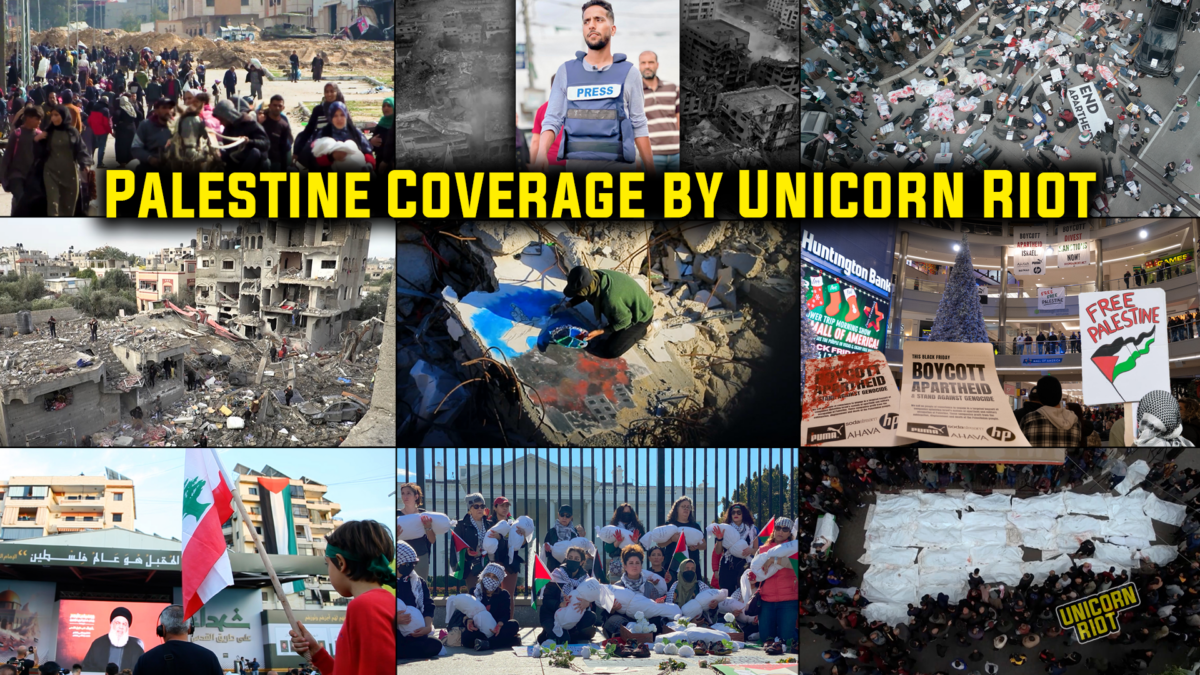
For more media from pro-Palestine protests and from the frontlines in Palestine, click the image below.
Follow us on X (aka Twitter), Facebook, YouTube, Vimeo, Instagram, Mastodon, Threads, BlueSky and Patreon.
Please consider a tax-deductible donation to help sustain our horizontally-organized, non-profit media organization: