Marco Rubio’s Visit to Athens Raises Questions About Western Democracy
Athens, Greece – U.S. Secretary of State Marco Rubio visited Athens to talk about democracy and to deepen political ties with the right-wing Greek government. However, his visit also stirred public outcry, with demonstrators showing anxiety about Greece’s growing militarization and the potential to get entangled in foreign conflicts.
Rubio arrived last Tuesday evening for the sixth round of the U.S.-Greece Strategic Dialogue. By the next day, he stood on Pnyx Hill, the Acropolis behind him, and delivered a speech that invoked ancient Greece to defend Trump’s “America First” approach. He called on Europeans to “awaken from their long slumber.” His nationalist speech called for dominance in supply chains and future technologies. CNN and the Washington Post viewed the speech as a campaign ad for his potential candidacy in the 2028 U.S. elections.
Prime Minister Kyriakos Mitsotakis described Greek-U.S. relations as being “at the highest level ever,” while Rubio referred to Greece as “such a strong partner.” The leaders announced that Greece agreed to spend up to $4 billion on a U.S. arms deal along with a joint counterterrorism program.
Yet, the streets of Greece during Rubio’s visit told a different story.
Rubio’s Arrival and the Protests
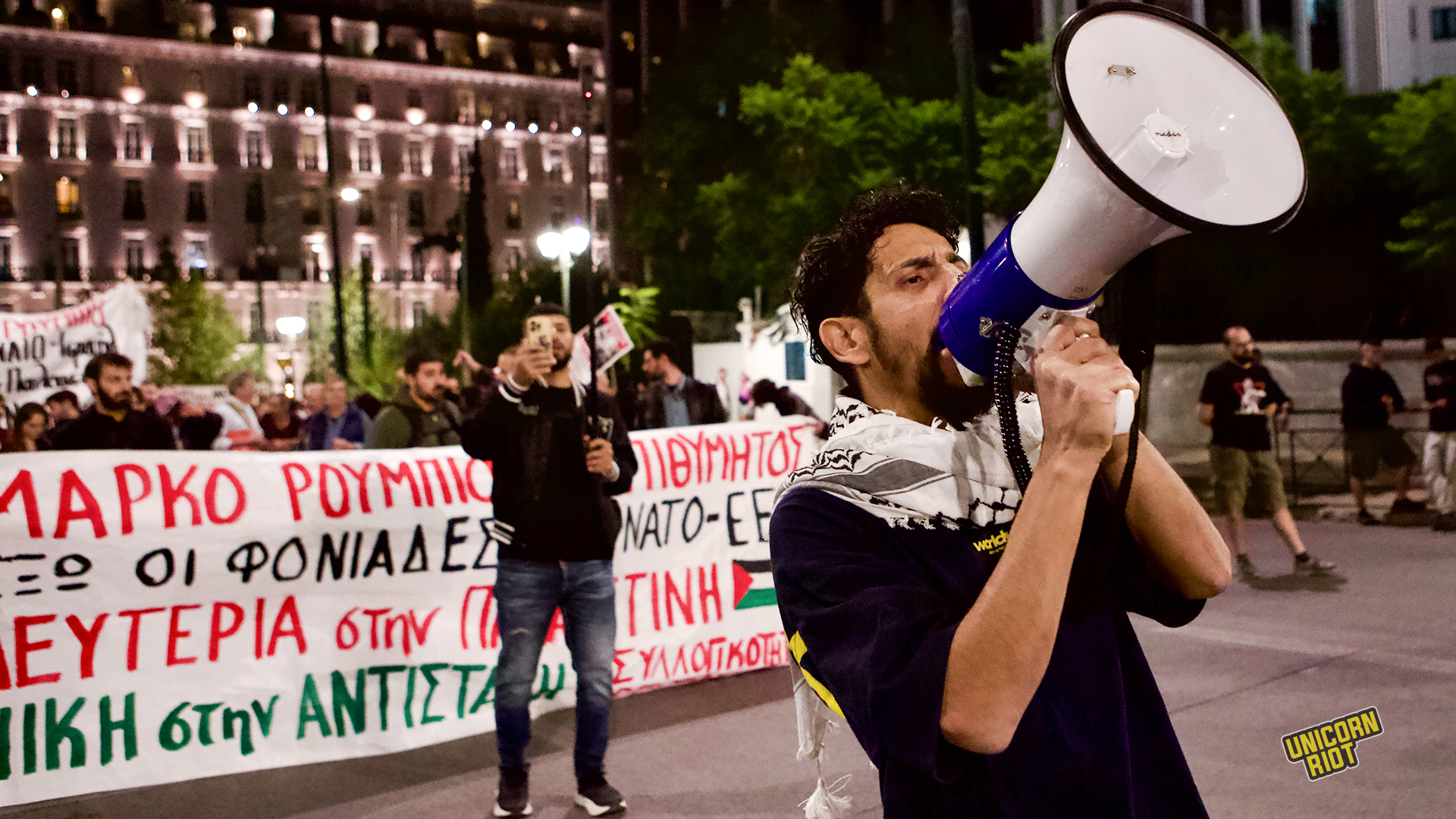
During Rubio’s arrival, hundreds of demonstrators took to the streets of Athens in opposition to his visit.
Among them was Omar Almaani, a Palestinian living in Norway, who drove a van to Greece covered with images of Palestinian suffering and statistical figures.
He called the project “Witness on Wheels” to raise public awareness. “All these numbers are not just aesthetics,” he said. “They are human beings. Every one of them has their own life, their own smile, their own history.”
Almaani said he lost friends, acquaintances, and family members in Gaza. Despite such circumstances, he urged that protests in solidarity with Palestine continue.
“Whatever is gonna happen, it will not stop us; it will not scare us,” he said. “We will stay for the truth, we will stay for humanity.”
Giannis Sifakakis of the Stop the War Coalition spoke at the same protest. “We are here today because we are fighting for Palestine and against U.S. imperialism,” he said. “The Greek government is going deeper into the war on the side of Trump and Netanyahu.”
On the evening of Wednesday, October 7, despite the 24-hour public gathering ban in Athens, a crowd of pro-Palestinian demonstrators gathered in front of the Israeli Embassy. They organized to mark three years of genocide in Gaza.
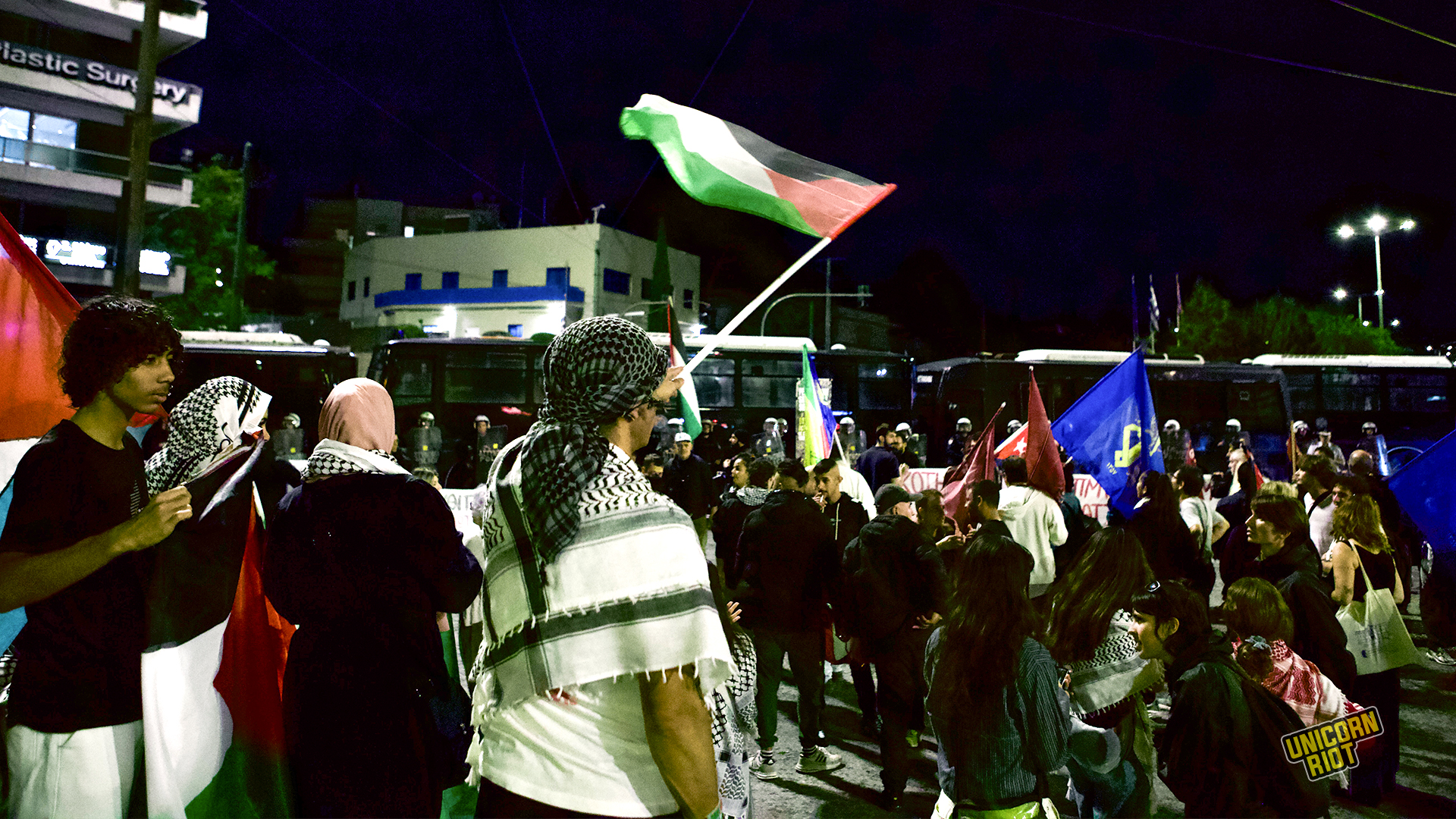
Greg, a Greek demonstrator, said he was there for two main reasons, “one, to honor the Palestinian resistance and two, to shout against the genocidal settler colonial regime of Israel.”
Konstantina Kartsioti, an organizer for the Anti-Imperialist Movement, linked the protest with Rubio’s visit, stating, “the collaboration of the Greek state with the Zionist entity and U.S. imperialism.”
“We are telling Palestinians they have the right to resist and the right to return,” she said. “We hope to join the resistance from Greece to Gaza, from Gaza to the West Bank, to Jenin, to Nablus … We unite, and we are telling [people] we must fight and win.”
Why Greece Matters to Rubio
The Strategic Dialogue covered energy, defense, trade, technology and investment. Discussions also centered on U.S. companies such as ExxonMobil and Chevron, the Vertical Corridor and electricity interconnections linking Greece with regional allies.
Greece’s ambition is to strengthen its role as a regional energy hub, distributing American liquified natural gas (LNG) to its European markets. The U.S., on the other hand, eyes Souda Bay and Alexandroupoli, which are both military logistics bases that project power across the Eastern Mediterranean, Eastern Europe, and the Middle East.
These discussions highlight the impact of Rubio’s visit by demonstrating how Greece serves as the perfect “model NATO ally,” combining strong self-defense investments with a dominance in strategic energy and logistics networks that support American interests.
The Contradiction
Rubio’s openly American-centric speech on Pnyx Hill talked about the ideals of protecting democracy and its future based on ideological goals.
But beyond the sanitized corporate-state spectacle, the city below had closed streets, banned gatherings, and detained journalists and protesters. The space for dissent that the state allowed had little to no room to take place.
Greg recounted the situation poignantly, “I feel shame, and I feel that we [Greeks] are just colonized people, that our voices are not heard.”
The Right to Protest
While Gaza currently has two-thirds of its territory occupied by Israel, pro-Palestinian demonstrators are silenced. Pro-Israeli Iranian demonstrators, on the other hand, faced no state intervention in front of the Israeli Embassy despite the public gathering ban in the capital.
Rubio’s speech echoed an authoritarian vision of what freedom is, a passionate promise made by the powerful, until those who dare to challenge it are ushered into silence.
The Greek government champions deepening ties with the Trump administration as a strategic win, prioritizing military spending and U.S. economic interests.
Yet those who took to the streets are asking a tough question – whose interests does the government actually serve?
As the country’s economy is becoming stronger, most Greeks feel no improvement in their daily lives, with the cost of living and energy and housing prices rising, poor working conditions, a shrinking education system caused by a demographic crisis, diminishing trust toward public institutions due to corruption, and simply trying to get-by remain difficult.
The question remains, as it does for many Greeks – is democracy being protected as the foundation of its history as proclaimed by Rubio, or is Greece replicating today’s U.S. system of backsliding democracy?
Cover image contributed by Elvis Takahashi Mantello. Omar Almaani chants in protest between the Greek Parliament and the Ministry of Foreign Affairs in Athens, Greece, on Oct. 6, 2026. The banner contains a message opposing Rubio’s visit and expressing solidarity with Palestine.
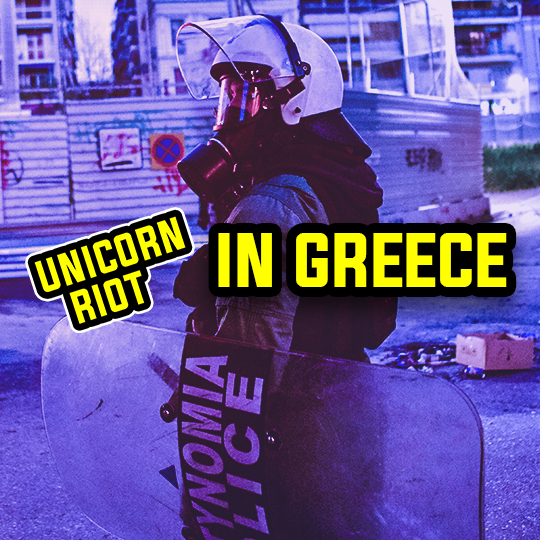
View all Unicorn Riot coverage from Greece by clicking on image below: