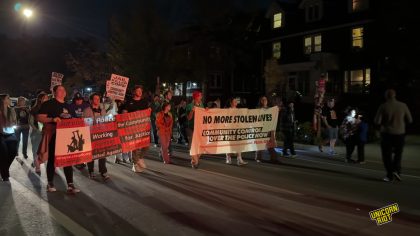
Inside Rouvikonas’ Push to Build a Nationwide Movement
Athens, Greece — Best known for its direct actions in Greece’s capitol city, the anti-authoritarian collective Rouvikonas has increasingly expanded beyond Athens. Over the past year, the collective has established a presence in Thessaloniki and Larissa, as well as in other parts of the country.
Their expansion, which includes mutual aid projects and volunteer firefighting, comes as they face new challenges including state repression. Greek Justice Minister Giorgos Floridis recently described Rouvikonas as a “criminal organization,” arguing that its activities warranted consolidating criminal case files across the country, as had been done in the case of Golden Dawn.
Rouvikonas has rejected the characterization, describing the government’s actions as another attack by the Greek state who is attempting to quell their popular buildup. Unicorn Riot sat down with several members of the collective to learn more – see the video below.
History and Expansion
Rouvikonas emerged in 2013, as Greece was still grappling with the aftermath of its financial crisis and years of austerity. Its name refers to crossing the Rubicon, the point of no return. Its signature phrase is “Not a Step Back.”
In the years following massive mobilization and civil expression, Rouvikonas maintained its political activity through direct action while building connections beyond traditional anarchist circles.
In recent years, Rouvikonas has gained greater public recognition and built a social media following of tens of thousands.
“The aim is one day to have a nationwide organization,” says Luka, a member of Rouvikonas. “We want common people, people from the working class, from the social base to join.”
This aim forces the collective to rethink how it organizes and builds relationships with emerging groups outside the capital.
Related: Passing the Point of No Return: Interview with Rouvikonas Anarchist Collective
K-Vox: The Base
This year, K-Vox, a squat in the Exarcheia district of Athens where political history has made it synonymous with resistance, marked its 14th anniversary with several days of cultural events and open political discussions.
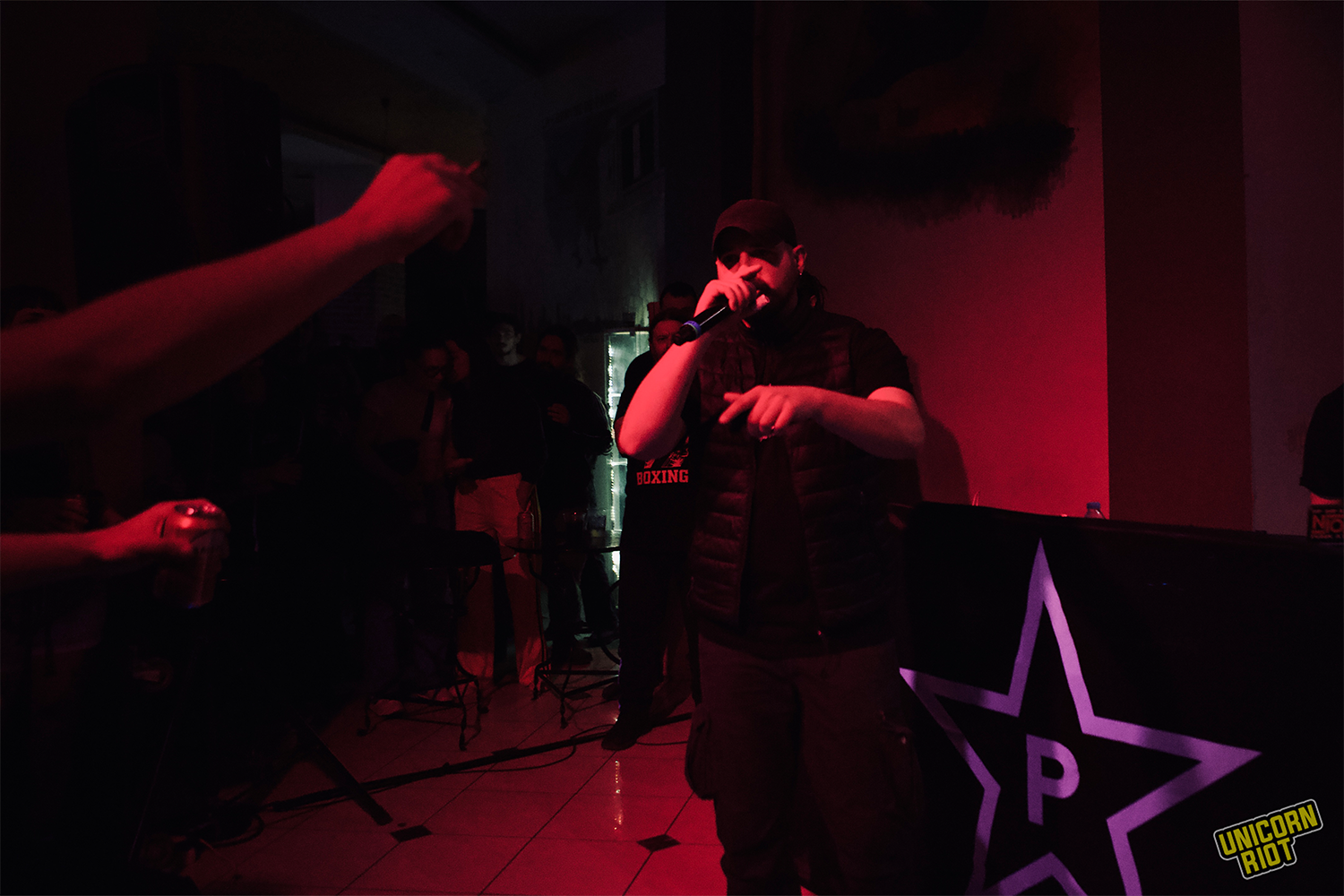
On a typical week, K-Vox operates as a bar and social space, drawing a mix of residents, activists and foreigners. Its walls echo histories of various movements beyond Greece, with murals and posters referencing the Paris Commune, Nestor Makhno’s Black Army and other revolutionary movements. Housed on the side of the building is a free healthcare clinic. The political character of the space is hard to miss.
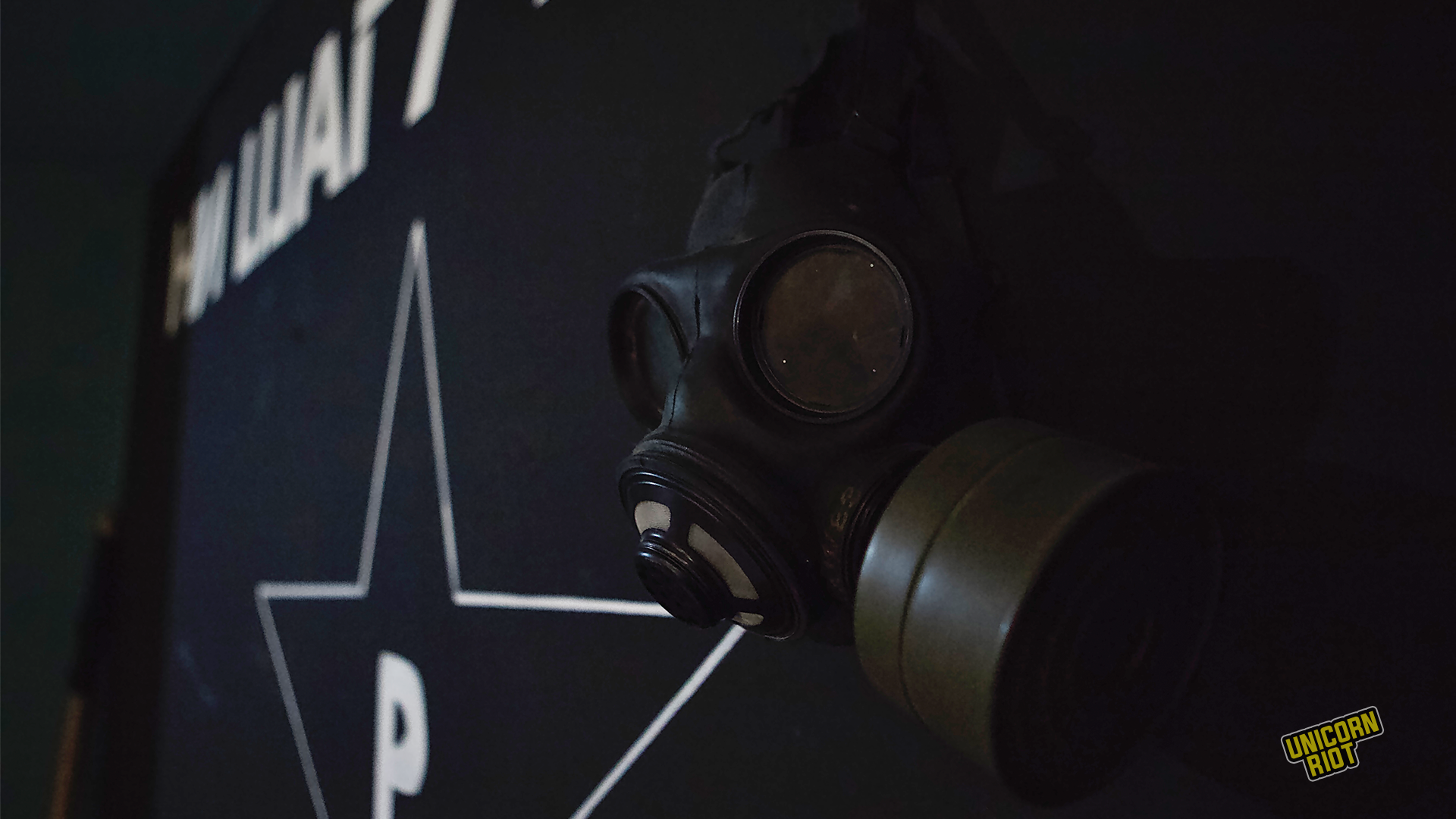
But K-Vox is not a sanctuary free from external pressure. Riot police carrying shields, stun grenades, tear gas grenades and service pistols are stationed only a few hundred meters away. At the same time, metal barricades obscure what was once a community park at Exarcheia Square, now surrounded by construction for a new metro station.
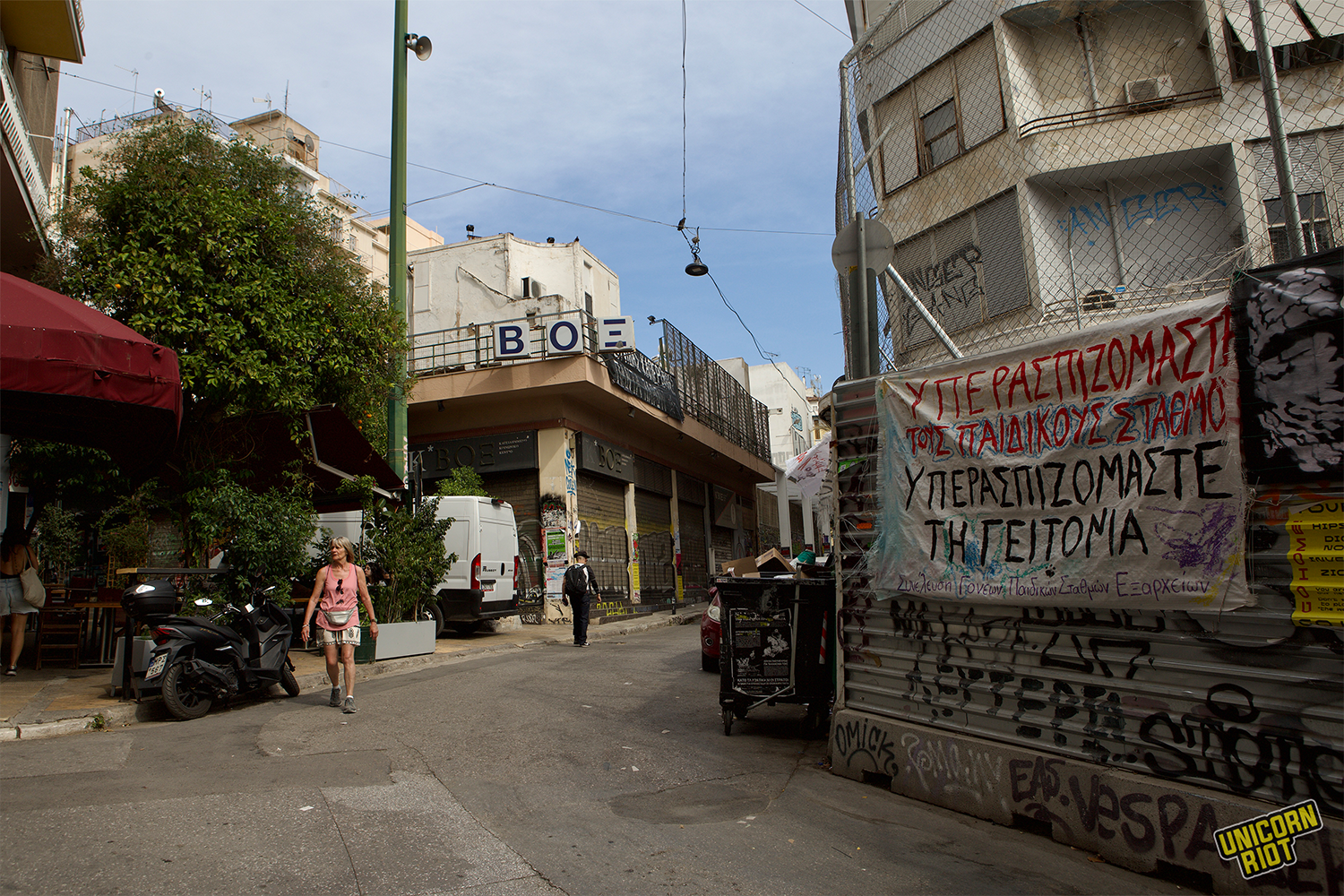
Past coverage: Altering Exarcheia From the Square to Strefi Hill: A Timeline and Film
And for years K-Vox has faced the threat of eviction. When the current government came to power in 2019, cracking down on squats was among its stated priorities.
According to Periklis, a veteran member of Rouvikonas, authorities have tried to pressure or remove K-Vox over the years but have never successfully evicted the squat, even as they cleared other spaces.
Periklis argues that the government and police have struggled to confront Rouvikonas because the collective has broader support in society. Even if the government removed the space, he said, the movement behind it would remain.
The collective has responded by maintaining its everyday activities, said Periklis. This continuity is central to Rouvikonas’ relationship with the wider community. K-Vox functions not only as a space for political organizing but also as a means of sustaining the group’s social base.
From Base to Network
Rouvikonas establishes support through its social centers, providing practical assistance to people in need, from food to medical care. These activities have helped the collective build connections beyond its traditional political base.
That support has also extended into Greece’s increasingly difficult wildfire seasons where seasonal firefighters, alongside their permanent colleagues, have repeatedly raised concerns about neglect and poor working conditions.
Amid this environment, Rouvikonas began developing its own volunteer firefighting corps, an initiative that brought the collective greater recognition.
One wildfire survivor recalled Rouvikonas volunteers arriving as the fire spread rapidly, then working through the night to protect the village.
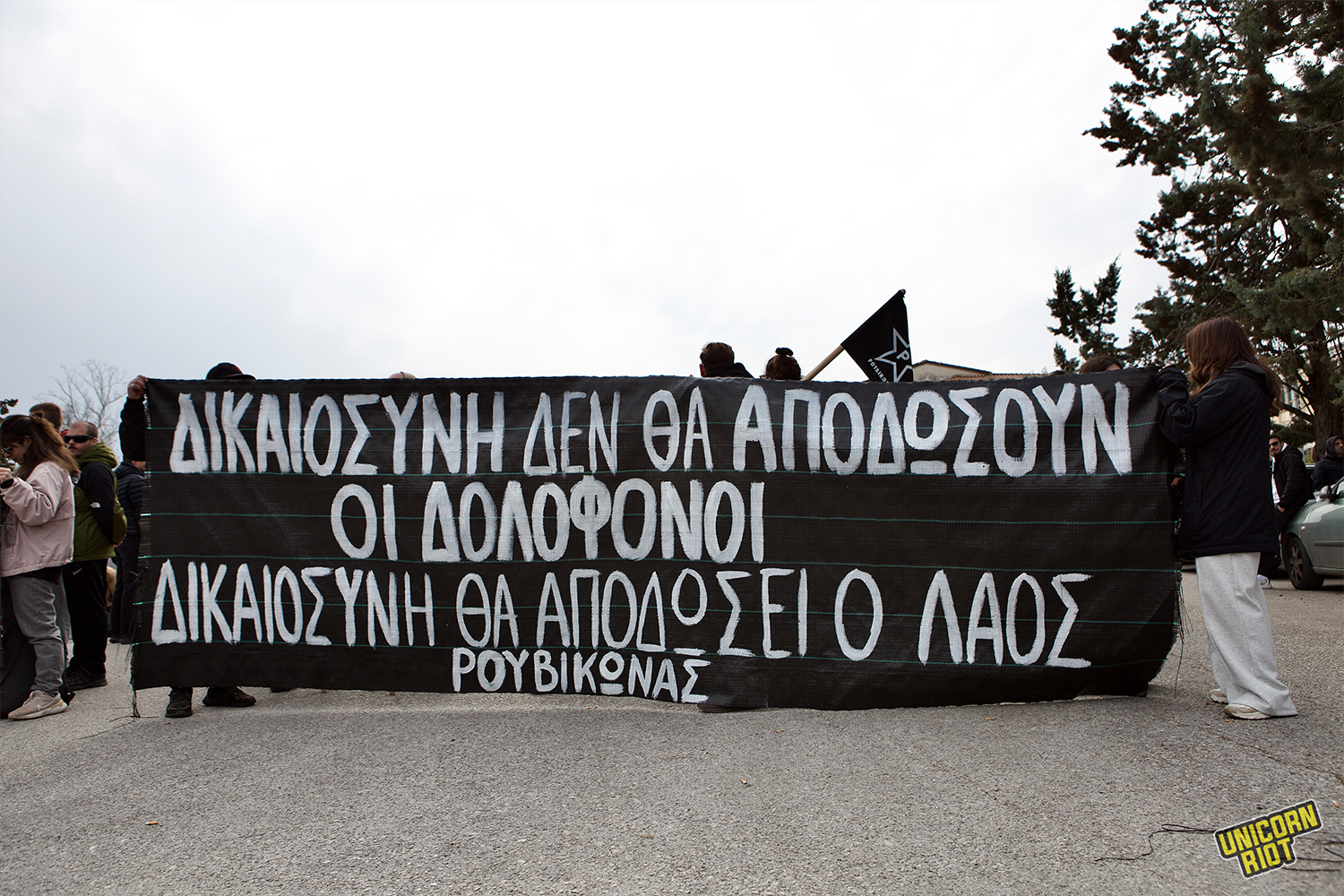
Rouvikonas’ most publicized and heavily criticized actions have involved direct confrontation. These have ranged from one-on-one confrontations to attacks on symbols of power, embassies, and major corporations, including through graffiti, leaflet distribution, and property damage. The group has also carried out nonviolent interventions in support of workers.
In one instance in Athens, members staged a protest inside a company’s offices calling for the reinstatement of a pregnant employee who alleged that she had been unlawfully dismissed.
In another incident in Thessaloniki, members marched through the streets to raise awareness of the war in Gaza, wearing T-shirts featuring the Palestinian flag. The action drew scrutiny over allegations that the group’s messaging was racist; however, the members framed their position as an ideological opposition to Israeli policies and Zionism rather than as hostility toward a racial or ethnic group. On another occasion, they unfurled a banner outside the U.S. Consulate calling for accountability over U.S. support for Israel and Zionism.
In Larissa, members of Rouvikonas attacked the Violanta factory with sledgehammers in protest against the release of the factory’s owner under restrictive conditions after the factory had been involved in an incident which resulted in the deaths of five female workers. The group said the action was intended to keep their memory alive as part of an ongoing struggle.
Another prominent instance of the group’s activism concerns its response to the Tempi train disaster, which tragically claimed the lives of 57 people, many of them students. On the anniversary of the disaster in 2025, members entered the offices of the Hellenic Train company, which has faced extensive allegations of responsibility in connection with the accident. They unfurled a banner denouncing the company as “murderers” in an act of protest.
The aim, Luka said, is to hold people in positions of power accountable.
“Bosses are not used to having workers confront them directly,” he said. “And in doing so, Rouvikonas also grew because workers can identify with the actions we do. By now, we’ve reached a point where a lot of Greek society trusts us.”
Furthermore, Rouvikonas operates a feminist branch, which has become an important part of its political values. Through its feminist sector, Rouvikonas has focused on issues including gender-based violence, and women’s rights, organizing interventions and public demonstrations.
Decentralization and Adapting Under State Pressure
Rouvikonas’ expansion has been driven in part by growing public demand. By 2021-2022, Luka said the group believed it was ready to move beyond Athens.
“We started taking step by step, following our strategy up until now,” he said.
But Rouvikonas does not simply replicate its Athens model elsewhere. Each local branch adapts its approach to local conditions.
“In each city, the people who are active in the local sector make their own decisions,” Luka said.
Rouvikonas’ expansion has unfolded alongside growing pressure from the Greek state. The group is not officially designated as a terrorist organization. But its members say authorities are trying to frame its activities as criminal by using the judicial system.
Giorgos Kalaitzidis, a Rouvikonas co-founder, says authorities are assembling years of the group’s activities to paint it as a criminal organization. He points, however, to its interventions over unpaid wages, workplace abuses, as well as its community efforts.
Kalaitzidis says authorities searching Rouvikonas’ social centers may expect evidence of criminal activity. Instead, he said, they could find “chickpeas, lentils and vegetables.”
Luka said the decision to expand across Greece came shortly after the group learned of an active investigation. “In a way, it was our way to raise the stakes,” he said.
Past coverage: Greek Anarchist Collective Targeted by the State
Can Rouvikonas Become Nationwide?
Rouvikonas’ expansion remains a work in progress. Eight new sectors, according to the group, have emerged outside Athens, with growth being gradual, built on maintaining connections with local communities rather than rapidly reproducing the organization across the country.
For Luka, the larger goal is not necessarily to make everyone part of Rouvikonas, but to encourage people to organize themselves.
“What we would like to see in the future is for more and more people to organize. Not necessarily with Rouvikonas, but to be organized.”
Greece has experienced economic growth in recent years, but many people still struggle with the cost of living. Rouvikonas’ strategy is to turn those frustrations into grassroots organizing, whether through workplace interventions or emergency assistance, from medical needs to wildfire response. The collective believes its community work can respond to these problems more immediately.
That approach reflects how Rouvikonas has positioned itself. Its members do not see political organizing as being confined to demonstrations or confrontations with the state.
Instead, they see it as something that can also take place through everyday relationships and practical support.
For example, their efforts in firefighting and workplace interventions provide opportunities for members to build relationships with people who may have little connection to anarchist or left-wing politics. For Rouvikonas, these encounters can become a starting point for longer-term relationships and collective action.
Building that trust is not easy, especially as the group expands beyond Athens, where it has built significant political networks and recognition over the years. But that is not stopping them from trying.
“We are also positive because we see that our work is bringing results,” Luka said.
Whether those efforts can provide the foundation for a nationwide organization remains uncertain.
“Who knows what the future will bring? Maybe we will succeed, maybe we will fail. But in either case, we would like to leave behind a better world than the world we found.”
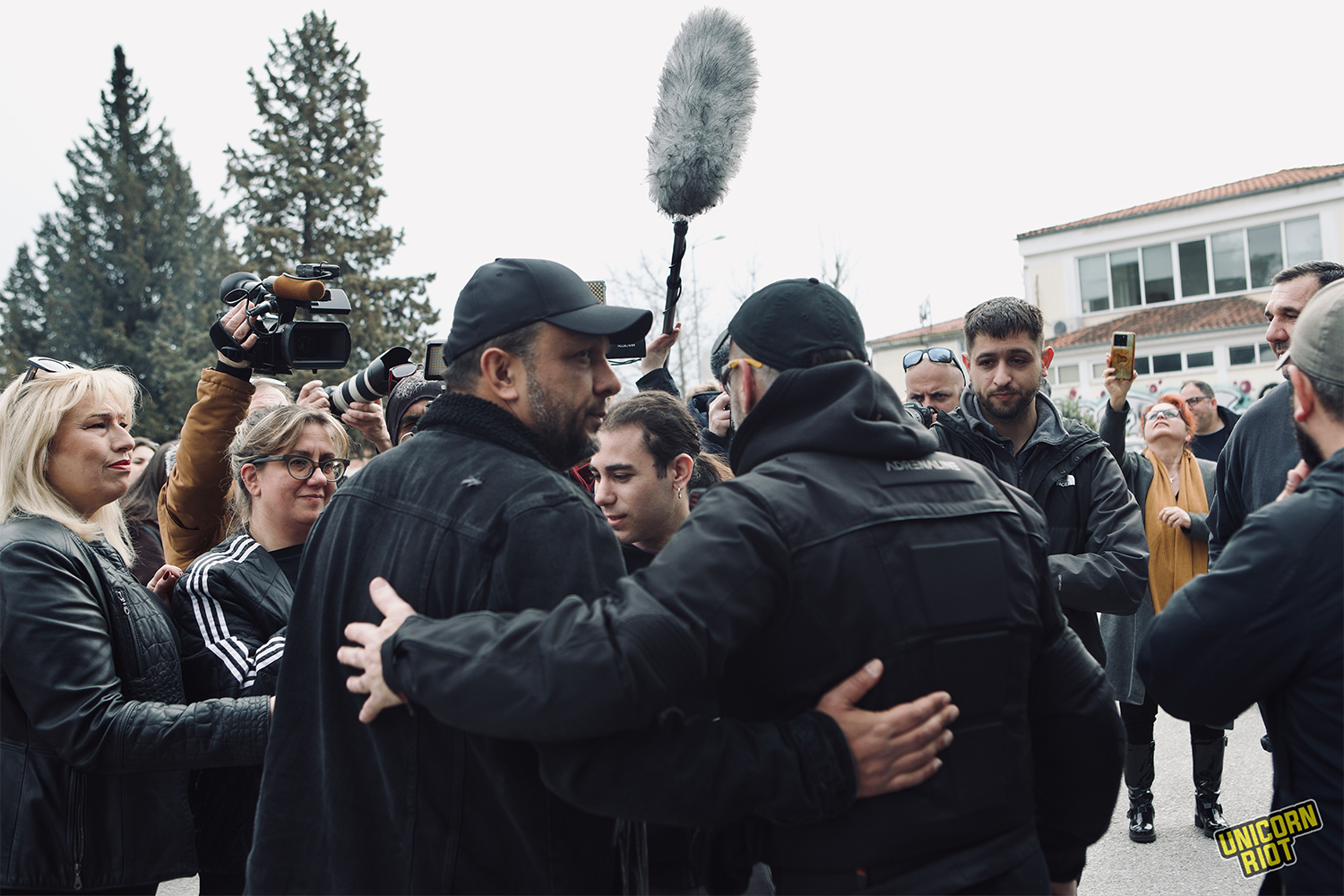
Cover image contributed by Elvis Takahashi Mantello.
View all Unicorn Riot coverage from Greece by clicking on image below:
Follow us on X (aka Twitter), Facebook, YouTube, Vimeo, Instagram, Mastodon, Threads, BlueSky and Patreon.
Please consider a tax-deductible donation to help sustain our horizontally-organized, non-profit media organization: