Mining Company Opts Out of Controversial Project Near Sacred Site in Black Hills
Exploratory mining project on sacred Indigenous lands is halted days after U.S. District Court grants temporary restraining order against the company.
Rapid City, SD — On Thursday, May 7, a mining company announced it was stopping operations three days after tribes and advocacy organizations were granted a temporary restraining order in federal court. On May 4, the U.S. District Court of South Dakota granted a temporary restraining order to nine federally recognized tribes and three conservation nonprofit organizations, stopping a controversial drilling project that tribes say threatened a sacred site in the Black Hills.
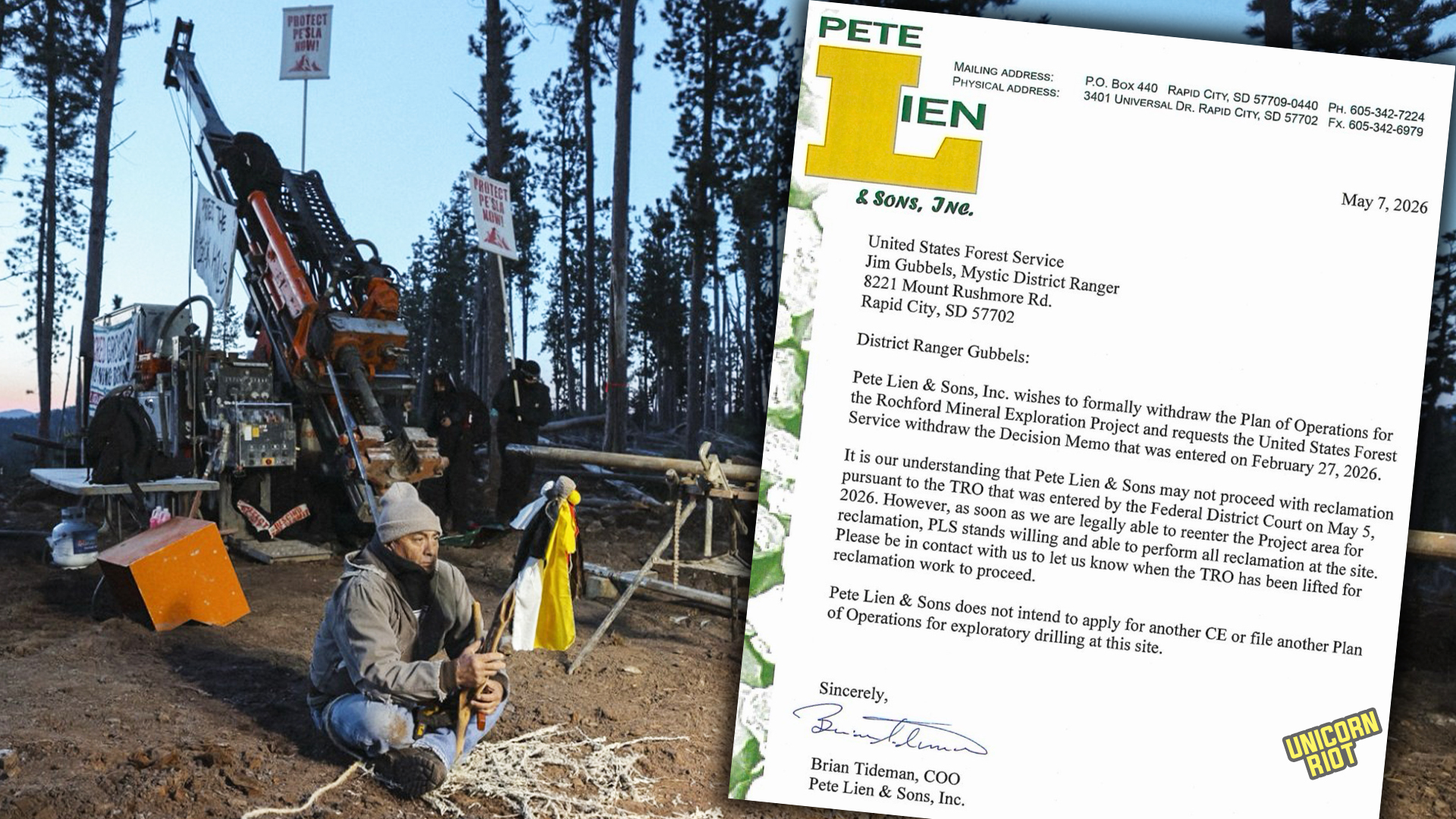
“Pete Lien & Sons, Inc. wishes to formally withdraw the Plan of Operations for the Rochford Mineral Exploration Project and requests the United States Forest Service withdraw the Decision Memo that was entered on February 27, 2026,” wrote Brian Tideman, the Chief Operating Officer of Pete Lien & Sons to U.S. Forest Service Ranger Jim Gubbels on May 7. “Pete Lien & Sons does not intend to apply for another CE [Categorical Exclusion] or file another Plan of Operations for exploratory drilling at this site.”
The mining company’s decision was widely celebrated by tribes and their advocates, with many saying that the withdrawal is a success. The project’s mining permit was recently granted by the U.S. Forest Service on February 27, 2026, where the agency issued a Decision Memo approving the Rochford Mineral Exploratory Drilling Project, near Pe’Sla.
Pe’Sla is a central location in the Black Hills of South Dakota and a sacred place to the Oceti Sakowin — the Lakota, Nakota, and Dakota tribes of the Great Sioux Nation.
“Pe’Sla is sacred to the Lakota, Nakota, and Dakota tribes of the Great Sioux Nation, including the representatives and members of the three nonprofit organizations that are Plaintiffs in Case No. 5:26-cv-05035 and the nine tribes that are Plaintiffs in Case No. 5:26-cv-05051-CCT,” U.S. District Court Judge Camela C. Theeler wrote in the court’s decision to grant a temporary restraining order on May 5, 2026. “These and other tribes have acquired much of the land within Pe’Sla.”
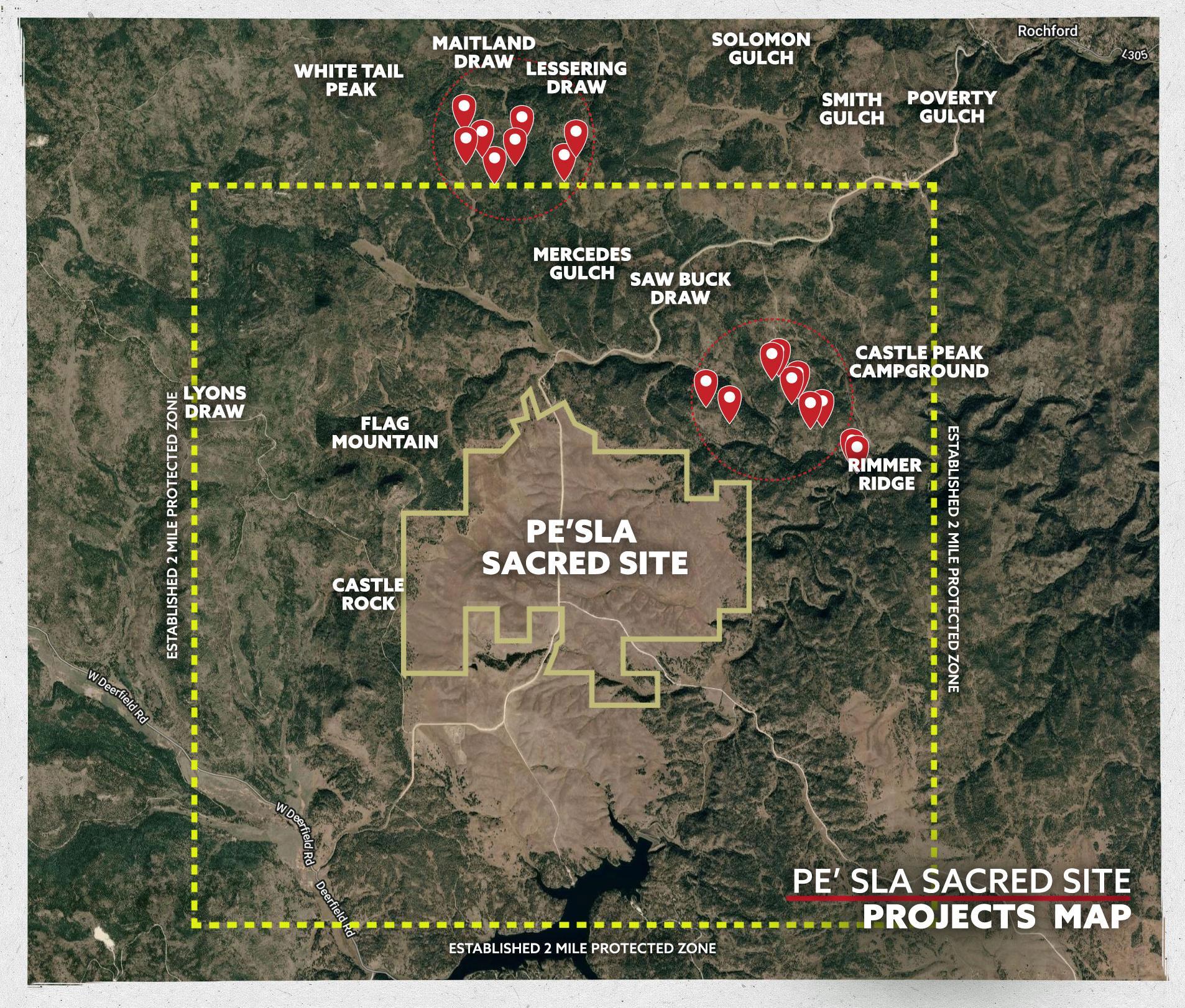
In the middle of the Black Hills, near Hill City, South Dakota, Pe’Sla is a site of sacred significance to the Oceti Sakowin, collectively known as the Great Sioux Nation. The Rosebud, Shakopee Mdewakanton, Crow Creek, and Standing Rock Sioux Tribes raised $9 million in 2012 to purchase the land, where they collectively petitioned the Secretary of Interior to place the 2,022-acre site into federal Indian trust status. It has been placed into federal Indian land trust status since March 10, 2016.
The effort to reclaim Pe’Sla began in 2011, when the Pete Lien and Sons mining company proposed building a limestone quarry near Pe’Sla, prompting an urgent push from tribes to protect the area.
The U.S. Forest Service said in a brief opposing the restraining order that the project is already “halfway complete,” and said the agency properly considered and approved the drilling plan. Up to 18 holes would be drilled in search of graphite materials. Each hole would be 3 inches in diameter and up to 1,000 ft. deep.
On April 30, a group of land protectors stopped drilling activity at Pe’Sla through direct action by conducting prayer and ceremony for several days. NDN Collective, a Rapid City-based nonprofit organization, largely led the direct action and was also one of the plaintiffs in the case against the mining project. The two other plaintiffs in a lawsuit with NDN Collective were the Black Hills Clean Water Alliance and Earthworks.
Lakota youth have locked down onto the drilling equipment at Pe’ Sla. An alter has been set up and community members have offered prayers. The drilling company said that law enforcement is on the way. 📸 Photos by Angel White Eyes
— NDN Collective (@ndncollective.bsky.social) April 30, 2026 at 10:39 AM
[image or embed]
Oglala Sioux Tribal President Frank Star Comes Out said in a press release on May 11, “the Court’s ruling and the decision by PLS [Pete Lien & Sons, Inc.] to drop the Project are important victories for the Oglala Sioux Tribe and all other tribes of the Oceti Sakowin.”
The court granted the temporary restraining order on several grounds, including that the U.S. Forest Service violated the National Environmental Policy Act when it approved a “categorical exclusion.” According to the law, an exclusion is reserved for projects that have plans of operation of under one year; the company cited three years of reclamation work after the operation. The court also stated that without a restraining order, the tribes would be irreparably harmed as during this time of year certain ceremonies are performed at the location.
Rather than provide an Environmental Impact Statement (EIS) or an Environmental Assessment (EA) — both are required for a permit to operate on federal land — the permit’s approval was granted by a categorical exclusion. U.S. District Judge Camela C. Theeler wrote on May 5, “Rather than preparing an EIS or EA, the USFS invoked Categorical Exclusion CE-8, which applies to ‘[s]hort-term (1 year or less) mineral, energy, or geophysical investigations and their incidental support activities.’”
“The temporary restraining order rested on solid temporary ground,” Danielle Finn, a professor at the William S. Boyd School of Law at the University of Nevada, Las Vegas, said to Unicorn Riot. “The tribes allege the Forest Service violated both the National Historic Preservation Act and the National Environmental Policy Act by approving the drilling project without conducting an environmental review and without designating Pe’Sla as an affected area.”
The court also stated that the operations of the mining project are within a 2-mile buffer zone of Pe’Sla, a site that has federal Indian trust status. The National Environmental Policy Act’s categorical exclusions can only be applied if a project is not operating on protected lands or habitats. American Indians and Alaska Native religious or cultural sites are protected lands and habitats listed in the law, and its significance was omitted from the plan of operations.
“The defense of Pe’ Sla, where Pete Lien & Sons was pushed to withdraw its plans for exploratory graphite drilling around the sacred site, should be celebrated and acknowledged as a significant success,” said Dov Korff-Korn, Sacred Defense Fund’s legal director, to Unicorn Riot.
“The moment indicates the powerful possibilities that can be achieved when Indigenous-led grassroots direct action and litigation driven by Indian Nations (with allied NGOs) occur in unison. Placing pressure with urgency—in this case locking down drill equipment and seeking a strategic federal court restraining order—challenged extractive industry both on the ground and in the courts, forming an opposition evidently too burdensome for the corporation to overcome.”
The multi-pronged approach including both direct action and legal strategy to protect a cultural site is one of few cases where protecting an Indigenous sacred site prevailed in court, but this time it was the government’s undoing.
Cover image features a photo of a man in prayer in front of drilling equipment near Pe’Sla from Angel White Eyes, NDN Collective, published Creative Commons by ICT, along with a letter from Pete Lien & Sons withdrawing from the mining project.
Follow us on X (aka Twitter), Facebook, YouTube, Vimeo, Instagram, Mastodon, Threads, BlueSky and Patreon.
Please consider a tax-deductible donation to help sustain our horizontally-organized, non-profit media organization: