Parallel Crimes: Novi Sad, Tempi and the Architecture of Neglect in the Balkans
Late on February 28, 2023, in central Greece, a passenger train collided with a cargo train, killing 57 people. One year and eight months later, in the northern Serbian city of Novi Sad, a train station’s canopy collapsed, killing 16 people. Both incidents shocked their nations, and questions of political responsibility quickly ignited massive protest movements. Over time, scandals and alleged cover-ups came to light.
The station in Novi Sad had just been renovated — financed through an agreement with China whose details still remain strictly confidential. For protesters, the collapse illustrates how corruption in Serbia has become an increasingly life-threatening issue.
In Greece, the railway company TRAINOSE had been privatized and sold to the Italian company Trenitalia — a consequence of austerity measures imposed after the financial crisis that struck the country in 2010 — while the railways of OSE stayed in public hands.
Both disasters expose a similar political landscape: the intertwining of economic dependency, privatization, deteriorating public institutions, and entrenched corruption — patterns seen not only in the Balkans, but around the world.
The events plunged their societies into grief and outrage, sparking mass demonstrations, student occupations, and escalating confrontations with state authorities. It soon became clear that these tragedies were not isolated accidents but symptoms of deeper political and economic decay. In both cases, the tragedies were dubbed as “crime.”
Collapse and Collision: Facts and Lies
The disaster in Greece was, in a sense, announced in advance: in an open letter, railway employees had pointed out weeks before that the safety systems for the tracks were incomplete and poorly maintained. It was an open secret that the line between Athens and Thessaloniki is in very poor condition.
Unicorn Riot reported in 2023 that the Tempi disaster was rooted in long-standing technical failures and systemic mismanagement of Greece’s railways. After the crash, it became clear that most safety systems on the Athens–Thessaloniki line — signals, remote control, traffic management, and communications — were largely non-functional, forcing drivers to rely on radio contact with stationmasters.
Critics and families of victims questioned how such critical infrastructure had been allowed to decay. Meanwhile, the Greek government initially framed the tragedy as an individual mistake. They overlooked the structural issues tied to the railway’s privatization during the debt crisis when the Greek train company TRAINOSE was sold to Italy’s Ferrovie dello Stato for just 45 million euros ($50 million) and continued to be subsidized with 50 million euros ($55 million) annually before being rebranded as Hellenic Train in 2022.
A report by a team of forensic investigators hired by victims’ families indicated the presence of highly flammable chemicals on the freight train, which led to an explosion and fire immediately after the crash. The substances in question are xylene and toluene — hydrocarbons used as solvents, which were transported on the train in violation of safety regulations.
According to expert reports, some of the 57 victims did not die as a result of the collision, but from oxygen deprivation caused by the fire on the freight train or were burned alive. Emergency call recordings confirm that trapped passengers complained of a lack of oxygen. It became clear that Hellenic Train — a company not included in the investigation — had used improperly flammable material for the seats, resulting in the fire expanding faster. The report also found that police and firefighters had illegally removed evidence from the train crash scene using photographs provided by Greek and international media.
About a nine-hour drive away, on November 1, 2024, at 11:52 local time, the Novi Sad station entry canopy collapsed onto people walking beneath it. Sixteen people in total were killed. The station has been closed since then.
The canopy that collapsed was part of the station recently renovated by the consortium China Railway International Co. Ltd and China Communications Construction Company Ltd (CRIC&CCCC). Many argue that the reconstruction was rushed and executed without adequate quality control or compliance with safety standards. The station was constructed in 1964 and was renovated from 2021 to 2024.
In Novi Sad, Unicorn Riot visited the train station and got in contact with local activists in a youth center named CK13. Laura explained to UR that the global Chinese state funded investment program known as the Belt and Road Initiative included railway reconstruction between Belgrade and Novi Sad.
“These projects are always huge publicity stunts,” Laura told us. “Officials show up to declare how important the investment is for the nation. And then, just a few months after the grand opening, the canopy collapsed.”
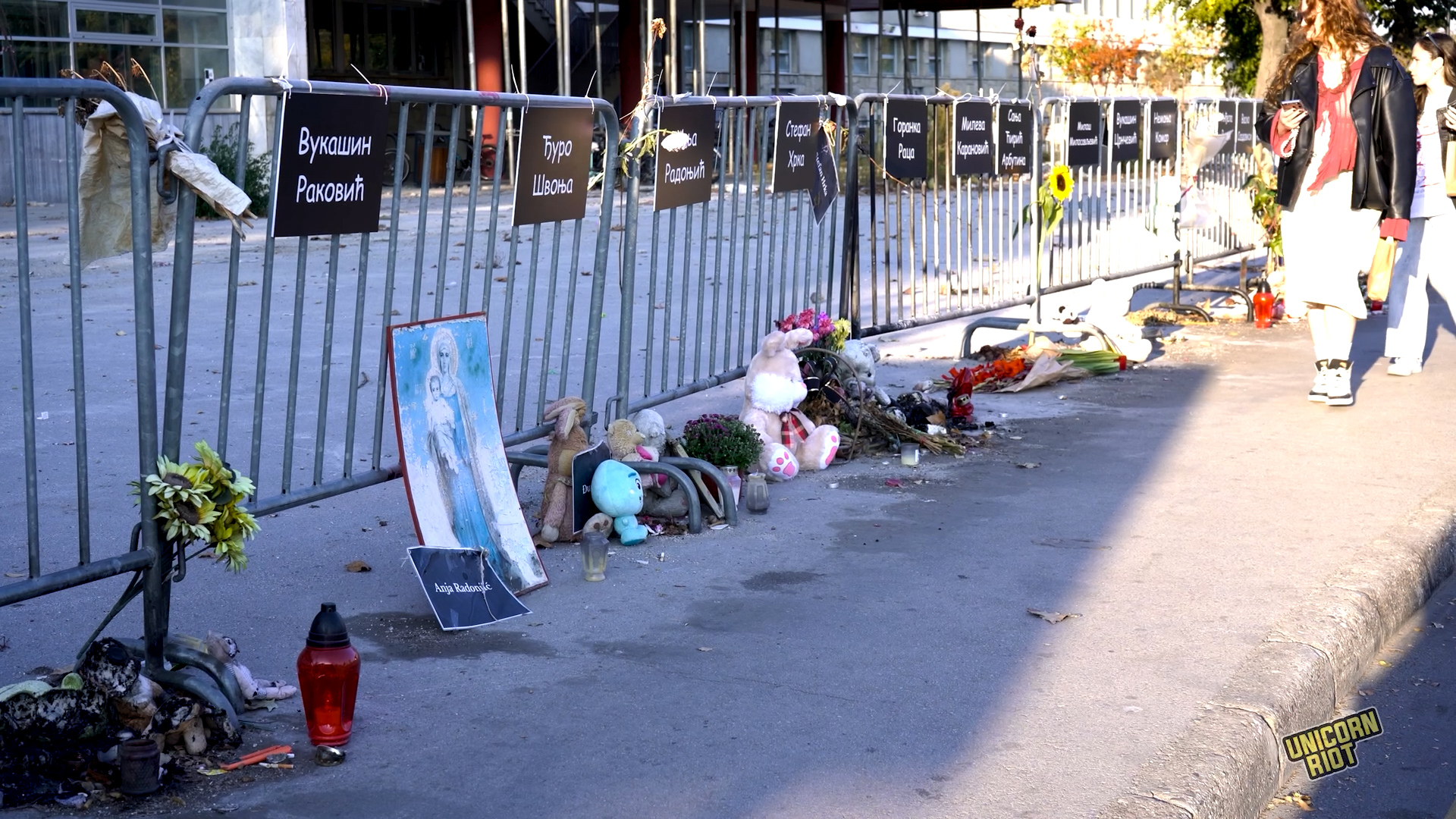
The canopy was constructed in 1964, but accusations state that construction works in order to modernize the station influenced its stability. Directly after the collapse, the CRIC&CCCC stated that the canopy was not reconstructed during the renovations and thus declined any responsibility. The company also refused a request by the media group Portal021 to share information related to the contract and content of the construction works to third parties.
Forty people, including the construction minister Goran Vesić who had resigned three days after the collapse, were questioned after the incident. Twelve of them, including Vesić and individuals who were in charge of the construction work, were arrested. In December 2024, Serbia’s public prosecutor indicted 13 people, including Vesić, with the charge of a grave criminal against public safety and irregular execution of construction work, risking a maximum of 12 years in prison.
Prime Minister Miloš Vučević said the indictment “confirms that no one has an intention to hide, conceal or obstruct anything.” Vesić was released some weeks later.
According to AP, opposition politicians see the indictment as an attempt to throw dust into the eyes of the public and that “there is no mention of corruption which actually fell on everybody’s heads on that day.”
For Laura, the disaster in Novi Sad reflects a broader erosion of public trust. “This country has completely changed in the past 13 years because of these mega projects,” she said. “Now, when you drive on the highway, you start to wonder: is this bridge going to fall? How many things were built under contracts we’ve never seen?”
In both cases, Greece and Serbia, the governments that were active during the catastrophes are still on duty. In both countries, the official response to tragedy followed a familiar script of denying crucial information to the public and thus creating wide anger in different parts of society, which were translated to mass movements in the streets.
The Movements for Justice
The image of the bloody hand is omnipresent: printed on posters, drawn across walls, pasted onto stickers or displayed literally as protesters raise hands dyed red. Even today, Serbia is still experiencing its largest wave of demonstrations since the overthrow of the Milošević regime in 2000. Rallying under the slogan “Krvave su vam ruke!” (“Your hands are stained with blood”), the red hand had emerged as the central symbol of the uprising’s first phase.
On November 25, 2024, students from the Faculty of Dramatic Arts at the University of Belgrade initiated the first blockade after a physical attack on their fellow students occurred during a memorial event.
Shortly thereafter, blockades began spreading to universities across the country with a main demand of transparency and the complete publication of the investigative documents over the collapse of the canopy. Other demands include the prosecution of every person responsible for the collapse and the ongoing violence against protesters, dropping the charges on all students arrested during the protests, more money for university budgets and less student taxes.
The protests quickly turned against the whole government of President Aleksandar Vučić, who has been called out for ‘poorly managing’ the aftermath of the canopy collapse and using police violence to shut down the government’s critics.
Unicorn Riot visited the philosophical faculty in Belgrade, one of the epicenters of the movement which was still occupied in October 2025. “The government has been waging a war against public universities, against public education … by allowing foreign private universities to enter and teach their students without accreditation,” said a participant of the movement.
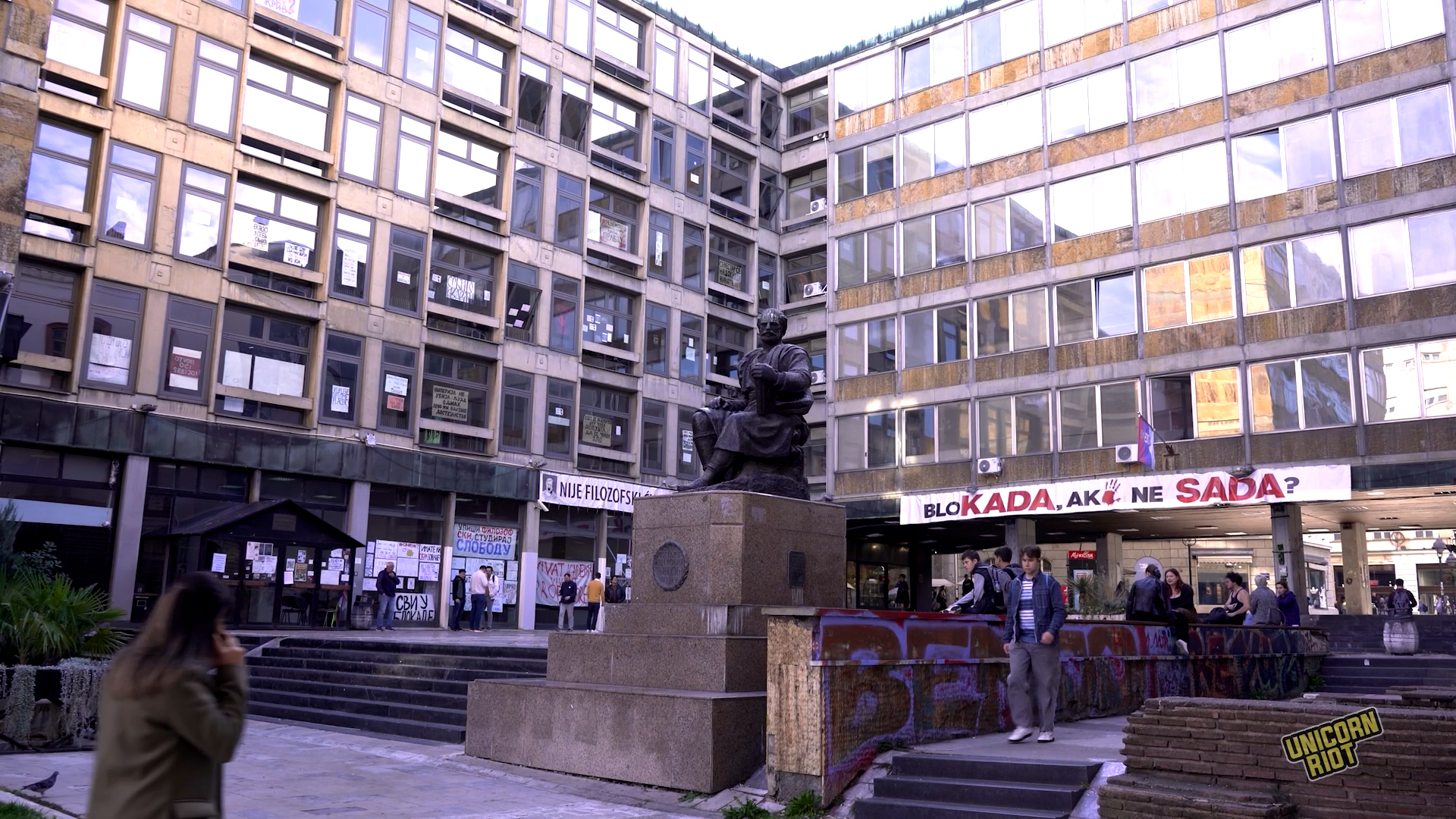
The movement of blockades expanded fast to schools, streets, bridges, cross-roads and work places. The blockades, such as the one at the philosophical faculty, are organized by direct-democratic assemblies, which try to dismantle hierarchies and the production of leading figures. There are bigger coordination assemblies between the different faculties and cities.
According to Dušanka Milosavljević, a sociologist at the University of Belgrade’s Institute for Philosophy and Social Theory, what is particularly interesting “is the combination of this tactic of assemblies with ‘reformist’ demands that remain largely within the framework of liberal democracy. Protesters are calling for the rule of law, public safety, anti-corruption measures, and the ‘liberation’ of captured institutions in order to ‘restore their proper functioning.’ One exception is the students’ socio-economic demand for initial steps toward a free education system.”
The students who spoke to Unicorn Riot said they were inspired from Greek student movements. “We realized our assemblies work most like the Greek model. We wanted to institutionalize direct democracy but restrict its drift into parliamentary forms. The assemblies had to stay sovereign” explained a speaker.
Indeed, back in 2006-07 during an attempt of the Greek government to privatize universities, students occupied hundreds of faculties across the country for months. The historical background of the Greek student movement is immense because of the popular student revolt against a military dictatorship, most known for November 17, 1973, when authorities crashed the gate of the occupied polytechnic school in Athens, killing more than 40 people.
Today, the Greek student movement is not as powerful as it was some years ago. Nevertheless the biggest part of society backing the movement for justice for the Tempi train-crash is young people – similar to Serbia. Most victims of the train crash were students who were going back to resume their studies in Thessaloniki returning from their homes in Southern Greece after a long weekend.
Following the crash, families and friends of the victims created an organization demanding justice and accountability. Two years after the crash, on February 28, 2025, more than one million protested all over Greece, with what was called perhaps the biggest post-war day of demonstrations.
In Athens, more than half a million filled the historic Syntagma Square. In Thessaloniki more than 150,000 people demonstrated through the city.
The trigger point was the victim’s last words in a message to the emergency services stating “I have no oxygen” during the fire that broke out after the train crash. Prime Minister Kyriakos Mitsotakis’ government was under increasing pressure at that time, especially since it had previously dismissed the presence of highly flammable materials as “fake news.”
‘I have no oxygen’ – Train Crash Leads to Greece’s Biggest Post-War Social Movement
Like the movement in Serbia, this mobilization is not organized through party or union structures, nor through left-wing organizations.
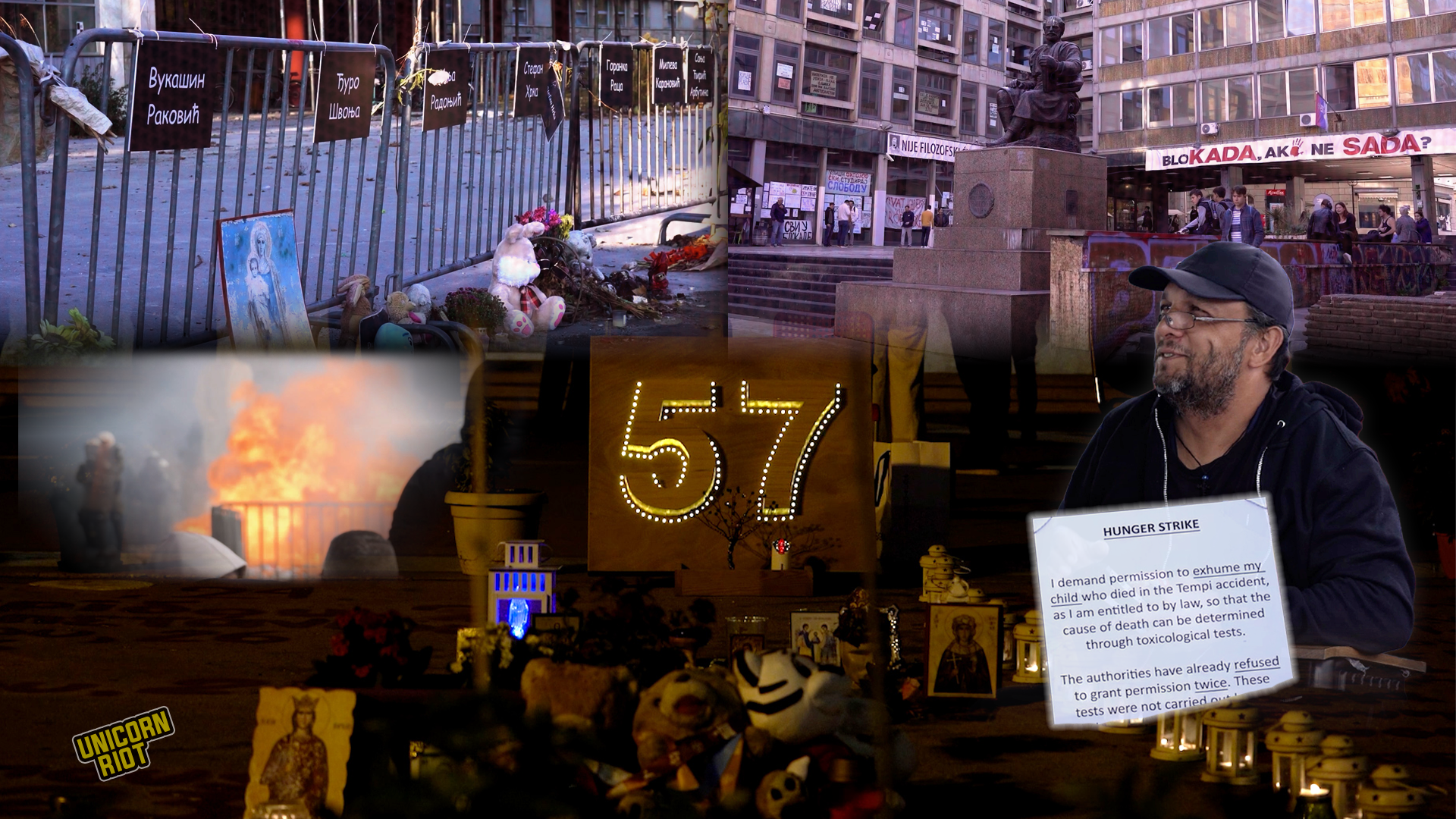
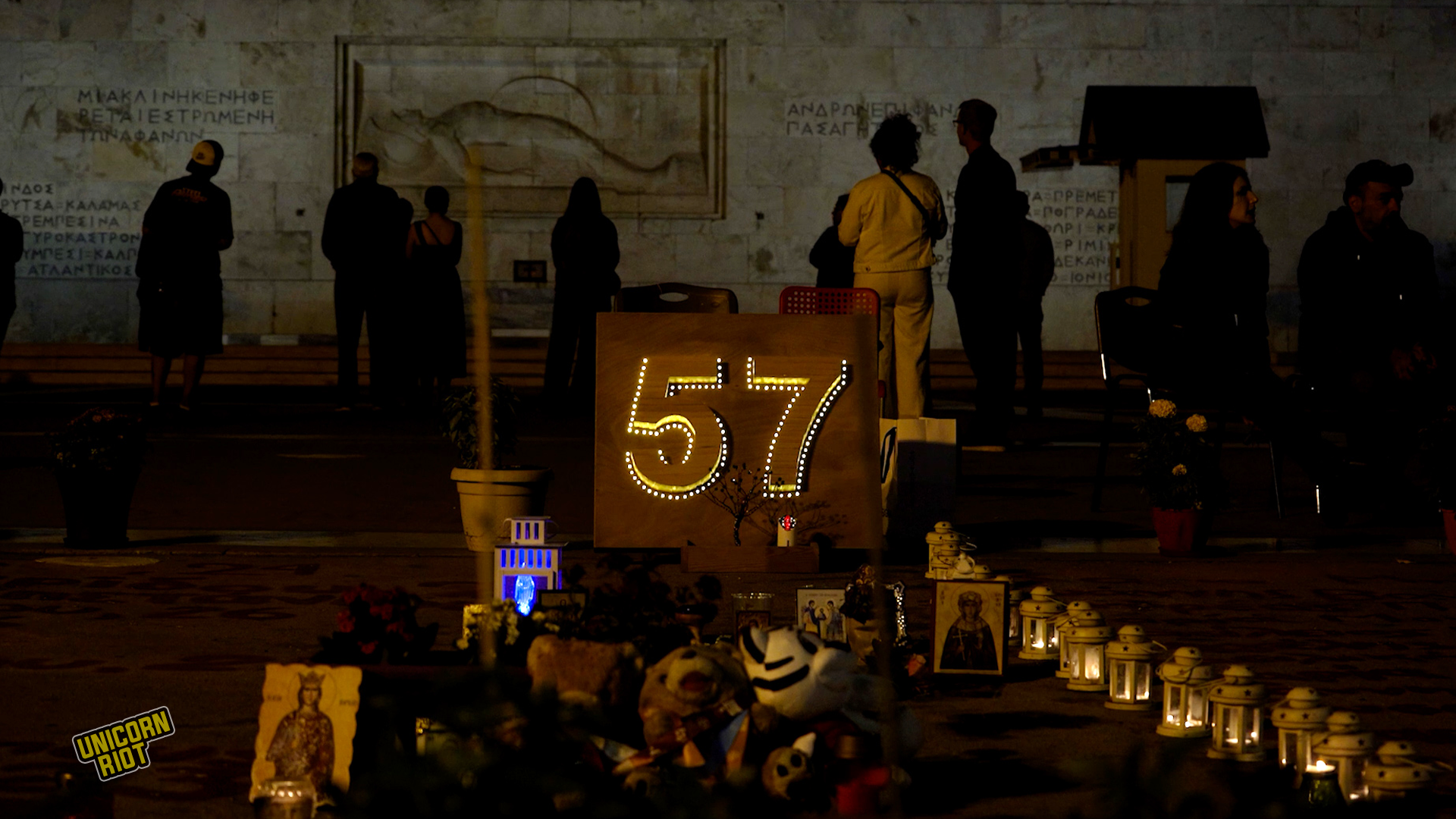
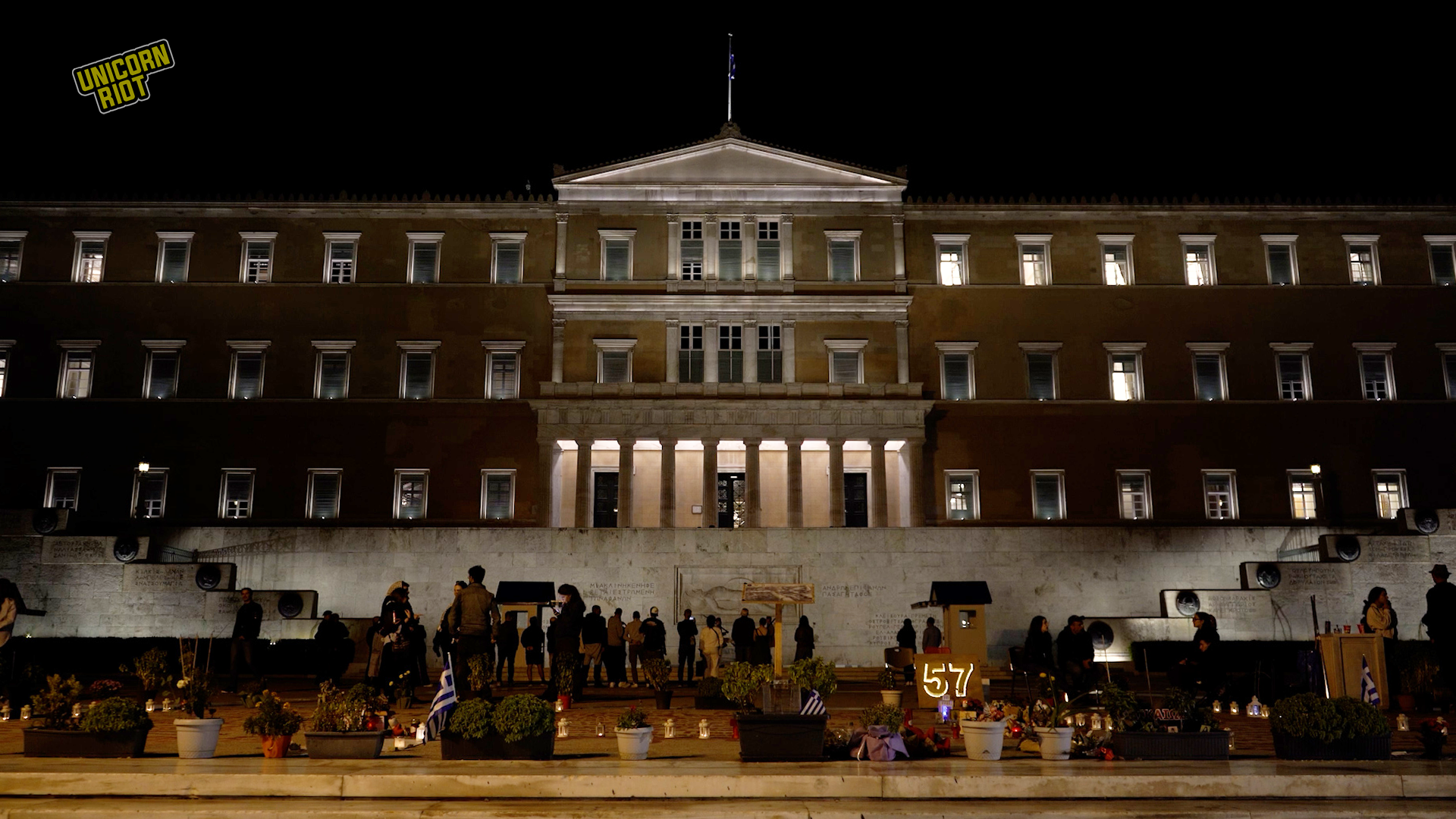
As with the red hand in Serbia, new symbols are being used — for example, the number “57” (the number of victims) and the slogan “I have no oxygen,” as mentioned above. This dynamic is also reflected in who participates: some family members of victims come from across the political spectrum, including people who identify with conservative politics.
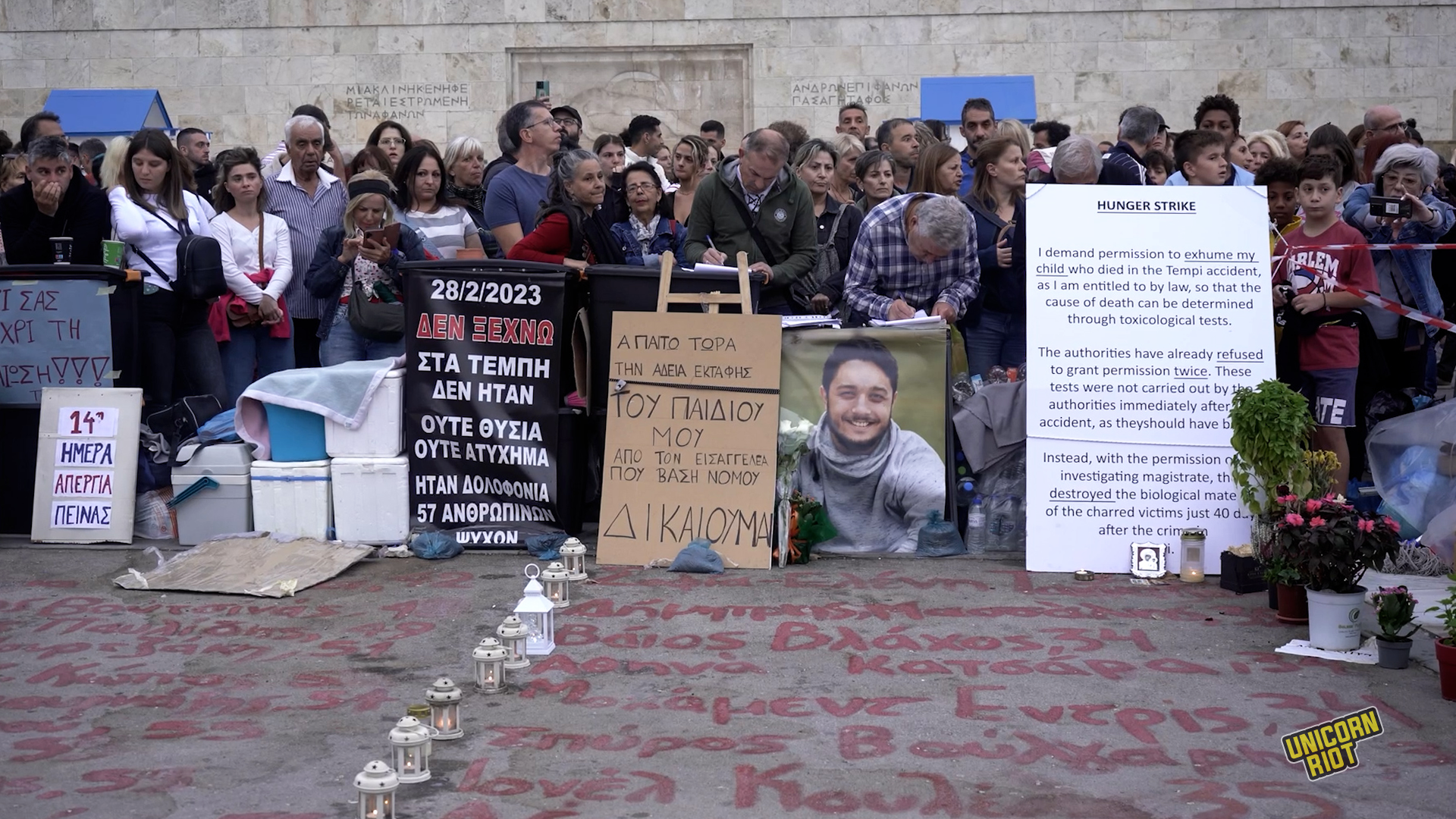
One widely noted example is the hunger strike by Panos Ruci, the father of the victim Dennis Ruci, who was seeking authorization to exhume the remains of his 22-year-old son so that an independent determination of the cause of death could be made.
For 23 days, he maintained a presence outside parliament near the Monument of the Unknown Soldier, where supporters gathered at a spot where the victims’ names had been written on the ground in red paint and held vigils.
The young people who supported him under the name “Until the end” presented themselves as unaffiliated with political parties, unions, or other formal organizations. The hunger strike was ultimately successful, as the prosecutor granted Ruci’s request.
Political Perspectives from Greece to Serbia and What’s Next
The Serbian movement provoked an intense internal debate about nationalism. Many students rejected both the old ethnic-nationalism and the liberal insistence that nationalism is inherently toxic. As the speaker of the philosophical faculty put it, “we want to be patriotic citizens of Serbia. Not in the regime’s sense, but in the sense of building something new together — a system where divisions no longer work.”
The question of patriotism seems to be a contested field. When Unicorn Riot visited an occupied high-school, Gymnasium Nr. 5, an interesting mingle was visible: self-organized school students supported by their parents, symbols of the protest (bloody hand, FCK SNS), Serbian and other not identifiable flags and most surprisingly some old people in military clothes. The latter were, as people explained, veterans of the army there to protect the occupiers from attacks from political enemies.
In Novi Sad, Vanja Petrović criticized the nationalism in the movement, saying “a lot of things were allowed at the beginning — for example, a lot of nationalism — while many leftist ideas were not allowed. For instance, you couldn’t have a rainbow flag or any other flag at protests, but very extremist, far-right flags were allowed.”
She believes that if the mass street movement had continued, “we would have started talking about these issues more seriously. We would have had deeper conversations and could have healed some very deep problems in this country.”
How will the movement in Serbia continue? According to the students of the philosophical faculty, the plan is to participate in the next elections, which Vučić has announced to make sooner than his end of term.
In the student movement there are different factions and some want to create a new party. The students in Belgrade reject this and want to form independent lists with prominent but trustworthy figures, such as university professors that have supported the movement. They said the lists are decided by the direct democratic processes at the self-organized university assemblies.
“This will be a complete attempt to rework everything wrong in Serbia for the past two decades. Hundreds of people are working on it. It must be relevant for the next ten years. We want sovereignty, social justice, and democratized political processes,” underlined the speaker at the occupation.
The protest movement in Serbia is facing major challenges, especially in maintaining momentum long enough to last until elections are called. One of the most significant obstacles is the lack of press freedom, driven in part by the concentration of media ownership and the government’s outsized influence over major outlets. In the 2024 World Press Freedom Index by Reporters Without Borders (RSF), Serbia ranks 96th.
During its reporting trip to Serbia, Unicorn Riot attended a protest against the media company Informer. One participant, Milan, said the outlet is presented as independent, but in practice functions as state media. “They always get all the information directly from the government,” Milan said and pointed to recent on-air comments that downplayed casualties from the “canopy” incident, saying that two days earlier an editor referred to “alleged victims” of the canopy collapse. He added that the mother of one of the victims was present at the protest and had asked police to bring the editor to her so she could confront her directly about what was said live on air. Another participant, Ana, highlighted the scale of government media access: “A couple of weeks ago, the president was addressing the nation on 16 different channels.”
#NoKings signs in Belgrade, Serbia today, as protesters converged outside of (Dez)Informer media offices after the government-friendly publication called the 16 people that were killed from the train station canopy collapse in Novi Sad on Nov. 1, 2024, "alleged victims."
— Unicorn Riot (@unicornriot.bsky.social) October 18, 2025 at 8:53 PM
[image or embed]
For comparison, Greece ranks 89th in the same RSF index. RSF notes that “a few entrepreneurs run the vast majority of media outlets, while being involved in other highly regulated business sectors. Some of them have close ties to the country’s political elite. As a result, the press is very polarized.”
There are a lot of similarities between Serbia and Greece, said Laura, “I have been in Greece and I’ve talked to comrades who are active in the movement for Tempi. And I think there are a lot of similarities. There is this aspect of government cover ups and foreign investments and neoliberal slashing of costs while at the same time investing in these construction and reconstruction projects that are then very useful for skimming off the top.”
There are also differences, she said. “In Greece, no institutions really formed around the protests. Like there wasn’t, in the same way that the student plenum or the citizens assemblies and so on, formed. I think that didn’t happen in Greece. And so, there wasn’t really a way to keep the continuity of this spontaneous energy going, I think in Greece there were situations before where this happened.”
The movement in Greece at the moment is at an important crossroad. Some parts of the movement are said to be considering participation in elections. Maria Karystianou, mother of one victim, Marthi Karystianou, and president of the Tempi Victims Relatives Association, has recently announced the creation of her own party. Different polls indicate that more than 15% up to 32% would vote for such a party. After the announcement she stepped back as president of the association. The final political profile of this party remains unclear, but neo-conservative/right views, such as stricter control of abortions, will play an important role.
At the same time the left-wing ex-Prime Minister Alexi Tsipras is preparing a comeback. While the official political landscape might change in the near future, and putting electoral pressure on Nea Dimokratia from all sides, the mass movement on the streets has declined, without building a constant force from below.
The court case on the train crash in Larisa starts on March 23, 2026, with 36 defendants facing criminal charges and hundreds of witnesses. A smaller trial has already started about the charges against two officials of the train network OSE for disappearing two videos of the cargo train.
All images via screenshots contributed by John Malamatinas and Yegor Halva. Cover image by Niko Georgiades for Unicorn Riot.
Three additional paragraphs were added on Feb. 27, 2026, to the last section regarding press in Serbia and Greece.
For more media from Greece, see our Greece archive page.
‘I have no oxygen’ – Train Crash Leads to Greece’s Biggest Post-War Social Movement – April 2025
‘It was a crime, not an accident!’ – Deadly Greek Train Crash Sparks Justice Movement – April 2023
Follow us on X (aka Twitter), Facebook, YouTube, Vimeo, Instagram, Mastodon, Threads, BlueSky and Patreon.
Please consider a tax-deductible donation to help sustain our horizontally-organized, non-profit media organization: