The Camera Ban and the Baton: How the Pentagon’s War on Journalists Comes Home
You already know this story. You’ve seen it play out dozens of times. A journalist shows up with a camera. Someone with a badge decides they don’t like what’s being recorded. The camera gets confiscated or damaged, the journalist gets shoved, the credential gets yanked. Welcome to covering protests in the United States.
The following article is a commentary on the Pentagon’s recent decision to ban certain journalists from entering its grounds to cover the Iran war.
Now imagine that same dynamic, except the badge belongs to the U.S. Secretary of Defense, the building is the Pentagon, and “the war being covered is happening in Iran.”
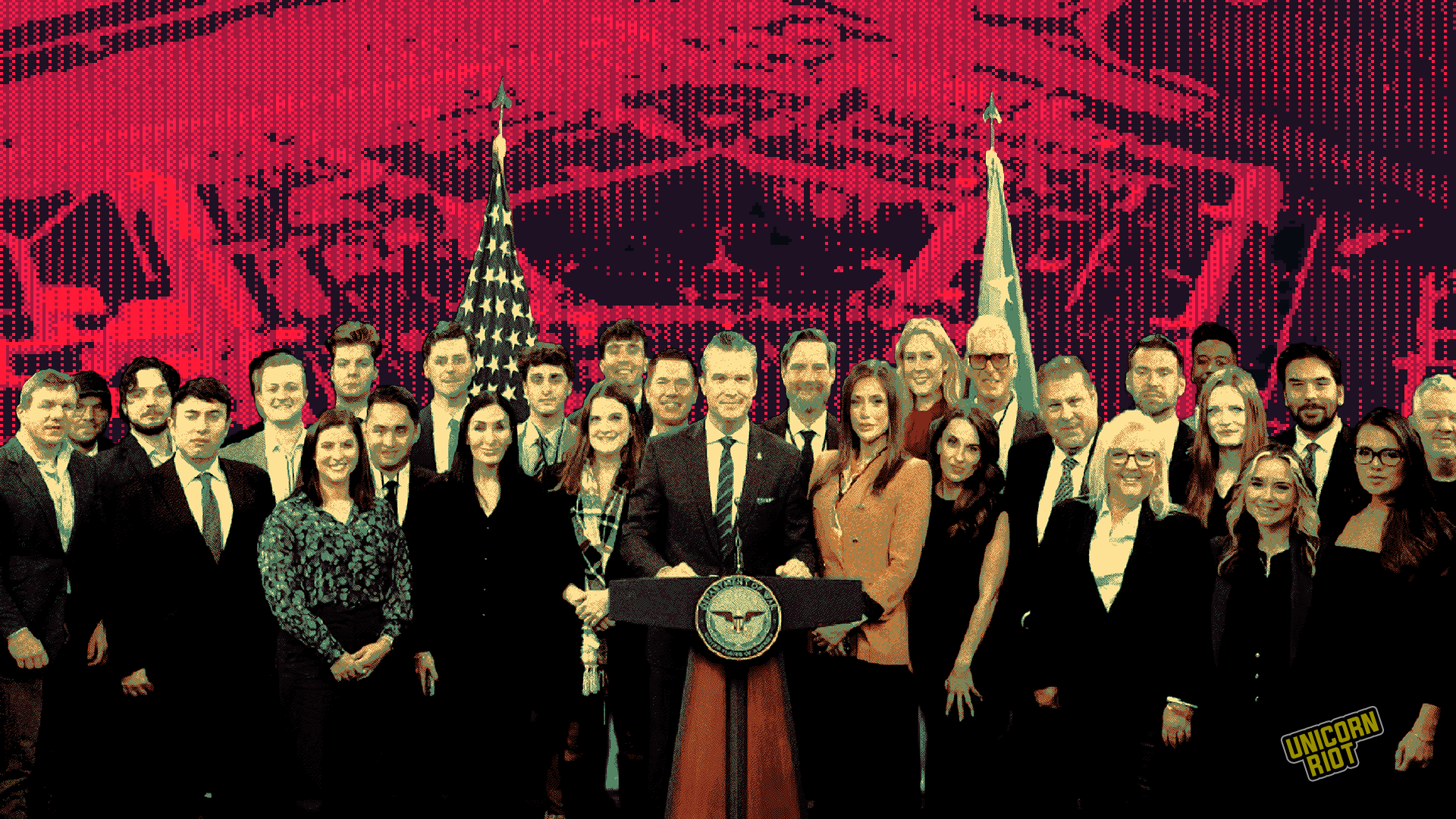
That’s not a metaphor. That’s what Pete Hegseth has been doing since the moment he walked into the Department of Defense — a department his boss has rebranded the “Department of War.”
The tactics are identical. The logic is identical. The only difference is scale.
The October Purge
In May 2025, Hegseth began restricting journalist access inside the Pentagon. But the real purge came in September. The Defense Department distributed new restrictions requiring journalists to pledge pre-approval before releasing any information gathered at the Pentagon — including unclassified material. Reporters who refused to sign would lose their credentials.
By October 15, 2025, virtually the entire mainstream Pentagon press corps — ABC, NBC, CBS, CNN, Fox News, Newsmax, the AP, Reuters, Bloomberg, the New York Times, the Washington Post, the Guardian, the Atlantic, NPR, Politico, the Wall Street Journal — had walked out, press badges handed over. Dozens of journalists carried their belongings out of the building rather than sign an agreement that would have subjected them to potential prosecution for reporting on their own judgment.
The desks didn’t stay empty long.
Laura Loomer — conspiracy theorist, far-right influencer, and self-described “Trump loyalty enforcer” — posted a photo of herself seated in the Washington Post reporter’s old chair, waving her new red press badge. Former Rep. Matt Gaetz, who had briefly been Trump’s nominee for attorney general before his own scandals caught up with him, was there too. So was James O’Keefe, the gotcha video artist. And a correspondent for a news site run by Mike Lindell — the MyPillow man.
This is who now occupies the Pentagon press room. This is the “journalism” Hegseth wants on record when decisions about war and peace get made.
The Iran War Blackout
When Operation Epic Fury — the U.S.-Israeli military campaign against Iran — began in mid-2025, Hegseth didn’t just control access to the building. He turned the press briefing room into a stage.
The briefings were theater. Hegseth fielded questions almost exclusively from the handpicked front-row loyalists. The few mainstream reporters allowed back into the room — after the networks cut a deal that got cameras back inside in exchange for reporters being allowed back in, at the back — were rarely called on. The Atlantic’s Nancy Youssef described it plainly: “Most of the press corps is not allowed in the Pentagon itself, where these very decisions are being made.”
Then came the photographer ban.
Following Hegseth’s first on-camera briefing on the Iran war in March 2026, his staff decided the published photos were unflattering. Photographers were barred from the next two briefings. Only Pentagon staff photographers — producing images for Pentagon distribution — were permitted inside. Independent visual documentation of a war secretary briefing the public on a war was simply removed from the equation.
Think about what that means. The government is bombing a country. The defense secretary goes on camera to explain why. And the only photos that exist are the ones his own staff took.
That’s not press freedom. That’s a state press office.
The Pattern Anyone Who’s Covered a Protest Can Recognize
Those paying attention didn’t need a law degree to understand what happened in October 2025. The playbook was familiar.
You show up. You’re told there are rules. The rules are designed to make independent documentation impossible. You either comply — which means producing content that serves power — or you lose access. If you refuse to comply and try to document anyway, the consequences escalate. Credentials get revoked. Escorts get mandated. Spaces get surveilled.
This is what Hegseth built at the Pentagon. A federal judge ruled in March 2026 that the Pentagon’s press restrictions violated the First and Fifth Amendments — that the policy had kicked out journalists who refused to be “spoon-fed by Department leadership.” The judge’s language was unambiguous. The Pentagon violated the Constitution to control its own image.
Hegseth’s response? Comply with the letter of the order and violate its spirit. By April 9, 2026, a federal judge ruled that the Pentagon’s revised policy still flouted his March 20 order. The Pentagon moved journalists to a separate annex and mandated escorts inside the building — not as a security measure, but as a mechanism for continuous surveillance of reporters.
Mandated escorts. Sound familiar? That’s what happens to journalists at protests when police decide their movements need monitoring.
The Institutional Cover Story
Here’s what always gets said at this point: the military has unique security concerns. You can’t have reporters wandering around a war department. There are classified programs, sensitive operations, national security implications.
Fine. Except this argument doesn’t explain why photographers were banned from a press briefing specifically because the images were unflattering. It doesn’t explain why Laura Loomer, who has no journalism training and runs a political influence operation, gets a Pentagon press badge while the AP doesn’t. It doesn’t explain why journalists who refused to pre-clear stories with the Defense Department were forced out, while those who agreed to work as effectively credentialed government communicators were welcomed in.
Security is not the point. Control is the point.
The New York Times eventually sued over First Amendment violations. Even Fox News — Hegseth’s former employer — refused to sign the original restrictions agreement, issuing a joint statement with the major networks noting “the policy was without precedent and threatens core journalistic protections.”
When Fox News is defending press freedom against the Defense Secretary who used to work there, you’re not dealing with a security policy. You’re dealing with something else entirely.
What the Elementary School Story Tells You
In March 2026, the Washington Post broke the story that the Shajareh Tayyebeh Elementary School in Minab, southern Iran — bombed on the opening day of the war, Feb. 28 — was on a U.S. target list and had been mistaken for a military site. At least 168 people were killed, more than 100 of them under the age of 12, according to UN and Iranian officials.
Preliminary findings from a U.S. military investigation, reported by the New York Times and AP, determined the strike used outdated Defense Intelligence Agency targeting data that had not been updated to reflect the school’s presence.
The Pentagon said nothing publicly for days. The story required a network of U.S. and Israeli sources — reporting that was, as one Washington Post journalist put it, “a beast to get out the door.”
This is the direct consequence of information control. Not just bad optics for a defense secretary. Not just an abstract threat to press freedom. A Tomahawk missile killed over 100 children at a girls’ elementary school, and the public found out through leaked sources, not government accountability, because Hegseth had spent months building a system designed to ensure that didn’t happen.
The cover-up didn’t work. It never entirely works. But the system wasn’t built for perfect concealment. It was built to slow everything down, raise the cost of reporting, and ensure that by the time the truth surfaces, the news cycle has moved on.
Again — anyone who has tried to document what happens to protesters after the cameras leave knows exactly how this works.
The Through-Line
There is a through-line from the cop who shoves a journalist at a protest to the defense secretary who bans photographers because he didn’t like his angles. It’s not a conspiracy. It’s a logic.
Power does not like documentation. Documentation creates accountability. Accountability is a threat to power. So power restricts documentation. It starts with new rules. Then enforcement. Then consequences for noncompliance. Then replacement of independent documentation with state-produced imagery. Then, if you push back, legal action against you for pushing back.
The Pentagon went through every one of those stages between May 2025 and April 2026.
What happens when the same administration that purged the Pentagon press corps turns its attention to the streets? The infrastructure is already being built. The logic is already normalized. The message has already been sent: accountability journalism is a security risk, and security risks get managed.
Independent media exists because the mainstream press was already unreliable long before Hegseth arrived. The question now is what happens when the state decides to formalize that unreliability as policy — when the restriction of independent documentation stops being an ad hoc response to a specific protest and becomes standard operating procedure, codified, defended in court, and replicated across every institution that wields power.
That is not a hypothetical. That is the direction of travel.
The camera ban at the Pentagon isn’t just a foreign policy press freedom story. It’s a preview. And everyone who’s ever covered a protest already knows the sequel.
Related – Jan. 30, 2026: Independent Journalists Georgia Fort and Don Lemon Arrested by Feds Along With Three More Activists
About the author: Hassan El Biali is a political analyst and writer specializing in U.S. foreign policy, international security, and Middle East geopolitics. He publishes at megam226.substack.com.
Cover image contributed by L. Cam Anderson.
Follow us on X (aka Twitter), Facebook, YouTube, Vimeo, Instagram, Mastodon, Threads, BlueSky and Patreon.
Please consider a tax-deductible donation to help sustain our horizontally-organized, non-profit media organization: