The US Brought the G20 to NC to Highlight the Region’s Hurricane Recovery. Locals Say the Government Wasn’t Who Made it Possible.
Asheville, NC — Last weekend, the G20 finance ministers and central bank governors met in Asheville at the behest of the U.S. federal government. Billed as an opportunity to showcase the region’s recovery after Hurricane Helene laid waste to western North Carolina in 2024, locals took issue with their suffering and hard work being co-opted by representatives of the world’s richest countries.
After the Department of Treasury announced in February that the meeting would take place in the Appalachian town, locals began organizing.
In the weeks before the meeting, organizers hosted a series of events and worked to spread the word about the finance ministers who had set their sites on Asheville’s Omni Grove Park Inn as their venue.
By the time delegates arrived on Saturday, August 29, a slew of organizations and unaffiliated locals had prepared a weekend of events to highlight that the often-overlooked meeting was taking place and emphasize that they, not the government or economists, were the ones who did the work of rebuilding the area after the storm.
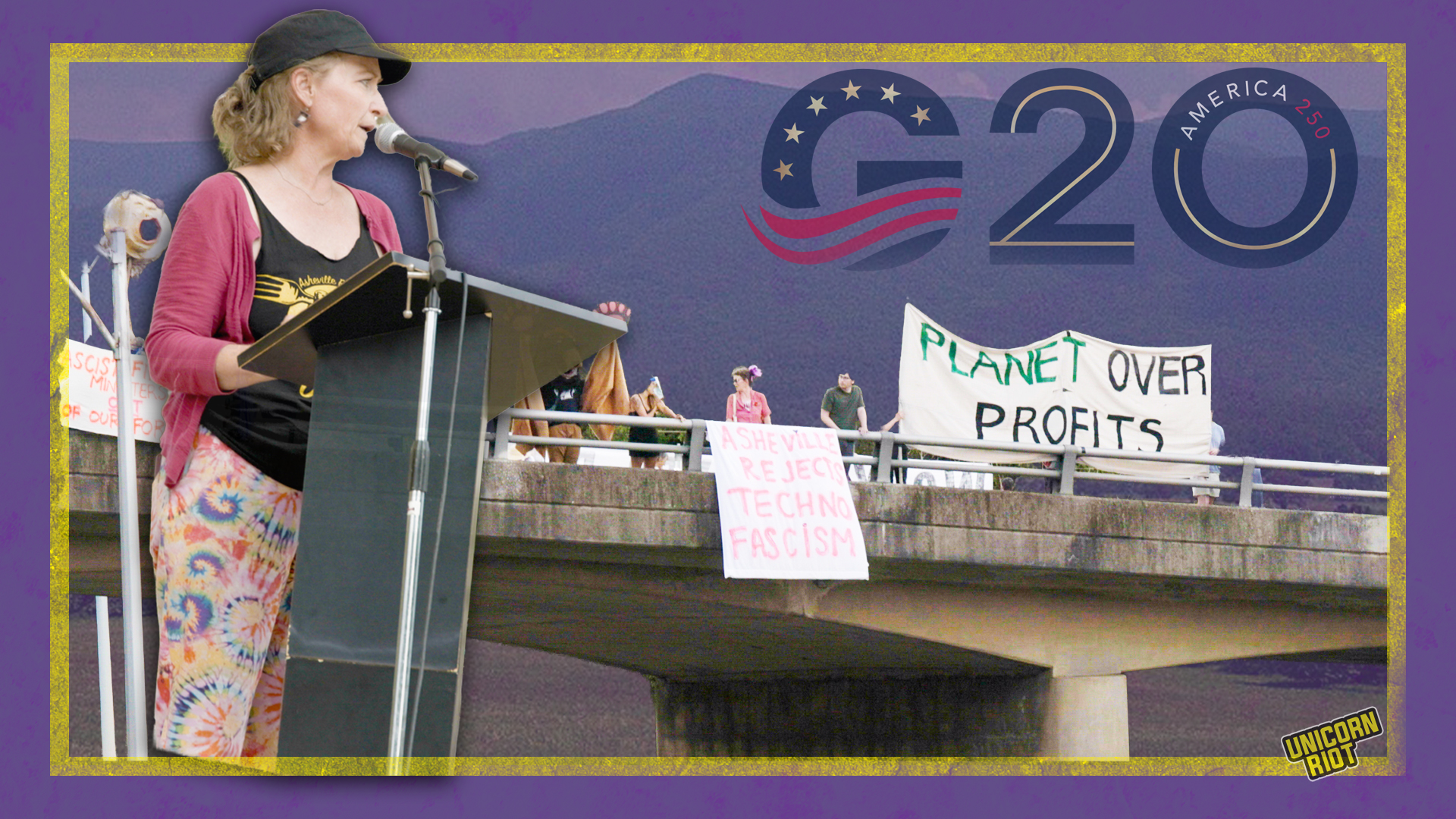
Starting on Friday, groups of protesters took space on bridges spanning the interstate that runs by downtown Asheville. Holding banners, locals decried the presence of the finance ministers who arrived in their town that day. On at least three bridges, organizers draped banners with messages including “Asheville rejects technofascism” and “workers over billionaires.”
“We think they’re more focused on corporate interests and the interests of the wealthy over the interests of everyday people and working people,” Rachel Cohen, local policy lead of Sunrise Movement Western North Carolina, told Unicorn Riot.
Cohen’s suspicion is supported by the group’s history. The G20, or Group of 20, is a coalition of the world’s 20 largest economies made up of 19 member countries, the European Union and the African Union. The finance track, which meets four times a year leading up to the annual global summit, sets policy and determines the focus of the broader group.
Among the forum’s stated goals is to ensure economic stability and cooperation, but historically the body has worked to prop up capitalism in moments of crisis.
The G20 was formed in 1999 following the Asian market collapse brought on by financial manipulation from foreign investors who saw vulnerabilities in booming southeast Asian economies. After Thailand’s baht collapsed, the International Monetary Fund loaned Thailand and other countries caught in the turmoil billions of dollars to be repaid with interest, prompting a steep rise in unemployment, poverty and a decrease in social welfare spending.
In 2008, after the U.S. housing bubble burst and sent the economy into a tailspin, the G20 held its first global summit to respond to the crisis facing U.S. markets and capitalism’s legitimacy. Called by President George W. Bush to address a problem bigger than any one government could resolve, the G20 assembled to develop solutions to the collapsing economy and ensure continued, perpetual growth.
Every year since, a member country has hosted the annual G20 summit as well as a series of satellite meetings that direct the group’s policies and mission. This year, the U.S. is hosting the G20, and last weekend’s gathering represented one of the finance track’s series of meetings leading up to the global summit to be hosted this December in Miami.
As vehicles honked in support during last Friday’s banner display, residents told Unicorn Riot that the G20 meeting in their town specifically to highlight the recovery post-Helene glossed over the reality of the situation.
Locals, like those waving banners from the bridges that afternoon, and nearby supporters responded to the crisis and are continuing the ongoing work of rebuilding the area, not the G20 or the entities they represent, Cohen said to UR.
The following morning, approximately 150 protesters spread out along Merrimon Avenue just north of downtown Asheville to oppose the meeting and continue to spread their message. There, along the busy thoroughfare, protesters waved signs and recalled who was present in the aftermath of the hurricane nearly two years earlier.
Lola Lafey, a local who lived through the storm, told Unicorn Riot that the first responders she saw were locals and neighbors, and that the federal government didn’t play as big a role as they needed to in the days after Helene.
“We want to send a message to our neighbors that anyone who has recovered – and we haven’t all recovered – we’ve recovered with our neighbors’ help, we’ve recovered with the help of immigrants, we recovered because the Cherokee Nation came down and quietly cut up trees that were blocking roadways, they didn’t stay to wait for thanks,” Lafey said.
Lafey, like others Unicorn Riot spoke with, was angry that the federal government chose to showcase western North Carolina’s rebound as if they had done the work of rebuilding. She emphasized that the federal government didn’t provide enough resources, let alone do much of the heavy lifting in the immediate aftermath of the storm.
“I feel like they’re using Asheville, they’re using our pain as a backdrop to prop up an administration that has done nothing to help the people,” she said.
While Lafey and others spread their message along Merrimon Ave., a marching band and a troupe of oversized puppets rallied up the street. After performing a few songs along the busy avenue, the marching band joined the puppets to take the streets, wandering through a neighborhood below the Grove Park Inn that hosted the finance ministers.
Led by horns and drums, masked puppeteers brought some levity to the event, mocking the G20 and it’s policies with larger-than-life paper mache and felt puppets.
A caricature of a Doge coin cryptocurrency and a grotesque Flock camera monster were hoisted into the air – a jab at the G20’s focus on AI development and cryptocurrency deregulation, one participant told UR.
Leading the way was a mock AI-data-center-prison hybrid, highlighting the overlap between the technology and the surveillance it bolsters.
Marching behind a banner reading “fascist finance ministers out of our forest,” the rally wandered around the neighborhood playing loud music and prompting neighbors to check out the commotion, many of whom cheered on the revelry. Police cleared the protesters from the street at one point, but after a quick reroute, the festivities resumed.
The following day, the capstone event of the counter-G20 activities took place in downtown Asheville. Local organizations gathered in Pack Square Park, directly in front of the city’s administrative building and detention center, and celebrated what they dubbed the “Community 20” aka C20.
Speakers from different organizations addressed the crowd while participants visited tables set up by local nonprofits, organizing initiatives and others.
Jen Hampton, an organizer with the Southern Workers Assembly, told UR that she thought it was important to organize this event and others while the G20 met in her town to emphasize that everyday people – not finance ministers, central bank governors, or the federal government – are who kept Asheville going during the storm and afterward.
“The federal government has not played much of a role at all in our recovery,” Hampton said while stationed at a table for Asheville Food and Beverage United, a local service workers union.
“Most of the recovery, the resilience, the rebuilding that’s happening has been from the community, from people coming together and taking care of each other,” she added.
Neighbors helping neighbors and fostering dependence on each other over financial or governmental institutions was a constant theme throughout the weekend. And while the protests weren’t the fiery displays seen at G20 meetings of the past, people still rallied to voice their opposition to the meeting and what it represents.
As the G20 meeting concluded Tuesday, locals who remain after the finance ministers’ departure are determined to keep fostering the cooperation and mutual aid that helped them during the storm, rather than looking to the government or heads of finance for a rescue.
See UR’s past G-20 coverage, including frontlines from the 2017 G-20 in Hamburg, Germany.
Follow us on X (aka Twitter), Facebook, YouTube, Vimeo, Instagram, Mastodon, Threads, BlueSky and Patreon.
Please consider a tax-deductible donation to help sustain our horizontally-organized, non-profit media organization: